










































Acceptability of an Integrated School-based HPV Vaccination Program within Two Districts of Tanzania: A Qualitative Descriptive Study
Johns Hopkins University (Guillaume, Rosen, Gerste, Holroyd, Limaye); Jhpiego (Guillaume, Giattas, Morgan); Muhimbili University of Health and Allied Sciences (Mlunde, Njiro, Munishi, Mlay, Sunguya); University of Melbourne (Morgan); Ministry of Health, United Republic of Tanzania (Kyesi, Tinuga); President's Office Regional Authority and Local Government, United Republic of Tanzania (Ishengoma)
"Improving HPV vaccine acceptability can heighten demand generation which can be critical in successfully meeting national immunization targets..."
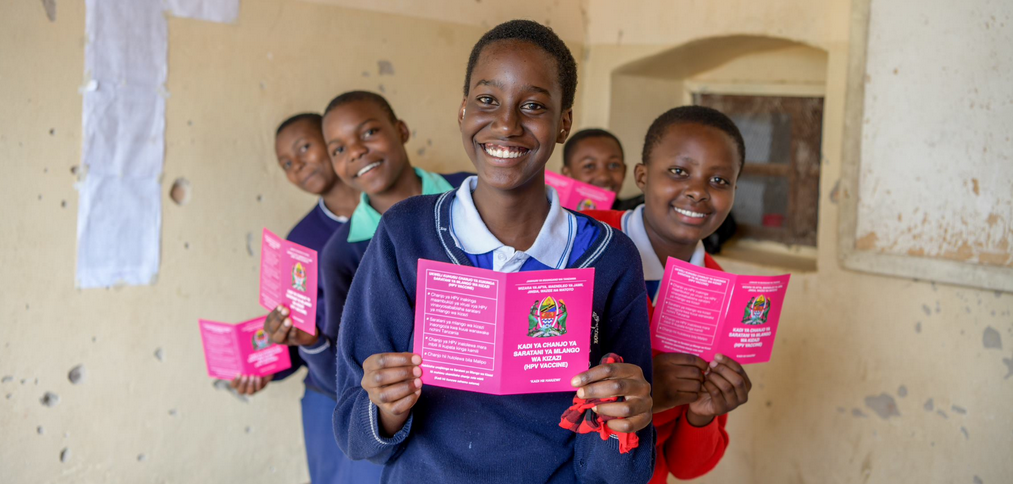
Among countries in East Africa, Tanzania exhibits one of the highest cervical cancer morbidity and mortality rates. To address this problem, the Tanzanian Ministry of Health worked with Jhpiego, a Johns Hopkins University affiliate organisation, to develop an integrated adolescent health programme, HPV-Plus, which was informed by human-centred design workshops in 2018 and finalised in 2019' focused district demonstrations took place from November 2019 to March 2020, with facilities enabled to continue implementation after this period. The programme combines human papillomavirus (HPV) vaccination with nutritional assessments, vision screening, and vaccination for adolescent girls, as well as health education for boys and girls, aged 10-14. This qualitative study evaluated the acceptability of HPV-Plus in two districts in Tanzania by including stakeholders of varying backgrounds.
The Makambako District Council (Njombe Region) and Ubungo District Council (Dar es Salaam Region) had been selected for the focused demonstration of HPV-Plus, as both districts needed to increase rates of HPV vaccine uptake, while representing a mix of urban (Ubungo) and rural (Makambako) settings. Study participants included 22 programme planners, 24 programme implementers (school health coordinators, educators, school officials, and healthcare providers), 25 adolescent girls, and 16 parents. Interviews were conducted from June to July 2021, more than two years after HPV-Plus was introduced in the two districts. The Theoretical Framework of Acceptability (TFA) was used to guide analysis of interview transcripts, with themes categorised according to theoretical constructs of affective attitudes (e.g., how participants feel about the intervention), intervention coherence (e.g., the extent to which participants understand the intervention and how the intervention works), and perceived effectiveness (e.g., whether participants believe the intervention was effective).
Overall acceptability of the HPV-Plus programme as a means to both prevent cervical cancer and address a broader range of adolescent health needs simultaneously was high among stakeholders. Across all stakeholder groups, education sessions were essential in dispelling misconceptions about the vaccine, increasing HPV vaccine and cervical cancer knowledge, and providing clarity to questions and concerns that participants had. Several programme implementers stated that providing educational sessions in a group setting encouraged students to ask questions regarding the vaccine, with numerous students requesting more information after educational sessions. Indeed, the educational component of the HPV-Plus programme was key in increasing acceptability.
Education was found to be beneficial in not only increasing knowledge, but also fostering positive attitudes towards the HPV vaccine among students. Adolescent girls who demonstrated high acceptability towards the programme also voiced encouraging and supporting their peers to participate in the programme. Several adolescent girls stated they were fearful of the vaccine due to the pain associated with injections. However, students noted that being surrounded by peers was helpful in overcoming initial fears of inoculation. Students reported feeling supported and empowered by teachers to participate in the programme.
The most cited misconception among parents was that the HPV vaccine caused infertility. Several parents highlighted the need for more education within the community to dispel myths and misinformation. Of all groups who participated in the study, parents reported the lowest acceptability towards the programme. This finding was found to be primarily due to perceptions of not being sufficiently engaged throughout programme implementation. Many parents stated they were skeptical of the programme and held negative beliefs due to not having adequate information and not being provided with education about the benefits of HPV vaccination prior to programme implementation. Parents who felt they did not receive adequate information did not perceive the vaccine to be beneficial and demonstrated hesitancy towards their children being vaccinated. Based on their beliefs, it was not uncommon for some parents to forbid their children from getting vaccinated.
Similar to the other key informant groups, programme planners and implementers were more likely to demonstrate positive attitudes towards the HPV-Plus programme after being provided with education on the purpose and benefits of the HPV vaccine. Programme planners and implementers noted that collaboration with education officers was critical in heightening acceptance and subsequent uptake of HPV vaccines. They also cited benefits of school-based vaccination delivery, such as providing an opportunity to link HPV vaccines within integrated packages for adolescents and being more inclusive by engaging multiple stakeholders throughout the community.
Some takeaways from the study:
- Beyond knowledge, education must address misinformation and rumours regarding the HPV vaccine.
- There is a need for educational initiatives to be designed to reach multiple stakeholders - parents, adolescents, health workers, teachers, and programme officials - to support the introduction of HPV vaccination programmes, particularly within school-based settings. In particular, interventions should emphasise educating parents and caregivers in order to increase HPV vaccine acceptability and uptake among adolescents.
- Key messages that promote HPV vaccines through culturally tailored, gain-framed appeals must be communicated consistently and mutually reinforced in order to heighten programme acceptability and facilitate the uptake of HPV vaccines.
- A subset of parents and girls identified ways that health facilities could be made more responsive to adolescent needs and preferences. Increasing the volume of the "youth voice" in the design of services, both for vaccination and linked services, may be an area of future attention by global commentators and researchers working on HPV-Plus.
Future studies could:
- Identify best practices in improving programme acceptability among stakeholders at all levels.
- Explore how to develop effective strategies for community mobilisation along with communication campaigns that are tailored to the context in which the programme is being implemented.
- Consider how to reach out-of-school girls, how to make health facilities more responsive to adolescent needs and preferences, and what acceptability of HPV vaccines is for out-of-school girls.
- Gather the perspectives of adolescent boys and explore their perspectives related to vaccine acceptability.
In conclusion: "Comprehensive health education that involves stakeholders at all levels must be prioritized to successfully heighten acceptability and uptake of HPV vaccines among communities. The school-based delivery of HPV-Plus was an acceptable means to integrate complementary adolescent health services, was seen to be more effective in reaching a higher proportion of adolescents and may function as a trusted service delivery platform that fosters confidence among participants."
PLOS Global Public Health 3(1): e0001394. https://doi.org/10.1371/journal.pgph.0001394. Image credit: Jhpiego
- Log in to post comments