










































Artificial Independence: The Fight to Save Media and Democracy - 22nd Annual South Asia Press Freedom Report 2023-24
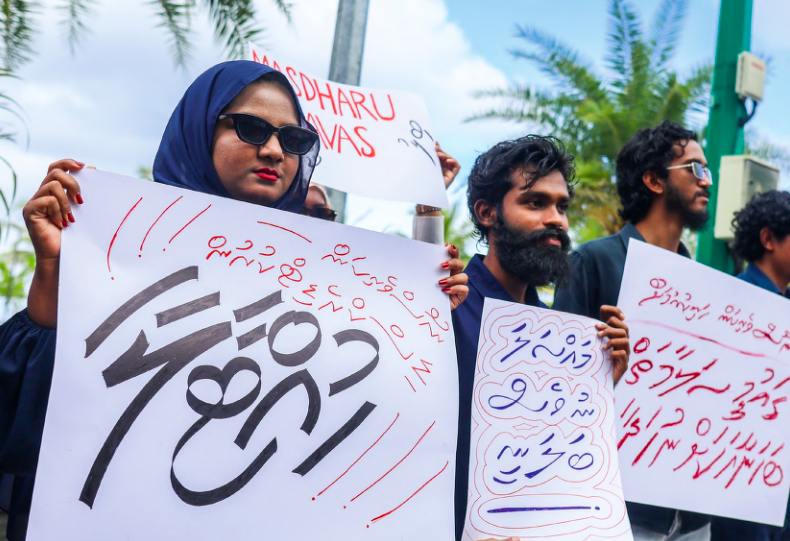
"With elected autocracies gaining ground globally, the synergy between freedom of expression and robust democracy was never more apparent in the year in review."
The South Asia Press Freedom Report for 2023-2024 (SAPFR 23-24) explores the working conditions of journalists and the complex interactions between democracy, media economies, and the fundamental freedoms of the press and expression across eight nations of South Asia. Focusing on the period from May 1 2023 to April 30 2024, it highlights the struggles for the future of media amidst state crackdowns, political polarisation, challenges to democratic rights, lack of media sustainability, and economic turmoil in the region. It is intended as a media advocacy tool for enhancing professional journalism in South Asia and is produced annually by the International Federation of Journalists (IFJ) on behalf of the South Asia Media Solidarity Network (SAMSN), a broad media alliance defending journalists' rights and freedom of expression in South Asia, and is supported by the United Nations Educational, Scientific and Cultural Organisation (UNESCO), Norsk Journalistlag (NJ), the European Commission (EC), and the National Endowment for Democracy (NED).
In brief and across the region, the report reveals the following:
- The ongoing crises in the region - both economic and political - have continued to have a devastating impact on the media's influence and sustainability in the past year.
- Governments have been using the law to curb freedom of expression.
- Journalists across the region were subjected to physical assaults, abduction, and arbitrary detentions, and some even paid the ultimate price for their work, with eight journalists killed.
- Access to information has deteriorated with laws not being upheld or not being present at all.
- Independent media are facing dire financial straits. Climbing out of the economic crises following the COVID-19 pandemic, the media industry across the region is facing immense challenges.
- Across the region, women journalists were worse off, whether due to conflict or economic crisis. Hard-won rights, whether to pursue a profession, move freely, and be treated on par with their male colleagues, remain a seemingly unattainable pipe dream for many.
- Governments are controlling the digital space - shutting down the internet or social media platforms - in order to silence critical voices.
- Besides external control and intimidation, self-censorship by journalists was practiced across the region.
- Trust in media was a concern across the region. Misinformation, inaccurate information, disinformation, or deliberately misleading and biased information ("fake news") and the entry of artificial intelligence (AI) in newsrooms and on social media have made the credibility question more complex.
- Yet, despite this, in the year under review, journalists, their unions, and media support organisations have collaborated to improve media rights in extremely challenging circumstances.
The report is available in summary format and as an extended interactive online version, which also contains the following:
Individual country reports:
- Afghanistan [PDF]
- Bangladesh [PDF]
- Bhutan [PDF]
- India [PDF]
- Maldives [PDF]
- Nepal [PDF]
- Pakistan [PDF]
- Sri Lanka [PDF]
Two special reports that analyse the following dominant themes across all countries:
- Precarious Democracies
- South Asia's Media Viability and Trust Issue
The online version also includes: a full list of jailed and detained journalists in South Asia; an IFJ mapping of media rights violations across the region by UNESCO Journalists' Safety Indicators (JSIs); and a section focusing on the work of the media unions in South Asia, which continue to struggle on many fronts to protect journalists' rights and press freedom and to remain relevant and at the vanguard of change in their communities.
IFJ website on July 30 2024. Image credit: Maldive Journalists' Association (MJA)
- Log in to post comments