











































Behaviour Change Communication in Emergencies: A Toolkit
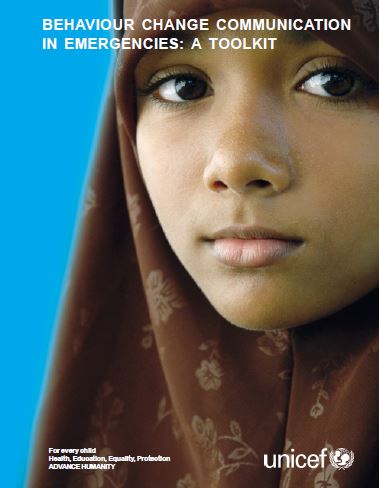
"Preparing and responding successfully to emergencies require that evidence-based behaviour change communication strategies become an integral part of emergency preparedness plans and training. Our communication efforts will result in improved health, hygiene, protective and caring practices. It will also lead to positive collective action and informed demand among affected communities for emergency assistance, supplies and services." - from the Foreword by Cecilia Lotse, Regional Director, UNICEF Regional Office for South Asia (ROSA)
This toolkit, offered by the United Nations Children's Fund (UNICEF) Regional Office for South Asia (ROSA), is a resource for those working in emergency situations caused by natural disasters. It is designed to help programme managers and government personnel prepare, plan, implement, and monitor behaviour change communication (BCC) initiatives supporting health, hygiene, and child protection efforts in emergencies in South Asia.
The toolkit stresses the importance of participation and consultation with affected individuals, particularly children and young people. "That affected communities are too shocked and helpless to take responsibilities for their own survival has been proven to be a myth. On the contrary, many affected people, especially children, experience psychosocial healing and are able to return to normalcy faster when they participate in helping others during and after an emergency."
The toolkit has 3 parts: an overview section, several programmatic chapters, and a series of 16 practical tools to plan, implement and monitor a BCC initiative for emergencies.
Part I: Overview - After an initial chapter mapping out the toolkit, the second chapter introduces the rationale for the toolkit. It discusses the most common emergency situations in South Asia, and the direct and indirect humanitarian consequences on the affected community. Chapter 3 introduces UNICEF's Core Commitments for Children in Emergencies (CCC) – the overarching organisational framework for UNICEF's humanitarian response. Finally, this section examines the definition and rationale for BCC in emergency situations, and introduces a series of principles and action points on how to plan a BCC initiative.
Part II includes chapters that focus on the following essential programmatic areas in emergencies: hygiene promotion, promoting measles vaccination and vitamin A supplementation, promoting breastfeeding, promoting safe motherhood, and supporting child protection and psychosocial development. The programmatic chapters follow a standard format that offers information on:
- Essentials about the subject - a snapshot of the programmatic area, with key definitions of terms and concepts.
- Communication principles for promoting the humanitarian/programmatic area at hand.
- Doing the groundwork - formative research, communication analyses, and standard surveys and rapid assessments.
- Getting the message right - outlines key messages for different audiences - caregivers, service providers, community leaders, etc. ["It is essential for you to involve caregivers, communities, service providers, children and youth and other critical groups in message development, dissemination and feedback gathering across all programmatic areas."]
- Communication actions to promote the subject - suggested BCC and social mobilisation activities that have proven to be effective from past experience.
- Monitoring milestones - outlines suggested indicators to measure and track if the communication efforts are contributing to behavioural changes.
- Practical examples.
- Resource bank - information resources for further reading, related websites, and a short glossary explaining the main terms and concepts.
Part III includes a series of tools:
- How to develop SMART behavioural objectives / results
- How to develop indicators based on behavioural results
- Most significant change technique
- Gender checklist
- How to conduct a key informant interview
- How to use a pocket or voting chart
- How to do a ranking exercise
- How to facilitate participatory exercises
- Monitoring chart
- Structured observation checklist for communication skills
- Tasks of men and women in the community
- A 12-point communication monitoring checklist
- Tools to monitor the milestones
- How to design a radio spot
- How to design print materials
- Principles and guidelines for ethical reporting on children and young people under 18
Complementary to this toolkit, UNICEF ROSA has developed an Education in Emergencies Training Package intended for UNICEF education programme officers at all levels - region, country, and headquarters (HQ). In addition, the UNICEF East Asia and Pacific Regional Office (UNICEF EAPRO) has produced a parallel initiative called CREATE!, a DVD collection of "ready-to-use or easy to adapt" communication materials for emergencies with sample messages on various programmatic areas, including avian flu.
246
- Log in to post comments