










































Behind the Brands
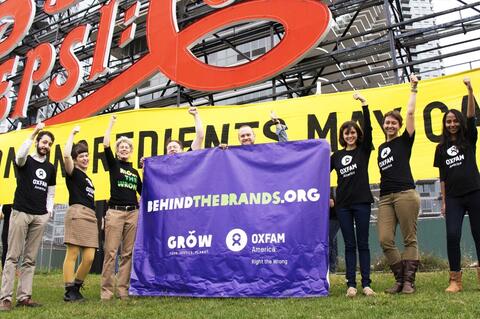
Part of Oxfam's effort to help create a world where everyone has enough to eat, the Behind the Brands campaign assesses companies' performance on social responsibility, compares them with their peers, and challenges them to use their power to help create a more just food system. Oxfam launched the campaign in February 2013 to challenge 10 of the largest global food and beverage companies (referred to in the campaign as the "Big 10") to improve their social and environmental policies and practices, and to amplify the voices of key stakeholders such as farmers, communities, consumers, and investors, calling on them to take action. Behind the Brands aims to provide people who buy products with the information they need to hold the Big 10 to account for what happens in their supply chains.
Behind the Brands illustrates how non-governmental organisations (NGOs) like Oxfam balance "carrot" and "stick" approaches to advocating for corporate policy change. The campaign has both "inside" and "outside" components, with efforts to engage consumers through awareness-raising activities as well as direct communication and collaboration with companies to help them make commitments to improve their environmental and social performance. A key component of the campaign is a scorecard, used to initiate a "race to the top" among the 10 companies to improve their scores over the life of the campaign. Oxfam explicitly sought to avoid a "name and shame"-style campaign, encouraging consumers and supporters to actively advocate change by companies rather than suggesting they boycott any products. In choosing which companies to target, Oxfam focused on companies with visible brands, rather than traders and agribusinesses, since those have less brand recognition among consumers and would therefore not be as influenced by Oxfam's brand and supporter base as the more consumer-facing companies.
Specifically, the Behind the Brands scorecard utilises publicly available information relating to the agricultural sourcing policies of the world's 10 largest food and beverage companies (Nestle, PepsiCo, Unilever, Mondelez, Coca-Cola, Mars, Danone, Associated British Foods (ABF), General Mills, and Kellogg's), focusing on 7 themes:
- Land - both rights and access to land and sustainable use of it
- Women farm workers and small-scale producers – in the supply chain
- Farmers (small-scale) growing the commodities
- Farm workers in the supply chain
- Climate change commitments to reduce greenhouse gas emissions and deforestation in agricultural supply chains, and to help farmers adapt to climate change
- Transparency at a corporate level
- Water - both rights and access to water resources and sustainable use of it
For each of these themes except transparency (which has a broader focus and rewards companies for disclosure on cross-cutting and corporate-level issues, including taxation), the indicators are grouped into 4 indicator categories (each worth one-quarter of the score available for that theme): awareness; knowledge; commitments; and supply chain management. The scores in each category are based on information in publicly available documents that addresses the following questions:
- Awareness: Does the company demonstrate general awareness of key issues relating to that theme and does it conduct projects to understand and address these key issues?
- Knowledge: Does the company demonstrate that it measures, assesses, and reports key issues and facts specifically in its supply chains that relate to that theme?
- Commitments: Does the company commit to addressing the key issues relating to that theme in its supply chains?
- Supply chain management: Does the company require its suppliers to meet relevant standards related to that theme?
According to Oxfam, from 2013-2016, more than 700,000 campaign actions - from targeted online social media to offline mobilisations and email petitions - were taken by Behind the Brands supporters urging the Big 10 companies to adopt policies that can positively impact the lives of people living in poverty.
Hunger, Poverty
Oxfam explains that nearly 1 in 8 people around the world goes to bed hungry. The majority of these people are farmers or farm workers supplying the very food system that is failing them. Yet there is enough food for everyone. The policies of the world's largest food and beverage companies drive how food is produced, the way resources are used, and the extent to which the benefits trickle down to the marginalised millions at the bottom of their supply chains. Oxfam argues that paying adequate wages to workers, a fair price to small-scale farmers, and assessing and eliminating the unfair exploitation of land, water, and labour are all steps that lie within the means of the Big 10 and other companies.
According to the scorecard rankings, Nestlé and Unilever are currently performing better than the other companies, having developed and published more policies aimed at tackling social and environmental risks within their supply chains. At the other end of the spectrum, ABF and Kellogg have few policies addressing the impact of their operations on producers and communities. Behind the Brands reveals that the social responsibility and sustainability programmes that companies have implemented to date are typically tightly focused projects to reduce water use or to train women farmers, for example. But these programmes fail to address the root causes of hunger and poverty because companies lack adequate policies to guide their own supply chain operations.
The campaign has been deemed highly successful by Oxfam and many others, including companies ranked by the scorecard. Behind the Brands generated over 2,500 news stories between January 1 - October 1 of 2014 alone, with a significant presence in both traditional and social media. All companies ranked on the scorecard improved their performance from 2013-2016, with gender equality, land rights, and climate change being the areas that saw the most progress. (In February 2013, 7 of the 10 companies had overall scores of 31% or below. By April 2016, no company scored below 36%). In Brazil, Coca Cola has engaged their suppliers on land rights as a result of the scorecard, and a majority (8 out of 10) of the Big 10 companies signed the United Nations Women's Empowerment Principles and conducted assessments focusing on the impact of women producers and workers in their supply chains. There were also indirect benefits from the scorecard and campaign. These enabled Oxfam to convene a multi-stakeholder process with large cocoa companies, traders, cocoa producers' organisations, governments, and NGOs to identify emerging good practice in the cocoa industry for empowering women farmers. The Evidence Project goes further, saying that, "while the campaign focused only on 10 companies, the scorecard has helped catalyze policy change and sustainable sourcing commitments more broadly among peer companies, amplifying the message and helping to fuel the 'race to the top' that Oxfam intended."
Oxfam says: "But even with full implementation, these incremental steps can only bring us so far. To accelerate the transformation towards a truly just and sustainable food system, companies need to fundamentally re-write the business models in their supply chains to ensure that much more power and much more of the value their products generate reaches farmers and workers; for example via an increase in farmer- and worker-owned businesses in supply chains....Oxfam will continue to engage and hold to account the Big 10 companies as they implement the commitments they have made to date. But we will also continue to push these and other companies and government elites to go further, and more radically shift power within the food system towards those who grow our food and those who consume it. That is the only way that the zero hunger vision to which our governments have committed will become a reality."
Posting from Kate Gilles via the IBP Knowledge Gateway, November 17 2017; and Oxfam's 'Behind the Brands' Campaign" [PDF] (from the Evidence Project), Behind the Brands website, Oxfam website, and "The Journey to Sustainable Food: A three-year update on the Behind the Brands campaign" [PDF] (from Oxfam) - all accessed on November 21 2017.
- Log in to post comments