










































The Best Defense: Threats to Journalists' Safety Demand Fresh Approach
Committee to Protect Journalists (CPJ)
"Much work remains to be done to improve the security of journalists in the face of unprecedented threats, including the spread of violent non-state actors, the shrinking rule of law, resurgent authoritarianism, and an industry shift toward reliance on freelancers. Journalists, news outlets, and press freedom groups must find approaches that go beyond traditional training and advocacy."
This Committee to Protect Journalists (CPJ) report explores the steps that are being taken to increase journalists' safety and access to resources, including equipment and training in physical and digital security. As CPJ demonstrates in discussing several recent incidents and continuing risks and threats, "[r]epression and impunity endanger the lives and liberty of reporters and foster a climate of fear and self-censorship among journalists and opinion leaders, suppressing news of public interest. This has consequences for all freedoms far beyond freedom of expression. A healthy democracy depends on the free flow of news and opinion to and from the governed. Journalists play a vital role in ensuring that flow and in holding the powerful to account."
"Against this backdrop of brutality and intimidation, traditional methods of advocacy are not enough. Journalists must strive to educate themselves about the threats and work in solidarity to combat violence and impunity. Press freedom groups who have relied on direct financial help to at-risk journalists and advocacy with governments must adopt a more holistic approach incorporating physical, digital, and psychological aid." The report examines various ways of mitigating the risks, such as hostile environment and first aid training (HEFAT) courses, which emerged during the Balkans wars when journalists became targets. But it wasn't until the wars in Afghanistan and Iraq in the 2000s that news organisations began sending significant numbers of staff to learn the basics of trying to stay safe while covering a war or civil unrest, according to editors and safety trainers. Not all international frontline reporters, let alone local reporters, have access to such training, first and foremost because it is expensive. Media development groups and charities such as the United Kingdom (UK)-based Rory Peck Trust provide free safety resources for independent journalists and pay for a limited number to attend HEFAT courses. Some training companies and news outlets subsidise training for freelancers either directly or through funding non-profits, but many do not.
Even if journalists could get the right safety training and equipment, the point is made here that this wouldn't be enough to keep them safe. Journalists working together in such networks can have a strong effect on safety. Examples are provided in the report's section titled "Solidarity, knowledge, and protection", such as the importance of networking. In Pakistan, where the media is subject to threats and violence from all sides, journalists banded together in a group called Editors for Safety, vowing to report on and highlight attacks on the press in an attempt to spur the authorities and their own employers into action. "Protection mechanisms are most likely to succeed when they achieve the trifecta of journalists, security services, and civil society."
Along with the need for better resources, CPJ notes, has come awareness of post-traumatic stress and other psychological injuries among frontline journalists. "In the global south, the psychological toll on journalists reporting difficult stories is not as frequently acknowledged, let alone treated." Suggestions for psychological support are provided, such as: Maintain social connections, as "peer support is often beneficial when experiencing traumatic stress."
CPJ asserts that safety experts and journalists can point to improvements over the past decade: (i) there is growing acknowledgement within news organisations that safety is an issue; (ii) journalists themselves, whether staff or contract hires, are more aware of risk and are demanding the means to ensure their own safety; (iii) cooperation among journalists has increased, and fewer local reporters in dangerous areas are working in isolation; (iv) media safety and the flagrant disregard of authorities for justice in the killing of journalists have been taken up by international bodies such as the United Nations (UN); (v) United States (US) authorities have taken steps to better address hostage situations; and (vi) the spate of kidnappings in Syria stirred a debate among journalists about the widespread news industry practice of keeping news of journalist abductions from the public while often reporting on the kidnapping of non-journalists.
The CPJ offers the following recommendations:
"To governments
- Comply with international law by asserting and defending the rights of journalists to report on armed conflict, based on their status as civilians.
- Publicly condemn attacks on journalists as soon as they occur.
- Prosecute perpetrators who murder, attack, or threaten journalists, and report on progress to the requests for voluntary information from UNESCO [United Nations Educational, Scientific and Cultural Organization]'s director general.
- Follow U.N. recommendations on the safety of journalists, including implementation of the U.N. Plan of Action on the Safety of Journalists and the Issue of Impunity, and the creation of national protection mechanisms in countries with high rates of journalist killings.
- Lift restrictions on personal protective equipment for journalists and media professionals.
To media companies
- Sign and implement the ACOS [A Culture of Safety Alliance] Alliance principles on safety of freelance journalists.
- Train editors and commissioning editors in how to work with and protect freelancers reporting in hostile environments.
- Pay freelance journalists fairly and on time, and reimburse expenses promptly.
- Provide free or subsidized HEFAT places for freelancers.
To journalists
- Research the risks on every assignment and follow international news organization best practice in planning and preparing for hostile environment reporting.
- Take a HEFAT course and keep your training current.
- Acquire assignment-appropriate safety and communications equipment and insurance.
- Provide local journalists and fixers you hire with the necessary safety equipment and training to ensure their safety.
- Secure your devices with strong passwords and encryption, and use encrypted communication tools.
- Cooperate with other journalists to promote safety, even in competitive environments.
To journalist safety trainers
- Work with the news industry and freelancers to agree on a minimum standard for training courses.
- Take local context and gender into consideration when planning and delivering training courses.
- Include physical, digital, and psychological components in all journalist safety courses."
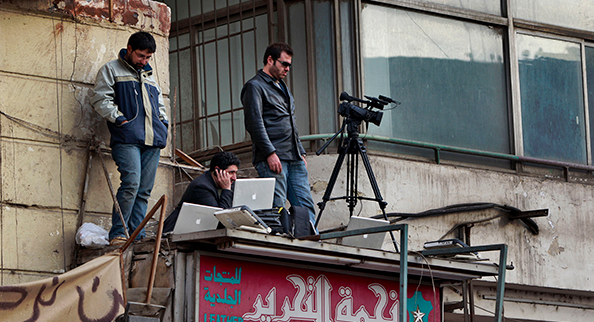
Ethical Journalism Bulletin - 23 February 2017; and CPJ website, February 27 2017. Image caption/credit: "Journalists transmit footage of protests in Egypt's Tahrir Square in February 2011. Advances in technology that bring reporters closer to the action increase the dangers they face." (AP/Ben Curtis)
- Log in to post comments