










































Communicating Climate Risks to Vietnam's Vulnerable Coastal Communities
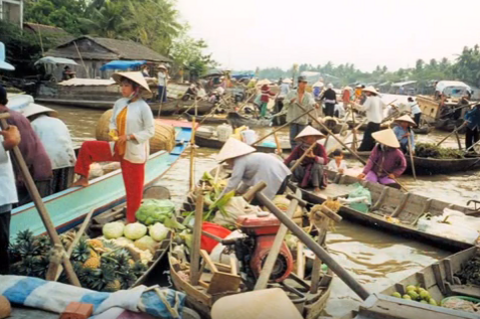
"While many of the households located in Vietnam's high-risk urban areas have an understanding of climate change, they lack detailed information about how local impacts may affect their lives and how they can prepare." - Bill Morton
Vietnam's National Institute for Science and Technology Policy and Strategy Studies (NISTPASS) is responding to this need for information by investigating how climate risk can be better communicated to households, schoolchildren, and policymakers in the cities of Can Tho, Da Nang, and Quy Nhon. The goal is to identify more effective communication tools for informing decision-makers about risks relating to climate change and development in Vietnam. A better understanding of risks would hopefully help improve response mechanisms to water-related hazards.
A key aspect of this research involves communicating climate change uncertainty and risk to different intended audiences in each of the three cities. Game theory approaches, which involve the study of interdependent decision-making, were used to communicate with policymakers and city planners. In addition, song writing and flash mob competitions were used to engage schoolchildren. The largest focus involved communication with households, typically the most difficult to reach. Short videos featuring local newscasters were presented to approximately 750 households in each city and were edited to present information and practical recommendations for addressing local climate risks, depending on the city. For instance, the video for Can Tho explains that there is an increased risk of dengue fever associated with climate change and that this risk can be reduced by removing standing rainwater from around homes and public spaces, where dengue-carrying mosquitoes are known to breed.
Researchers recorded the responses of householders to determine which messages were most effective. Videos were shown using tablets (mobile computers) so as to engage participants' interest in climate issues. Reportedly, at the end of the exercise, many of the participants were keen to learn more. A key finding from this part of the research is that people are more likely to take action to address climate risks when information is delivered by a recognisable and trusted messenger, such as a well-known newscaster. NISTPASS is working through the CCCO to develop television programmes based on information from the videos for broadcast to a wider public audience. It is also building on youth engagement initiatives on climate issues in Can Tho to more extensively involve young people in discussing how climate will affect them in the future.
Researchers collaborated with the Climate Change Coordination Office (CCCO), a government unit with specific expertise on the biophysical, economic, and social impacts of climate change across the Mekong Delta. The CCCO helped mobilise a range of organisations across the three study locations, including youth groups and women's unions, to share climate expertise and improve overall communication of policy-relevant messages within government and among external stakeholders. The researchers hope that this work will have practical and policy outcomes for organisations and local governments, including by informing the creations of guidelines on how to effectively communicate climate change risk and uncertainty to households and communities. For example, NISTPASS's affiliation with the Ministry of Science and Technology is part of a strategy for helping position the organisation to contribute to policy development via broader inter-ministerial efforts at the national government level.
Climate Change
Vietnam is particularly vulnerable to climate change and associated sea level rise, as much of its population lives in high-risk, low-lying delta, and coastal areas. For instance, in 2011, severe flooding hit the coastal city of Can Tho and its population of 1.2 million people. Climate scientists predict that most of the city will be inundated with water by the end of the century.
Funded by the International Development Research Centre (IDRC)
Email from Kelly Haggart to The Communication Initiative on October 15 2015; and "Communicating climate risks to Vietnam's vulnerable coastal communities", by Bill Morton, IDRC website - accessed October 20 2015.
- Log in to post comments