











































Communication for Avian and Pandemic Influenza in Indonesia: School Programme
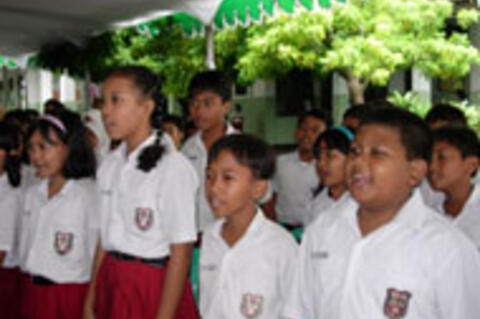
This campaign relies on the idea that entertainment-education can be a powerful tool to raise the awareness of children about how to prevent avian influenza - and that they can then become the "messengers", bringing life-saving messages to their families. In short, mass media (such as video and television) are being used here to spark interpersonal communication between and amongst generations.
Each school is to receive a kit complete with a variety of educational tools that were specially developed using characters from a popular local TV series ("Bajaj Bajuri and Oneng's Salon"). UNICEF worked with the creative team from the show to develop a short cartoon and public service advertisements (PSAs) that will also air on several stations. Animated chickens figure prominently in the cartoon, which is designed to be humourous while sharing simple information about why bird flu is so dangerous, and what can be done to prevent it. The launch of this initiative at one school featured the Chief Executive of the Avian Influenza Commission and other officials, reflecting the strategy of showing commitment from higher-level personnel to empower children with information (while having fun).
A drawing competition for elementary school children with themes related to the 3 key messages - don't play with sick/dead poultry, always wash hands with soap, and report sick/dead poultry to teachers/parents - will also be conducted.
In addition, teachers are participating in orientation sessions designed to help them understand the programme and to familiarise themselves with the school kits. In some districts, educators have developed curricula that includes poetry, art, math, and language classes that incorporate avian influenza information.
Health, Children.
According to UNICEF, since approximately 40% of victims of avian influenza are children and they often come into contact with backyard poultry, awareness at this level is vital. The communities involved in this programme mostly consist of low-income families who - more often than not - raise backyard poultry or live in areas where chickens run freely.
A study will be conducted to assess awareness levels of the students in order to gauge the effectiveness of the messaging.
UNICEF has been working in avian influenza communication in Indonesia since 2006. This has included working directly in communities. The organisation has also developed PSAs, and has worked to raise awareness amongst journalists.
UNICEF, Indonesian National Commission on Avian and Pandemic Influenza, local education departments.
Emails from Muktita Suhartono and Suzanna Dayne to The Communication Initiative on January 9 2008 and March 6 2008, respectively; UNICEF Launches Bird Flu Education Campaign to Help Indonesian Children, by Suzanna Dayne, December 19 2007; and Central Java Joins School Campaign against Bird Flu, February 14 2008.
- Log in to post comments