










































COVID-19 Digital Emergency Relief Programme (C-DERP)
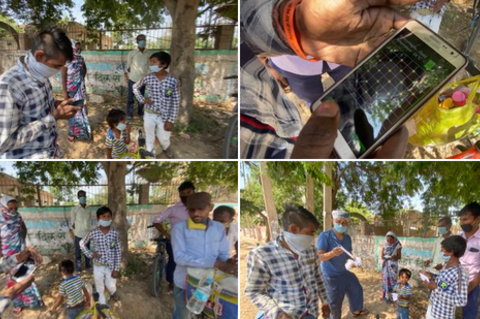
"With the belief that war against Covid-19 can be only won with awareness, empathy and coordination among communities, collective engagement becomes paramount."
India's Digital Empowerment Foundation (DEF) has been working to empower marginalised communities in information-dark regions for since 2002. With the aim of serving the community amid the COVID-19 pandemic, DEF launched an information and communication technology (ICT)-enabled, community-specific programme centred around virtual community and service facilitation. The COVID-19 Digital Emergency Relief Programme (C-DERP) has galvanised over 600 digital information resource centres and over 10,000 foot soldiers ("COVID-19 Relief Warriors") across 23 states and union territories in an effort to reach over 60,000 households and 300,000 individuals in rural India.
In India, as elsewhere, the COVID-19 crisis has led the physical network to come to a halt, which has changed the way of community interaction for income-generation activities and social networking. Online platforms and e-network solutions have become paramount in the functioning of the economy due to their potential to act as a support mechanism amid the healthcare crisis. As they work to provide digital access and information in rural areas through some of the organisation's existing programmes, DEF's COVID-19 Relief Warriors are helping build community engagement and trust in the COVID-19 response.
Broadly, C-DERP uses ICTs and community engagement to address problems faced by the population amid the pandemic - in particular: lack of physical and mental health awareness; misinformation and fake news; lack of information, guidance, and facilitation related to public entitlements and resources; and livelihood and income strains and lack of access to opportunities. To that end, DEF's COVID-19 Relief Warriors have delivered food relief kits, provided access to information on banking services and government schemes and other digital services, helped raise awareness about COVID-19, tackled misinformation and fake news, and enabled women entrepreneurs by setting them up to make and distribute masks and hand sanitizers. Some specific activities include:
- DEF's Community Information Resource Centres (CIRCs): Over 600 CIRCs across India are facilitating internet support, manufacturing and storage of essential items, digital service delivery, health services, and linkages to entitlements to the economically impoverished.
- Samarth Soochnapreneur: 150+ digitally empowered differently-abled entrepreneurs are facilitating digital services delivery, providing access to government schemes, and generating awareness around COVID-19 through a physical centre and door-to-door service.
- Digital Cluster Development Programme: 20 handloom and handicraft clusters across India are facilitating digital literacy, raising awareness around COVID-19, and building community trust.
- e-NGO: DEF's network of 5,000+ non-governmental organisations (NGOs) are aiding in ensuring and deliverance of services, access to information, and awareness to the last mile.
- GOAL (Going Online As Leaders): DEF's mentorship programme endeavours to provide digital education in the rural and tribal communities where girls and women are deprived of digital education. During the lockdown, mentors have been offering regular classes electronically to 100 mentees. For instance, Mentor Kamna has been engaging the mentees from Nauj, asking them about the happenings in their village and giving assignments to support local communities and governance. Mentor Primly with mentees in Murshidabad, West Bengal, has been taking up topics of self-love and self-image.
- Technology Empowering Girls: 300 rural digitally literate women are addressing issues around COVID-19 in their communities and helping in digital access.
- Smartpur: 130 digital centres across India are creating a holistic digital community to address the needs of the members during the pandemic in health, education, governance, finance, and livelihoods. For example, the Smartpur team in Chirala, Prakasam district, Andhra Pradesh, acquired information about local problems and needs through various WhatsApp groups and, in response, distributed vegetables and relief-kits to around 300 families at Ambedkar Nagar in Thotavaripalem, Chirala. Working especially in red zone areas, which are the most vunlerable to COVID-19, they also distributed handmade cloth masks and sanitizer and conducted a short session explaining the importance and correct steps of hand-washing and adhering to social distancing.
- Soochnapreneur: 200+ digital entrepreneurs with phycical centres are supporting communities for digital information, services, and entitlements.
- Wireless for Communities: DEF's Barefoot Wireless Engineers have established networks to enable last mile access, especially during the pandemic.
- Internet Saathi: This joint initiative of Google and Tata Trust is committed to increasing interest in and usage of the internet among women in rural areas. DEF, the implementation partner of the project in Madhya Pradesh, Bihar, West Bengal, and Punjab is training rural women to boost digital literacy. During the pandemic, approximately 8,900 Internet Saathis produced essential items, facilitated operations of local health centres, and generated awareness around COVID-19, both online and offline. For example, Nutan Kumari, an Internet Saathhi and DEF's COVID-19 Relief Warrior from Bhagwanpur, Bihar, took up the task of spreading awareness in her community. Proficient in tailoring, she also stepped up to the responsibility of stitching masks for distribution by the Internet Saathi team to every member in her village. Her efforts caught the eye of various organisations; as of April 2020, Nutan had supplied 2,300 masks and was working on 2,000 more. Making masks is an alternate means of livelihood both for these women and for weavers in Chanderi in Madhya Pradesh and Barabanki in Uttar Pradesh. In addition to attempts to keep these weavers in business by giving them small orders and mask stitching work, DEF has held digital workshops to help raise awareness about preventive measures and has distributed essential items like soap.
Using ICTs, DEF has also developed specific resources, including:
- Available in English and Hindi, the Crowdsourced COVID-19 Resource Kit addresses misinformation (fake news) around the virus and can be used to guide students, community members, and trainers. The kit is a one-stop information repository on facts about novel coronavirus, measures for sound physical and mental health, and do's and don'ts during the pandemic.
- COVID-19 DEF Dialogues is a special series where DEF connects with its network in 600 locations across 25 states to find out how COVID-19 and the lockdown situation has impacted the communities of DEF's COVID-19 Relief Warriors and the measures they are undertaking to tackle the situation. Through the series, DEF brings out different perspectives from across states to its audience. For example, Girish, a nomad from Karnataka, runs a community radio station. He has travelled about 50 villages in Karnataka to gather real stories from the ground amid COVID-19 and has given a voice to their stories. He has worked to bust myths around COVID-19 and has also provided an internet facility by setting up a small bandwidth bundler - connecting 3 dongles (a small piece of computer hardware that connects to a port on another device to provide it with additional functionality). In addition, with Osama Manzar, the Founder and Director of DEF, as the host, the recordings feature interaction with industry experts to gauge the situation and explain what measures that are being undertaken.
- On May 9, 2020, Osama Manzar talked about impact of COVID-19 on communities in rural India and explained how C-DERP works. Click below to watch it.
- MeraApp is an information and facilitation app for citizen entitlements that links the intended beneficiary to government schemes; it has been used during the pandemic.
Health, Technology, Economic Development
India's county-wide lockdown situation throughout April and May 2020 have affected the country's social, economic, services delivery, demand-supply, and governance chains and networks. Livelihood, work, income, and security have been disrupted, especially for the economically poor, the vulnerable, and those living in rural and remote communities due to lack of information, resources, and support systems.
An initial survey conducted by DEF in 7 states (Haryana, Uttar Pradesh, Rajasthan, Andhra Pradesh, Tamil Nadu, Telangana, and Karnataka) highlighted that the main source of information for 53% respondents on COVID-19 is through mobiles, with WhatsApp ranking the highest. In this context, C-DERP sought to leverage ICTs to engage and connect vulnerable communities.
Digital Footprints (DEF newsletter), May 14 2020; DEF website, May 18 2020; and email from Kriti Singh to The Communication Initiative on June 11 2020. Image credit: DEF
- Log in to post comments