










































COVID-19 Vaccine Selfie: Why Does It Matter?
University of Kansas (Ittefaq, Abwao); Universität Bremen (Kamboh)
"[A] well-established vaccine selfie culture could really contribute to increase vaccine acceptance rate in every part of the world."
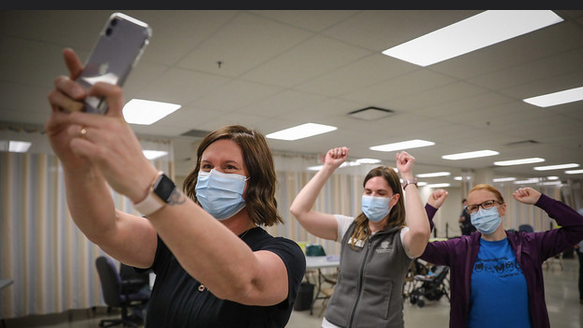
The theory of normative conduct holds that humans are a naturally social species and tend to do what they observe the majority of others doing. People use social media to share their behaviour and reactions, including by communicating to others they are vaccinated. This trend was evident as COVID-19 vaccinations began in December 2020, when social media and online platforms were awash with everyone from healthcare workers and politicians to laypeople sharing selfies confirming they got the shot. Meanwhile, anti-vaccination debates are augmented and strengthened via those same platforms, where arguments and misinformation raise questions about the vaccines' safety and efficacy. This commentary argues that vaccine selfies, when done properly, can be an effective way to fight misinformation and strengthen social norms around COVID-19 vaccination.
As explained here, people have been sharing their vaccine selfies (taken during or after the administration of the vaccine) on different online platforms owing to multiple motivations: to let others know that they are vaccinated; to assure their social circles (e.g., friends, families, and colleagues) that it is safe to include them in social gatherings again; to encourage those who are skeptical to get vaccinated; and to share their personal stories about their experiences of the effects of the COVID-19 vaccine. For example, doctors from minority communities have posted their vaccine selfies and videos as a step toward reducing medical mistrust about vaccines among communities of colour. Research shows that healthcare workers (HCWs) play a crucial role in encouraging vaccine uptake. The hope is that sharing vaccine selfies, particularly when done by HCWs, will build public confidence, promote public trust, and project pro-vaccination messages.
When accompanied by visual images, vaccine-related content on social media is more likely to be shared. This phenomenon may reflect the fact that photographs can be persuasive tools, particularly when they have effective or engaging captions. Anti-vaxxers rely on the power of personal narratives to bolster claims of vaccine danger on social media. However, persuasive techniques such as visuals can be used to counteract this rhetoric, as they can resonate with the public in a way that data-driven discussions of vaccine efficacy and infection rates cannot.
The authors make several recommendations for sharing effective vaccine selfies, including a well-lit photo that shows a person's face and arm. Such a photo, accompanied with clear text that indicates what type of vaccine the person received along with hashtags such as #IGotTheShot, #fullyvaccinated, or #vaccineswork, can encourage others who may be hesitant to take part. Vaccine selfies that project health, joy, and optimism have the potential to positively shape public perception of COVID-19 vaccines.
The authors suggest that future studies could test the presumed relationship between the vaccine selfie and vaccine acceptance rate. In addition, public health and communication scholars could conduct experiments wherein participants are exposed to a selfie of a celebrity and non-celebrity individual while having their COVID-19 vaccine. Visual analysis could also be conducted (e.g., on Instagram) to explore how people share and engage with vaccine selfies. On the theoretical front, additional work could be conducted, for example, to understand users' motivation to post selfies on social media using motivation theory.
Though there are valid concerns around the practice - e.g., the selfies may be insensitive to those (e.g., in the Global South) who have yet to gain access to the vaccine - the authors suggest that vaccine selfies have the potential to encourage vaccine acceptance behaviour among social media users and other people in their network.
American Journal of Health Education, DOI: 10.1080/19325037.2021.1973615 - sourced from "Vaccine Selfies, When Done Right, Can Be Effective, Ethical Way to Fight Pandemic, Scholars Argue", University of Kansas, September 9 2021 - accessed on October 5 2021. Image credit: Leah Hennel/AHS via Flickr ((CC BY-NC-ND 2.0)
- Log in to post comments