











































Environment Radio Soap Opera for Rural Vietnam
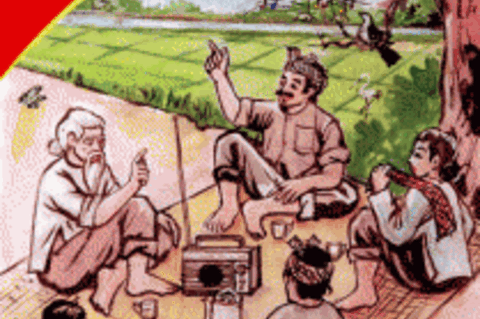
This project drew on the use of radio to bridge key knowledge gaps and motivate farmers to modify their attitudes and practices. The strategy of entertainment-education (EE) was used here to share information with rice farmers about environmental conservation principles, methods to reduce environmental impacts, and ways to protect ecosystem services, with the ultimate goal of modifying farmers' attitudes towards - and behaviours concerning - the use of farm chemicals, burning straw, water use efficiency, wildlife, soil health, and biological control.
The development of the soap opera involved a participatory design/creative process in which a project team made up of social scientists, ecologists, and writers crafted what they hoped would be an informative and motivational radio soap opera that appeals to its rural audience. As part of this process, an audience analysis involving interviews with 604 farmers was carried out. The focus group discussions (FGDs) showed that farmers mainly use television for news, entertainment, and feature films and radio for news, agricultural information, and drama. Many farmers know about air and water pollution problems but had not done much to reduce them because they did not know what to do. Based on the farmers' input as well as the design team's insights, the drama series was developed.
"Que Minh Xanh Mai" was launched to commemorate World Environment Day (June 5) 2006; a TV advertisement was used to draw attention to the radio soap 2 weeks before launch. Drawing on findings from the baseline survey, the storylines focused on sustainable agricultural practices and ways of preventing air, water, and soil pollution (e.g., by exploring the link between too much insecticide use and pest resurgence, and the connection between straw burning and air pollution).
Complementary on-the-ground extension support reinforced the programming through activities such as local competitions, radio clubs, printed materials, and videos.
Environment, Natural Resource Management.
According to IRRI, most rice farmers in Vietnam use excessive amounts of fertilizer, pesticide, and water, and partake in other practices that contribute to environmental pollution and degradation. Although a large quantity of data is available on integrated pest management (IPM), water management, and crop residue management, the information is not disseminated in simple, easily understood forms and, thus, is largely ignored by farmers.
IRRI is an international agricultural research institute that was established in 1960 by the Ford and Rockefeller Foundations in cooperation with the Philippine government. IRRI works in rice-producing and -consuming countries, conducting research and providing training and education for those helping rice farmers by disseminating information and sustainable technologies.
The process and demonstrated impact of an earlier soap opera, broadcast in 104 episodes with the title "Chuyen Que Minh" (or, "Homeland Story") informed the development of "Que Minh Xanh Mai".
In December 2007, "Que Minh Xanh Mai" was awarded the 2007 COM plus Award by the Alliance of Communication for Sustainable Development; click here for details.
IRRI, Voice of Ho Chi Minh, Radio Cantho and Radio Angiang - with World Bank funding.
World Bank completion report [PDF]; the IRRI website; DevCom website; and "Entertainment-Education and Rice Pest Management: A Radio Soap Opera in Vietnam" [PDF], by K.L. Heong, M.M. Escalada, N.H. Huan, V.H. Ky Ba, P.V. Quynh, L.V. Thiet, and H.V. Chien. Crop Protection, Volume 27, Issue 10, pages 1392-1397, October 2008.

- Log in to post comments