










































Evaluating Heartlines: Eight Weeks Eight Values One National Conversation
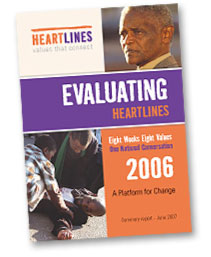
This evaluation of HEARTLINES, a programme developed by The Mass Media Project in South Africa to address social issues such as HIV/AIDS, crime, violence and the breakdown of family and social structures, aimed to look at the successes of the programme and its achievement of a national dialogue on values. Using the authority of faith-based organisations (FBOs) and religious faith, the Mass Media Project aimed to promote values, to encourage people to live out their values more fully, and to provide tools for this purpose. This evaluation focuses on the first stage of the HEARTLINES intervention. This included two main initiatives: first, the national broadcast of 8 weekly HEARTLINES films or dramas, with supporting print and below-the-line media components, and, second, the start of social mobilisation of FBOs, which were provided with relevant tools to teach values and encouraged to undertake discussion-based activities.
The first phase of HEARTLINES was evaluated using a baseline benchmarking survey prior to the project. The post-intervention evaluation included interviews with 3,500 adults across the country supplemented by 37 in-depth interviews and nine focus groups.
According to the evaluation, during the 8 weeks that the films were broadcast, an estimated 26% of the adult population (or, 7.3 million adults) watched one or more of the HEARTLINES films on television. Because of time constraints in getting ethical approval for the research, people under the age of 18 were not included in the group. The total number of people exposed to the films is therefore likely to be much higher than this, since 22% of the population falls between the ages of 10 and 19, with 6.48% falling between the ages of 15-17. In the 18-24 age group, exposure was particularly high, with 34% of people aged 18 to 24 years having watched HEARTLINES. The audience of HEARTLINES doubled from the first to the last week.
The evaluation found that almost two-thirds of those who had watched HEARTLINES had discussed the films with others. Thus, HEARTLINES was responsible for an estimated additional 4.5 million values-related conversations. Both quantitative and qualitative evaluation showed that HEARTLINES helped South Africans to be more connected to others in their lives. This was evidenced in greater self-reports of having helped others in difficult situations, increased willingness to volunteer for caring for someone affected by HIV/AIDS, concrete action taken in this regard, and more forgiving attitudes on several attitudinal measures. In addition to the quantitative data supporting this claim, the organisers say there is a lot of qualitative evidence of the positive impact of the campaign.
The evaluation's key findings include:
- an estimated 26% of the adult population (or, 7.3 million adults) watched one or more of the HEARTLINES films on television;
- highest viewership (34%) was among the people aged between 18 and 24 years;
- audience numbers doubled from the first film to the last film;
- almost two-thirds of those who watched HEARTLINES discussed the films with others – resulting in an estimated 4.5 million additional values-related conversations;
- HEARTLINES had a positive impact on decreasing stigma towards people living with AIDS in South Africa; and
- HEARTLINES established support and credibility within FBOs that were visited; according to evaluators, stories of far-reaching self-reflection and change attest to the impact of HEARTLINES on individual-level attitudes when used at FBOs, particularly with respect to forgiveness.
The evaluation made several conclusions about the programme.
- HEARTLINES achieved excellent reach for an 8-week intervention. Reach was especially high among youth, and young women in particular, a very important group for HIV prevention.
- HEARTLINES was highly successful in achieving national dialogue on values in South Africa, both during the intervention (as indicated by the qualitative data), and sustained 3-4 months after the intervention (as shown in the quantitative evaluation survey). This is an important intermediate step in terms of behaviour change. Overall, this phase of HEARTLINES has laid a firm foundation for the continuation of the programme. However, the programme does need to be continued and extended in order to show significant measurable impact in behaviour change.
- Opportunities to integrate the material in school, FBO, and correctional service programmes that have been created by the success of the first phase of the programme will be important in deepening the impact of the intervention.
- One of the important areas that HEARTLINES wanted to have an impact on was promoting caring for people. Here again the proportion of the respondents in the survey who held positive attitudes and behavioural intention was very high, and so it becomes difficult to show change in this situation.
- HEARTLINES did have a positive impact on making people more accepting of differences, especially racial differences. This is still an important issue in South Africa.
- HEARTLINES also had a demonstrable impact on reducing stigma towards people living with HIV.
- The FBO part of the intervention was clearly successful at creating an opportunity for FBOs to engage in discussion around the values highlighted by HEARTLINES. This occurred even in settings where these discussions were not previously happening.
- Some FBOs became more actively involved with projects as a direct result of HEARTLINES.
The report also suggests that in the next phase of HEARTLINES it may be beneficial to tie the messages on values with providing direction on concrete action that people can take, as many communication campaigns have demonstrated that clear messages relating to some form of action are both easier to understand, as well as easier to evaluate.
Email from Jennifer Charlton to Soul Beat Africa on October 26 2007; and HEARTLINES website on December 3 2007.
- Log in to post comments