










































Facilitating Community-Led Disaster Risk Management
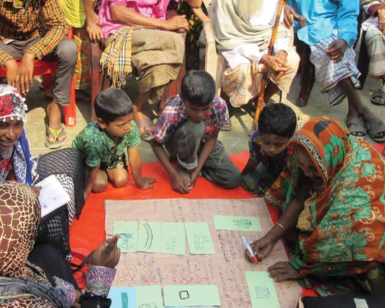
"We must empower communities to plan and drive change, and reinforce governments' responsibility to provide their people with a protective and enabling environment."
This guide is designed to support those promoting a community-led, inclusive, and accountable approach to managing disaster risk, whether they are working on a development programme, a disaster recovery intervention, or on a specific disaster risk management (DRM) project. Its step-by-step instructions, examples, tips, and lessons learned by community mobilisers and facilitators are relevant for both urban and rural communities, and to addressing risks created by slow- and rapid-onset hazards.
Recognising that disaster risk is increasing, Catholic Relief Services (CRS), the Catholic Agency For Overseas Development (CAFOD), and Caritas Australia joined together to create the guide, which builds on previous manuals produced by CRS and CAFOD and incorporates learning and feedback from hundreds of community members, community-level facilitators, and other implementing agency staff who have used those guides. The new elements of this revised guide include:
- Full recognition of challenges related to climate change and climate change adaptation as issues that are integral to disaster risk analysis and management.
- Greater emphasis on community leadership, which requires a supportive and facilitative role by implementing agencies, and a greater emphasis on government involvement, where applicable.
- Specific mechanisms to ensure that the community-led disaster risk management (CLDRM) process is inclusive of and accountable to all community members.
- More attention to DRM actions required at the household level, not just the community level.
- Examples from all regions of CLDRM in practice, from rural to urban and peri-urban, to coastal and small island contexts.
- Attention to a wide range of slow- and rapid-onset hazards, including migration and conflict.
- Use of appropriate technology, where applicable and feasible.
The guide starts by outlining the principles of CLDRM, namely: leadership by the community, inclusion of all social groups in the community, and accountability by all involved. Three stages follow, each comprised of a number participatory processes. Stage 1 describes how to decide where to work, how to set up a system to engage all groups in the selected communities, and how to involve all relevant stakeholders, from local authorities to non-governmental organisations (NGOs) and private entities. It also helps the reader set up the participation mechanism that will ensure that the DRM planning and implementation is indeed inclusive and accountable. Stage 2 guides the reader through facilitation of the community risk-assessment process, to the point where the community is able to decide which risks to address as a matter of priority and to explore options for reducing and managing them. Stage 3 involves supporting the community to identify and agree on the most feasible and appropriate solutions that will help them to reduce their disaster risks, and to develop a plan of action that they can implement and monitor at both the community and household levels.
CLDRM in practice examples provided throughout the guide include:
- Bangladesh: Inclusion of all community members in DRM cash-for-work activities
- Bangladesh: Setting up the participation mechanism through clusters in a diverse community
- Vietnam: Accountable government in early warning and evacuation for storms and floods
- Solomon Islands: Child-centred DRM through songs and games
- The Philippines: Reaching out for support from a local association to reduce flooding
- West Timor: Joint ventures in reforestation to reduce disaster and climate risk
- Guatemala: Engaging key stakeholders to increase agricultural sustainability
- The Philippines: Using technology to understand the geographic dimensions of urban risks
- Gaza: Seeing hazards and vulnerability from the community's perspective
- Myanmar: Reducing illness by understanding and responding to flood trends
- Afghanistan: Prioritising migration challenges through transparent voting
- Ethiopia: Deepening understanding of drought challenges
- Mali: Deepening understanding of urban disaster risk reduction [DRR] to counter flood risk
- Haiti: Seeking community consensus on solutions to flash flooding
- India: Persistently advocating for government support for piped water
- Niger: Collaborative approaches to food insecurity and drought challenges
At the back of the guide is a resources section containing additional information, checklists, templates, sample materials, and further reading. Resource A provides an overview of the 3 stages and 10 processes in this guide. (The 10 processes are: (i) inclusive foundations; (ii) reach out for buy-in; (iii) understand cycles and trends; (iv) past, present, and future; (v) understand geography of risk; (vi) prioritise challenges; (vii) understand challenges; (viii) agree on solutions; (ix) develop action plan; (x) track progress.) Resource B provides guidance for managers on recruiting facilitators with the right skills for CLDRM. Resource C provides guidance from experienced CLDRM facilitators on good facilitation practices.
"Interaction with the DRR and resilience quality management teams and technical advisors of the implementing agency is necessary at all stages and, in all situations, is vital to ensuring the approach is community-led, inclusive of the most vulnerable and promotes accountability."
Publishers
113
CRS website, December 13 2017. Image caption/credit: Community members of all ages help map their village in Bangladesh in preparation for creating a disaster risk action plan. Photo by CRS staff
- Log in to post comments