











































Graffiti as Social Protest
This article explores street art, or graffiti, as a form of expression for individuals or groups, often the most marginalised, seeking to proclaim their existence and announce their identity or cause. It can be a strategy for challenging social and political structures when other options are limited.
As explained here, graffiti as a term has roots in the Italian word "graffiare", meaning "to scratch" and has been a means of communication for hundreds of years. Modern graffiti is often viewed as an insignia of gangs or a pastime for destructive young pranksters. There are also protest painters who use graffiti to paint socio-political dissent on the walls. One expert quoted here (Jeff Ferrell, a cultural criminologist with Texas Christian University in the United States) explains that "[h]ip hop graffiti, with its roots in the American struggle for justice and ethnic equality and ethnic identity and pride, has become part of a broader discourse or language, a grammar for marginalized groups around the world." For example, during times of dictatorship, Nicaragua's citizens protested with stencils of their revolutionary hero Augusto Sandino. These stencil writers risked being beaten or put to death for spraying these images, Ferrell says, but people in corrupt and repressive regimes still take the risk. "It is an affirmation of who you are, it is an affirmation of your politics and political aspirations and it is a way to gain visual power and make a statement not only about your politics, but about who you are. It is a real affirmation of your presence, which is otherwise erased or ignored."
Several other examples of how grafitti is used as a communication tool are provided here. Briefly,
- In Zimbabwe, women use road painting to express dissatisfaction with the socio-political landscape. In August 2008, 9 women were charged and arrested for "malicious damage to property" for their road painting which read "Woza Moya" (which translates to "Come, healing wind"). Members of Woza (Women and Men of Zimbabwe Arise), a solidarity rights group for Zimbabweans, have since proclaimed that they "will continue with our graffiti road writing our messages until the politicians hear us loud and clear."
- In Palestine, the graffiti of rebel politicos includes simple messages, phrases, slogans, and images. These include the v-sign, the Palestinian flag, a map of Palestine, fists, or rifles. Much of the graffiti is from Palestinian and Muslim history, religion and culture. Representations of land also appear often in graffiti images, and slogans such as "Allah" and "al-maktub", the word for "the written" serve as identity and territorial markers in a place where there has been a loss of national identity.
- In the past few years in Lebanon, graffiti has become more modern and stylised, with more inclusive messages such as "Beirut Never Dies" by writers attempting to unite the masses, rather than divide them with politics. After Lebanese Industry Minister Pierre Gemayel was killed, a group of graffiti artists known as "the space invaders" began stenciling "Public Space" across the city, signaling their attempt to take back the streets of Beirut.
- In Tehran, Iran, graffiti artist A1one uses his paint to protest and educate. He wants his images to make Iranians open their minds to see the repression around them, explaining that censorship is commonplace in Iran. His graffiti portfolio includes pieces of bombs with children's faces on them, faces of Iranian women donning head scarves, and men bombing the golden arches of McDonald's. A1one would like to see promotion of the arts by the government: "Our government is not wise enough to use this opportunity as a good way for showing free speech and not dictatorship to the world." He has also created a website where he posts photos of his street artwork. "The experience of free speech was the first motivation, but it made a new path in my mind when I saw the diversity of possibilities in the web," he says.
"Graffiti in its very presence threatens and undermines that sense that the authorities are in control,” says Jeff Ferrell. "There is a kind of deeper battle for how we read our environment. Graffiti forces a re-reading of it, which of course also threatens people in power."
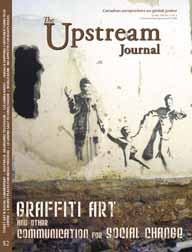
Editor's note: The issue of the Upstream Journal in which the above-summarised article appears is not yet online. To inquire about obtaining a copy, click here and/or contact the journal's editor (see below).
Posting to the OURMEDIA listserv, March 4 2009; and Upstream Journal Jan/Feb 2009, Vol. 22 No. 3.
- Log in to post comments