










































Hilkor ("Ripples in the Water") and Mai Sari Sunakhari ("Orchid, Like Me") Radio Dramas
"Now 22 years old with a 3.5-year-old daughter, Lalita lives with her parents and listens avidly to a radio drama, Hilkor ('Ripples in the Water'). In it, she hears her story and she hopes that other girls will know the truth and be able to avoid situations exactly like hers."
In an effort to address issues around the health and rights of girls and women in Nepal, Population Media Center (PMC) has created 2 radio serial dramas: Hilkor ("Ripples in the Water"), a 104-episode drama airing from April 2016 to April 2017 and rebroadcast from April 2017 to April 2018 in the Maithili language, and Mai Sari Sunakhari ("Orchid, Like Me"), a 208-episode drama airing from April 2016 to April 2018 in Nepali, the official language of Nepal. The broadcast network for Hilkor and Mai Sari Sunakhari includes Radio Nepal, Kantipur FM, and 65 stations nationwide through Ujyaalo 90 Network. The goal of the dramas is to entertain listeners by encouraging attitudinal and behavioural change so as to stop social ills like child marriage and gender-based violence.
As with all PMC radio serial dramas, Hilkor and Mai Sari Sunakhari were created using PMC's serial drama methodology. PMC dramas are culturally specific stories with "positive" and "negative" characters, as well as "transitional" characters to model behaviours. The goal is to broaden the behavioural choices available to the audience by showing a large range of choices and the realistic consequences of different decisions. Hilkor and Mai Sari Sunakhari don't tell people what is "good" or "bad" because that would oppose their goal of introducing more information and encouraging discussion and self-reflection. The dramas contain plots and sub-plots that unfold over time, allowing the audience to get involved with the story and watch the actions and consequences. The goal is to provide powerful stories filled with realistic characters and plot twists that generate a range of emotions as the audience gets pulled into the story.
- To read about the characters and storylines of Hilkor, click here.
- To read about the characters and storylines of Mai Sari Sunakhari, click here.
Prominent personnel have lent their voices in an effort to raise awareness about the issues explored in the dramas and draw listeners to them. As people gathered to celebrate the Nepali New Year in 2016, the former Nepali president Right Honorable Former President Ram Baran Yadav, who was married at age 14 (his wife was 12), spoke about the dramas, saying of his own marriage: "that was 60 years ago. The situation on child marriage is almost the same as it was before, especially in Madhesh where I come from. Things need to change."
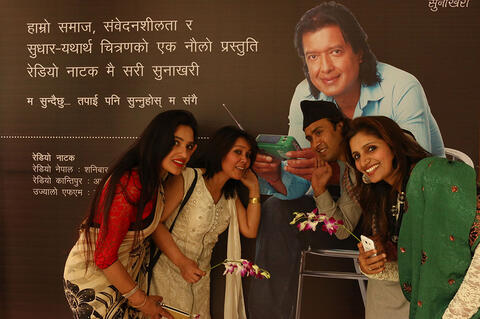
Rajesh Hamal, a Nepali actor with so much notoriety people often call him "Maha-Nayak", which means "Great Actor", promoted Mai Sari Sunakhari on TV spots that have run on national and local stations throughout Nepal, calling it his favourite radio show. "Hamal is generally not involved in commercial promotion," says Rajan Parajuli, PMC's Country Representative in Nepal. "He is always taken as one of the few intellectual celebrities of the country. The people of Nepal believe his words." Hamal is the ambassador for the National Campaign of the Ministry of Women, Children and Social Welfare in Nepal. He publicly strongly supports ending child marriage and gender-based violence.
Child Marriage, Domestic Violence, Education, Family Planning, Gender Equality, Gender-Based Violence, Maternal and Child Health, Nutrition, and Reproductive Health
According to Girls Not Brides, Nepal has one of the highest rates of child marriage in the world and has the third highest rate of early marriage in Asia. For many economically poor families, the marriage dowry for their daughter is a necessity, and others suffer from the misperception that women who are not married early are not "pure". Girls Not Brides reports that 41% of Nepali girls are married before they're 18 years old and that the devastation of the 2015 earthquake has put girls and women in even more vulnerable situations that may increase rates of child marriage. The CIA reports that only 53% of women over the age of 15 in Nepal can read and write.
According to a study done by Samarth-Nepal, 80% of the people of Nepal consider radio to be one of their prime media outlets. Research carried out by Sharecast Initiative Nepal showed that 35% of the respondents tune in to the radio daily. This demonstrates why PMC chose radio to reach key intended audiences. They hope to reach families with important messages. "I dream if I could stop [the drama character] Shilpa from obeying her family," says Lalita about Hilkor. She says she has learned that crying and complaining about life is not a solution and that listening to the drama has made her feel empowered and hopeful for other girls. "If I had chance to listen the drama 'Hilkor' before in my life, I would have filed a case against my parents but would never get married."
PMC and the Antenna Foundation (AFN), with funding from the Kendeda Fund.
"Nepal's First President Celebrates Efforts to End Child Marriage this Nepali New Year", April 18 2016 press release, and Hilkor description on the PMC website and Mai Sari Sunakhari page on the PMC website, all accessed on February 24 2017; and email from Missie Thurston to The Communication Initiative on February 27 2017.
- Log in to post comments