










































Human Papillomavirus Vaccine Sources of Information and Adolescents' Knowledge and Perceptions
University of Cincinnati (Rosen, Ding, Mullins, Kahn); Indiana University (Shew, Zimet); Cincinnati Children's Hospital Medical Center (Ding, Mullins, Kahn)
"...[S]ources of information about HPV vaccines, including media and individuals, are associated with greater knowledge and more positive perceptions among adolescent girls who received the first HPV vaccine dose."
Despite the importance of knowledge and perceptions in vaccine uptake, little is known about the factors associated with higher knowledge or positive perceptions toward human papillomavirus (HPV) vaccination, especially among adolescent girls. Believing that understanding where adolescents obtain information about HPV vaccines may be helpful in designing public health interventions promoting them, this study assessed the following: (i) exposure to specific sources of information about HPV vaccines, (ii) self-reported helpfulness of these sources of information, and (iii) whether the specific source of information was associated with knowledge and perceptions about HPV vaccines among adolescent girls.
Girls aged 13 to 21 years were recruited from an urban hospital-based adolescent primary care office in the United States (US) for the longitudinal study, and 339 of them (mean age = 16.8 years) participated in the study. The majority was black (n = 259, 76.4%), followed by white (n = 56, 16.5%) and other (n = 24, 7.1%)
Table 1 in the paper provides the percentage of participants who responded correctly to the HPV and HPV vaccine knowledge scale. Table 2 provides sources of information about HPV vaccines and helpfulness of each source. Regarding the latter: Television advertisements, the internet, doctors/nurses, and mothers were the most frequently reported sources of vaccine information; more than 90% of participants who received information from these sources reported they were helpful.
Greater number of media sources was associated with higher knowledge (rs = .22, P < .0001), higher normative beliefs (rs = .20, P = .0002), fewer perceived barriers related to vaccine safety (rs = .17, P = .0023), greater perceived benefits related to vaccine safety (rs = .14, P = .0083), and greater perceived severity of genital warts and cervical cancer (rs = .13, P = .02). Further details:
- Having received information from a TV advertisement was associated with higher knowledge (t = 5.05, P < .0001), higher normative beliefs (i.e., belief that important individuals would want her vaccinated; t = 2.90, P = .004), fewer perceived barriers related to vaccine safety (t = 2.55, P = .011), greater perceived benefits related to vaccine safety (t = 3.05, P = .0024), and greater perceived benefits related to vaccine protection (t = 2.75, P = .0062). In contrast, TV advertisements were associated with lower perceived susceptibility to genital warts and cervical cancer (t = 1.98, P = .049).
- Having received information from the internet was associated with higher HPV knowledge (t = 3.23, P = .0014), and having received information from the internet (t = 2.06, P = .04) and a newspaper (t = 4.08, P < .0001) were also associated with higher normative beliefs. ("However, people searching the Internet for vaccine information are likely to experience a mix of accurate and inaccurate information. Thus, public health officals should include efforts to help parents and adolescents to distinguish Internet sites that provide medically accurate, evidence-based information from those based on misinformation and myths...")
Higher number of individual sources was associated with higher normative beliefs (rs = .15, P = .0067) and fewer perceived barriers related to vaccine safety (rs = .15, P = .005). Higher number of total sources was associated with higher knowledge (rs = .16, P = .0025), higher normative beliefs (rs = .21, P < .0001), fewer perceived barriers related to safety (rs = .17, P = .0013), and greater perceived benefits related to safety (rs = .13, P = .0201) and vaccine protection (rs = .13, P = .0165). Further details:
- Doctors and nurses were the most commonly reported individual source of information about HPV vaccines. Those who indicated that doctors or nurses were sources of information had higher knowledge scores (t = 1.98, P = .049), higher normative beliefs (t = 2.22, P = .027), fewer perceived barriers related to vaccine safety (t = 3.27, P = .0012), and greater perceived benefits related to vaccine safety (t = 2.34, P = .02). ("Public health efforts need to focus on creating interventions to assist and support clinicians to effectively communicate information about HPV and the vaccine and implement strong and consistent recommendations for all adolescent vaccines.")
- 38% of the participants endorsed their mother as a source of information; they had higher normative beliefs (t = 2.45, P = .015) and fewer perceived barriers related to vaccine safety (t = 1.98, P = .048).
- In contrast, the few participants who endorsed fathers as a source of HPV vaccine information had lower knowledge about HPV and HPV vaccines (t = 2.25, P = .025) and fewer perceived benefits related to vaccine safety (t = 3.84, P = .0001).
Recommendations going forward offered here include:
- Use these findings to create culturally appropriate HPV vaccine interventions by disseminating medically accurate information through the most common reported sources of information.
- When developing interventions, consider the sources of information that were associated with higher knowledge and perceptions, and utilise these avenues to increase adolescents' HPV vaccine knowledge, improve the appropriateness of their perceptions, and increase vaccine uptake.
- To maximise the impact of future vaccine campaigns, assess the accuracy of HPV vaccine messages and heighten the awareness of healthcare providers to communicate accurate HPV vaccine messages, given the associations between media and individuals as sources of information and adolescents' knowledge and perceptions about the HPV vaccine.
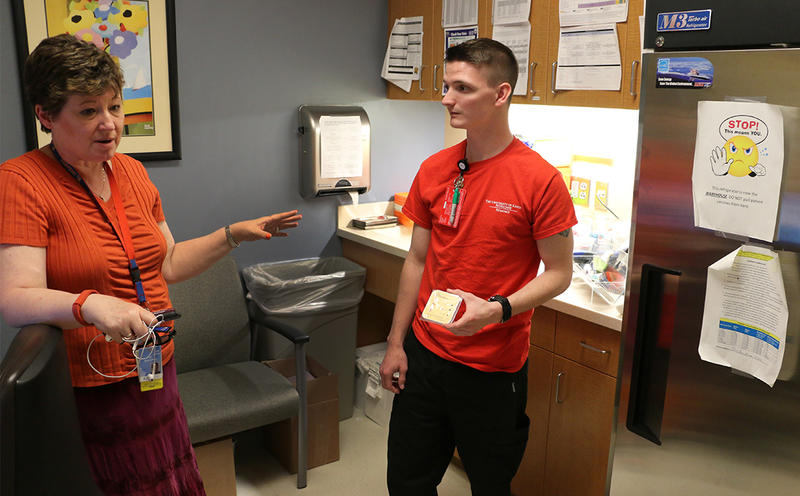
Global Pediatric Health. 2017; 4: 2333794X17743405. doi: 10.1177/2333794X17743405. Image caption/credit: "Dr. Pam Shaw, a pediatrician with the University of Kansas Hospital, discusses the importance of vaccinating adolescents against the human papillomavirus as medical assistant Travis Whaley looks on." Mike Sherry / Heartland Health Monitor
- Log in to post comments