










































From "Infodemics" to Health Promotion: A Novel Framework for the Role of Social Media in Public Health
University of California
"Given the scope of the digital revolution and its impact on contemporary communication, observational research is needed to deepen our understanding of the complex dynamics inherent in how social media functions across the public health continuum."
In the modern era, health communication has become more democratised, with social media enabling anyone to create, share, or exchange information and ideas in virtual communities and networks. During the COVID-19 pandemic, social media has been described as endangering public health, advancing it, or performing some function in between. This paper presents a framework to guide the investigation and assessment of the effects of social media on public health: the SPHERE (Social media and Public Health Epidemic and REsponse) continuum. It also describes a set of outcomes relevant to the evaluation of the effects of social media on the public's health.
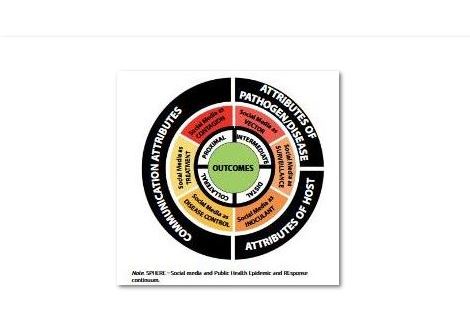
To describe the functions that social media can play, the researchers employ the metaphor of an epidemic: Communication is the process of passing information and understanding from one person to another, just as communicable diseases can be passed from person to person. These functions are illustrated by their SPHERE model, which depicts potential - and often conflicting - functions of social media across the epidemic-response continuum (middle concentric ring - e.g., social media as a surveillance tool), recognising that communication itself can contribute to health or disease. The model also describes factors that influence which roles social media play based on the contextual attributes in a given circumstance (outer ring - e.g., communication attributes) and outcomes relevant to the evaluation of the effects of social media on the health of the public (inner ring - e.g., proximal).
Specifically, social media can be conceived of as:
- Contagion - Misinformation that can spread widely and rapidly has the potential to: lead individuals, subgroups, or communities to pursue ineffective, unsafe, costly, or inappropriate protective measures; undermine public trust in more evidence-based public health messages and interventions; and lead to a range of collateral negative consequences.
- Vector - Social media can serve as a medium through which risky behaviours are enabled and associated diseases transmitted.
- Inoculant - Proactive communications, usually generated by public health entities, can prevent or minimise the spread of misinformation and increase public awareness of accurate information.
- A tool for surveillance - Advances include so-called citizen science platforms and methods that allow the harnessing of big data to identify emerging trends, track behavioural changes, and detect or even predict disease outbreaks.
- A tool for disease control and mitigation - Social media can disseminate health-promoting information that positively influences health behaviours.
- Treatment - For example, social media can play a role in enhancing social connectedness and well-being for populations with a range of disabilities or those subject to social or geographic isolation, such as during COVID-19.
A number of factors influence the role of social media across the SPHERE continuum, including: (i) characteristics of the pathogen or disease (is this a pandemic or a catastrophic public or media event, or is the discussion around common, noncommunicable diseases?); (ii) properties of the host (refers to the sociocultural and political contexts in which threats to health emerge, which present variable degrees of susceptibility or resistance to social media messages); and (iii) attributes of health communication, including:
- framing and content associated with messages, such as their language, clarity, and ability to engage;
- sources and messengers of the information;
- characteristics of the platform and its participants;
- timing and volume of messages;
- influence of amplifiers and detractors on platforms, including autonomous social media agents (bots);
- presence of message sponsorship and disclosure therein; and
- rules, regulations, and controls, or extent of information filtering or censorship applied by the platform or its governing bodies.
Rather than limiting examination of outcomes such as the accuracy of information, extent of dissemination, uptake of misinformation, and effects on knowledge, attitudes, and beliefs, SPHERE looks at:
- Proximal outcomes - e.g., surveillance and monitoring, uptake of accurate (and inaccurate) information, and public awareness;
- Intermediate outcomes - e.g., outbreak preparedness, implementation of health-promoting policies, mobilisation of resources to combat disease, the adoption of health-promoting behaviours, and social well-being;
- Distal outcomes - e.g., disease incidence, transmission rates and morbidity and mortality, and cost-effectiveness; and
- Collateral (nonhealth) outcomes - e.g., economic consequences, preferential or irrational allocation of public resources, mass anxiety or fear, discrimination and stigma, denial of basic rights, retaliation, and the erosion of public trust.
The researchers assert that the SPHERE continuum can inform and explain the work of health communication research, providing a common language to facilitate collaboration. It can be used both in randomised controlled trials in carefully controlled settings and in "real-world, real-time, practice-based quasiexperimental research to be conducted with large populations..." In conclusion, both types of interventional research "can further inform efforts to effectively harness social media for health promotion while maintaining the unique appeal and value of social media as a platform for constructive discourse in an open society."
American Journal of Public Health. 2020 September; 110(9): 1393-96. doi: 10.2105/AJPH.2020.305746. Top image credit: Michigan State University College of Communication Arts and Sciences
- Log in to post comments