











































Know Your Rights Guide for Journalists in India
Image
SummaryText
"In India, there are a wide variety of laws which have been used for potentially targeting journalists, including laws which arguably are intended for purposes other than regulation of journalism."
This guide is intended to provide user-friendly, practical guidance for journalists and newsrooms seeking to understand their rights and protections in India. It was developed by the Committee to Protect Journalists, which has been responding to the needs of journalists in India as they confront a range of challenges, from criminal action to online abuse, and learn to navigate an increasingly hostile environment for the press. The guide covers the legal rights journalists have in India and is designed to equip journalists with a working understanding of the remedies and protection measures that are available under Indian law.
Following a brief overview of summarised takeaways for journalists (also available in a separate document, with links below), the guidance for journalists is covered across six chapters:
This guide is intended to provide user-friendly, practical guidance for journalists and newsrooms seeking to understand their rights and protections in India. It was developed by the Committee to Protect Journalists, which has been responding to the needs of journalists in India as they confront a range of challenges, from criminal action to online abuse, and learn to navigate an increasingly hostile environment for the press. The guide covers the legal rights journalists have in India and is designed to equip journalists with a working understanding of the remedies and protection measures that are available under Indian law.
Following a brief overview of summarised takeaways for journalists (also available in a separate document, with links below), the guidance for journalists is covered across six chapters:
- Chapter I: Rights of Journalists - looks at the fundamental concepts of free speech
- Chapter II: Getting Booked under Law - highlights the different kinds of laws that are used to target journalists with criminal actions
- Chapter III: Getting the Right Recourse - discusses what steps journalists can take if they face criminal charges in the course of their work
- Chapter IV: Getting SLAPPed with Suits - looks at what to do when journalists are served notices for legal actions by large corporations and powerful persons, a common tactic used to intimidate journalists, also known as Strategic Legal Action against Public Participation (SLAPP) suits
- Chapter V: Combatting Online Abuse - sets out learnings from past instances where journalists have faced online abuse and the remedies available in such instances
- Chapter VI: COVID-19 Reporting - sets out guidelines for reporting on the COVID-19 pandemic based on advisories, guidelines, and orders issued by the Indian central and state governments
Publishers
Publication Date
Languages
English and Hindi
Number of Pages
24 (full guide); 6 (brief overview)
Source
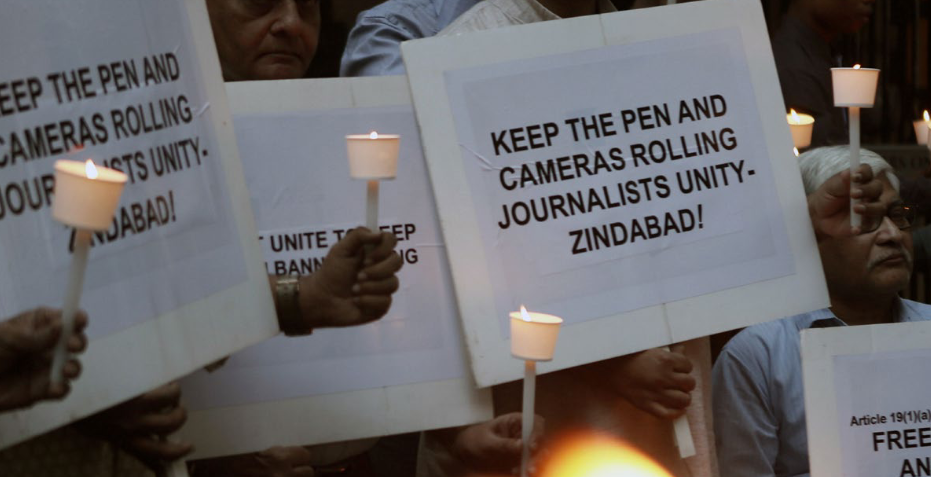
Thomson Reuters Foundation website on June 15 2023. Image caption/credit: Journalists hold candles and placards during a candlelight vigil against police brutalities and attacks on press freedom in Mumbai, India, December 26 2019. REUTERS/Francis Mascarenhas
PDFLink
- Log in to post comments