










































The Liga Inan Project - Timor Leste
The Liga Inan ("Mobile Moms") Project is using mobile phones to connect expectant mothers with health care providers in Timor-Leste to improve the likelihood of a healthy pregnancy and birth. Funded by the United States Agency for International Development (USAID)'s Child Survival and Health Grants Program, Liga Inan is implemented by Health Alliance International (HAI) with Catalpa International, in partnership with Timor-Leste’s Ministry of Health (MOH). The goal of the Liga Inan project is to increase utilisation of quality skilled care before, during, and after delivery.
Because of the remote and rural locations of women in Timor-Leste, advice and support to improve their chances of a having a safe pregnancy and healthy baby are more difficult to access, including through midwives. HAI designed and developed the Liga Inan mobile phone system to send maternal health-related text messages to pregnant women who enrol in the project at the time of their first antenatal visit. The system also facilitates phone contact between pregnant or postpartum women and their midwives, including regular phone contact around the time of delivery.
Initially, the text messages available from the Mobile Alliance of Maternal Action (MAMA) were reviewed. Fifteen prenatal and 157 postpartum messages that aligned with messages of the Timor-Leste Ministry of Health (MOH), as well as those that seemed particularly relevant to the rural population, were chosen, translated into Tetum, the local language, and edited to assure that they could be clearly presented within the maximum SMS (text message) length of 160 characters.
In stakeholder meetings with the MOH at both the national and district levels, messages were reviewed, which provided an opportunity for feedback and policy alignment. Based on that feedback and on existing literature indicating that more frequent messages were more likely to be effective, messages were sent twice a week, instead of the originally planned once a week.
"Ultimately the emphasis of most of the messages consisted of cues to action: having four [antenatal care] ANC visits, using a skilled birth attendant, nutrition messages, birth planning, and knowledge about danger signs of pregnancy, delivery and the newborn period. It was also decided to provide messages regarding traditional practices around birth that are prevalent in Timor-Leste and may have harmful consequences. For example, many women in Timor-Leste practice a postpartum tradition of tuur ahi (literally, 'sitting fire') where the new mother and newborn are sequestered in the home for several weeks next to an open fire because the heat is believed to have beneficial healing effects...", countered with advice to keep mothers and newborns at a distance from the smoke.
The Liga Inan project was designed to include active involvement of district and subdistrict midwives. Training was conducted to introduce the smart phones for patient enrolment and for other key mobile phone functions. In addition, HAI staff trained midwives in better estimation of birth date, how to respond to questions over the phone, and general communication with pregnant women with the goal of helping them to strengthen communication and engagement with their patients and promote healthier mothers and babies.
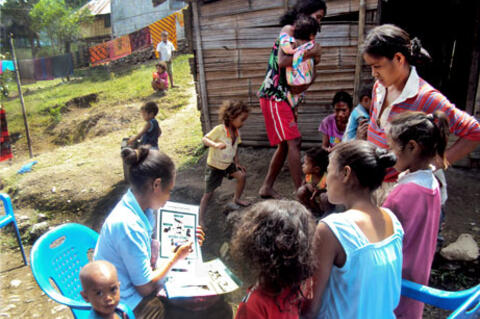
"In order to coordinate a thorough and effective community socialization plan to market Liga Inan while also closely monitoring the implementation process, HAI decided on a phased rollout starting in the largest and most densely populated subdistrict of Same." The phased roll-out allowed for troubleshooting of enrolment errors and for time to adapt the service to align with the free "call me" service provided by the local telecommunications provider, making this service entirely free for mothers wanting to call their midwives. "Socialization activities were carried out in communities throughout Same and included stakeholder meetings with broad community participation - village chiefs, health facility managers and other health staff, community health workers, teachers, community women with special effort extended for pregnant women to attend. HAI and MOH staff conducted a general health education session about maternal and newborn care, introduced the Liga Inan project and provided information on how women could enroll. The socialization efforts have been key in gaining widespread community support and participation in the Liga Inan project." Easily recognisable project promotional materials were created through a logo and tag line: "Your Health is in your hands” (already a recognisable phrase used by the MOH) that were used for t-shirts, brochures, banners, and posters that were distributed during the socialisation campaign.
A monitoring and evaluation process collects utilisation data on key indicators, including skilled birth attendance and facility deliveries, to be assessed via a pre- and post-implementation survey in the implementation district and a neighbouring comparison district. In addition, health information data collected routinely by the health system will be monitored in both districts. Phone surveys to assess enrolees’ early experiences and an assessment looking at the impact on workload for midwives are also planned. Catalpa International developed a website for the Liga Inan project with a password-protected private dashboard on the website, which collects real-time project data, providing staff with a tool to monitor progress and a tool to monitor real-time interactions of midwives and women.
Reproductive Health
At the start of the Liga Inan project, HAI conducted a knowledge, practice, and coverage household survey to collect data on utilisation of health services and mobile phone ownership and usage in the implementation district. Cell phone ownership and familiarity with texting were high; 73% of women reported being able to read the local Tetum language. Midwives use a smartphone to enroll women in the project during a first ANC visit. "With 93% of women in the implementation district accessing at least one ANC visit it serves as a...portal to the project."
Enrollment was launched in February of 2013. After 10 weeks, 278 women were enrolled and 70 births recorded among enrollees. Early results show in increase from 38 births per month attended by a skilled birth attendant in 2012 to 56 in the first month of the programme; an average of 27 births per month were at a health facility in 2012 with an increase to 38 in the first month of the programme. One lesson learned in the project is the effect of a shortage of vehicle fuel for transporting women to health facilities, including in emergencies.
Health Alliance International (HAI), Catalpa International, Ministry of Health of Timor-Leste
Mobile Alliance of Maternal Action (MAMA) website, November 4 2013, and the May 2013 MAMA Spolight [PDF format].
- Log in to post comments