










































Media, Migration and Displacement in the Middle East and North Africa: An Explorative Study
"For a refugee or migrant, a smartphone is as important as food, shelter or a lifejacket."
This explorative study seeks to understand the communication challenges posed by migration and displacement in six Middle Eastern and Northern African (MENA) countries: Lebanon, Jordan, Libya, Tunisia, Algeria, and Morocco. In particular, it seeks to understand how refugees access information, the communication challenges they face, their information needs and how they are being met, and how best to communicate with displaced people as humanitarian or media development organisations. It also looks at how the national media in these countries portray topics related to migration and displacement. The study was conducted by Deutsche Welle (DW) Akademie, which has been working to support media and communication in these six countries.
According to DW Akademie, in a context where refugees are often stereotyped in the media, there is a "growing need to become more familiar with 21st-century migrants and refugees across the Middle East and North Africa and to understand their use of digital media as well as the news and information they rely on to stay informed." The report explains that MENA is a region with a long history of migration and is today shaped by complex and mixed migration patterns, including forced migration and internal displacement as a result of ongoing and protracted conflicts in Iraq, Syria, Yemen, and Libya, among others. To date, more than 5.5 million Syrian refugees have been displaced and are now hosted across the region, mostly in neighbouring countries such as Turkey, Lebanon, and Jordan (Lebanon and Jordan are two countries with the highest ratio of refugees per capita in the world). In addition, due to their geographic proximity to Europe, countries in North Africa play a triple role in the process of migration and escape: countries of destination - mainly for persons coming from Sub-Saharan countries - of transit, and of emigration.
The study involved expert interviews with a variety of stakeholders - development practitioners, officials, community representatives, media professionals, and academics - and focus group discussions with refugee and/or migrant communities. The study was conducted guided by the following research questions:
- How does the national media represent the topics of migration and displacement? Are the voices of migrants and refugees heard in mainstream media?
- What are the communication tools and strategies of important stakeholders in the field of migration and displacement in each of the six countries?
- How do migrants and refugees access information, and how do they communicate within their communities and the host societies?
- Are migrant and refugee communities able to access information necessary to making informed decisions? What information do they seek?
- What are the existing media development initiatives in each country?
Each chapter in the report focuses on one country and was compiled by a researcher/s from that country. The country chapters all outline the refugee situation in the country, offer key conclusions related to the research questions, and draw out recommendations for improving communication for refugee and migrant communities in the country.
Based on the research findings, the six countries can be divided into three different groups with regards to national policies towards migrants and refugees. First, there are the countries with a clear national strategy protecting migrant and refugee rights: Morocco and Algeria. The report makes the point that this finding does, however, not mean that the policies are translated into practice. Second, there are countries with a clear national strategy of not protecting migrant and refugee rights: Lebanon and Jordan (with the exception of registered Syrian refugees in Jordan). Third, there are countries without any national strategy towards migrants and refugees: Libya and Tunisia.
Regarding media coverage of migrants and refugees, all country reports pointed out the same observation: Media coverage of migrants and refugees is extremely negative, sensationalist, judgmental, and subjective. Very often, the media's only focus is on irregular migration. They use language that is frequently described as racist, and they feature both a lack of journalistic ethics and any basic understanding of the topic. Nevertheless, some interviewees in Jordan stated that hate speech has decreased and that the awareness of refugee rights has improved. Some interviewees in Jordan and Libya mentioned smaller community radio stations producing more appropriate and fact-based content.
In every country assessed, social media plays a vital role for migrants and refugees, mainly WhatsApp and Facebook. However, their importance decreases in the case of migrants and refugees who are staying in a transit country and preparing to continue their journey to their country of destination. In this case, it was unanimously asserted that face-to-face communication is the most important means. Hotlines and SMS (short messaging service) services provided by United Nations High Commissioner for Refugees (UNCHR) and International Organization for Migration (IOM), the two main international players for refugees and migrants, were also mentioned. Some interviewees did mention a lack of confidence in the information distributed through these channels, as well as a fear of sharing their telephone numbers in order to access them. In almost all cases, the interviewees added face-to-face communication to help confirm information obtained from digital sources.
Findings around data security showed that protection of personal data is pivotal for persons migrating or fleeing a country. Here, the findings distinguish two groups: The first group is composed of Morocco and Tunisia, which both have legal frameworks for the protection of personal data. Whether or not they are realistically applied is another question. The second group is composed of Algeria, Libya, Jordan, and Lebanon, which do not have any legal instrument designed to protect migrants' and refugees’ personal data. Regular leaks, as well as the fear of being persecuted by security forces, have been reported. Interviewees added that these leaks have also occurred within international organisations like the UNCHR.
Recommendations emerging from the research range from increasing the involvement of refugees in communication that affects them, to undertaking development projects to support online community radio stations, to introducing data security training. Other examples of recommendations include multilingual coffee shops that offer migrants and refugees the chance to get in touch with each other and with members of the host community, as well as cross-border journalistic projects to cover migration.
Click here for the French version of this report in PDF format (34 pages).
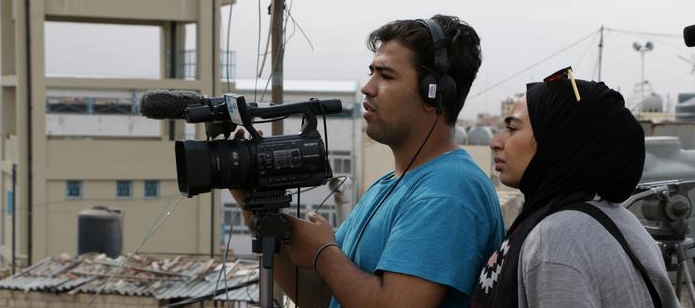
DW Akademie website on June 2 2022. Image credit: DW Akademie/O. Ahmad
- Log in to post comments