











































Mobile Solar Computer Classroom

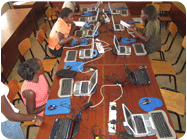
The MSCC consists of a modified Toyota RAV4, three 70 Watt solar panels, one 200 Ah battery, 15 Intel Classmate PC laptop computers, and a 5m x 2.5m foldable tent, eight folding tables and 15 folding chairs. All the material is custom designed to fit in the car with room for two computer teachers. According to organisers, each MSCC has the capability to train over 100 students in a day.
As internet access is unreliable in Uganda, organisers could not depend on teaching skills with a live web connection. In order to get around this challenge, the Foundation introduced purpose-build training software that provides graduated skills training using cached web content (content saved by web browsers for offline viewing) where the internet is not readily available. Organisers say this approach enabled continuity in lessons even though the MSCC might only visit a given school once a week.
Another challenge encountered by the project was the efficiency and durability of the low cost, low specification desktops originally sourced for the project. These PCs proved unfit for the extremes of temperature, dust, and conditions they faced every day. Organisers were also unable to find a local distributor for the more efficient, more durable Intel PC Classmate laptops, and had to source them from overseas. However, the energy efficiency of the new Intel PCs allow organisers to teach an entire class of students at once over a period of more than six hours using only the energy stored in the solar batteries.
In 2009, Maendeleo Foundation won Intel’s Inspire-Empower Challenge award in the category of education. The award included a grant which allowed them to create a second MSCC, which would visit village schools in various parts of Uganda while the original MSCC would still visit the poorer schools around Uganda’s capital of Kampala. Maendeleo’s two Mobile Solar Computer Classrooms provided training for more than 1,500 primary school students, more than 100 primary and secondary school teachers, in 12 Ugandan schools, and for orphanages, libraries, and community centers.
In 2010, Maendeleo is building a prototype Advanced Training Centre near Kampala where they intend to give further training during school breaks and to those not able to afford to attend schools. The Advanced Training Centre, set to open in early 2011, is intended to give further individual training to those that show potential and interest to work in the ITC industry.
Click here for more information on the project.
You can also go to the Maendeleo-Foundation's Facebook page to make comments and suggestions and see more photographs.
Education, Information and Communication Technology (ICT)
In the longer term, the organisers hope that steady and repeated exposure to computer technologies will encourage students to consider careers that might have previously seemed out of reach – including web design and roles in a potential services-outsourcing industry that could eventually expand across Eastern Africa.
Currently broadband infrastructure is being built throughout East Africa, but it will take several years for it to be available and affordable to the public. Primary 4 through 7 students today need to be ready to take advantage of that infrastructure.
The Mobile Solar Computer Classroom was showcased at the 2009 Innovation Economy Conference. The conference, in Washington, D.C. was sponsored by The Aspen Institute, PBS News Hour, Intel, and Democracy: A Journal of Ideas. Click here to see the video shown at the event.
The Maendeleo Foundation is currently consulting with more than 10 NGOs around Africa and India, who want to build MSCCs for their own regions, and their training software is being used in many locations around the world.
The video below was produced by Intel for the Inspire-Empower Challenge Award Ceremony.
Maendeleo Foundation, Essential Skills and Development Corporation, Kageno.org, Sister Schools, and Evenio Media Corporation.
eLearning Africa website and Maendeleo Foundation website on August 9 2010, and email received from Eric Morrow on August 20 2010.

- Log in to post comments