











































Monitoring & Evaluation: An Introduction for Practitioners
Wellcome Trust
"Monitoring & evaluation can play a vital role in the management & improvement of an activity, organisation or process..."
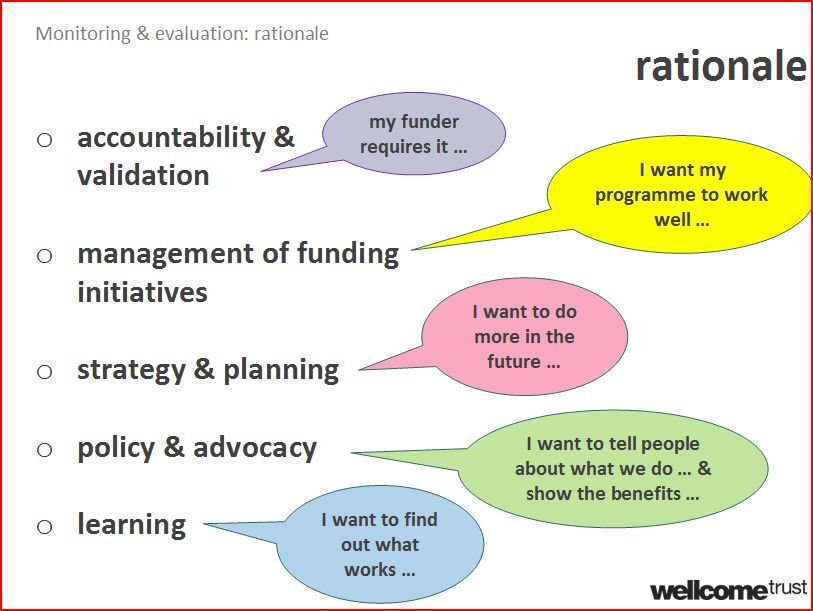
Delivered at the Wellcome Fourth International Public Engagement Workshop, October 3 2012, Cape Town, South Africa, this presentation is designed to guide a range of stakeholders in the research process through monitoring and evaluation (M&E). Liz Allen starts by exploring the rationale behind M&E, such as policy and advocacy: "I want to tell people about what we do and show the benefits". Allen outlines the process, including: establishing an M&E framework, monitoring, setting up a review, and carrying out a process review, a formative review, and a summative review. She notes that tracking includes inputs/activities, outputs, outcomes, and impact.
The next few slides outline theory and formal M&E frameworks. For instance, within the payback framework, one category is research targeting and capacity building: postgraduate research training, career development, the building up of tacit knowledge and technical expertise could lead to informing future research studies. Allen explains what the benefits and limitations of framework approaches are; for example, it can be a challenge to accommodate context.
While stressing that there is a risk in overdoing M&E, Allen asks: "what will you use to indicate that you are making progress?" One of her suggestions is that that M&E focus on involvement of stakeholders. Quantitative research can hone in on such areas as access and participation data. Qualitative research can include interviews, open questions (in a questionnaire format), focus groups, ethnography, participatory research, observation, comment/bulletin boards, and visitor books.
To offset various challenges (such as getting agreement on goals, objectives, indicators, and method), Allen recommends strategies such as: building in M&E from the start; understanding stakeholder and audience requirements; and being flexible, because learning is iterative and should be part of the process.
The following slides share Wellcome Trust's indicators of progress. For instance, in the area of engagement, indicators include: enhanced level of informed debate in biomedicine and significant engagement of key audiences with increased reach. Several examples of Wellcome's work when measured by the indicator "influence" are provided, such as this article: "The Effect of Mobile Phone Text-Message Reminders on Kenyan Health Workers' Adherence to Malaria Treatment Guidelines: A Cluster Randomised Trial".
Editor's note: The first 30 slides of the 37-slide presentation may be viewed below; to download the entire presentation, please click here.
Email from Liz Allen to The Communication Initiative on October 17 2012.
- Log in to post comments