










































Narrowing the Gap between Citizens and Government in Nepal
This brief documents research on exposure and engagement of citizens of Nepal with BBC Media Action's Department for International Development (DFID)-funded governance project, comprising three media outputs:
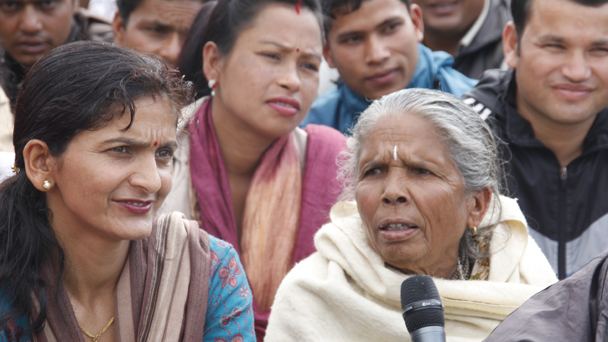
- "BBC Media Action's radio and television panel discussion programme 'Sajha Sawal' provides a platform for people in Nepal to express their views and to hold government officials and other leaders to account. It is recorded at a number of locations around the country and is broadcast by 270 radio stations including the BBC Nepali service network, the Association of Community Radio Broadcasters, Nepal (ACORAB) as well as Kantipur Television.
- Katha Mitho Sarangiko is an award winning improvised radio drama which uses members of the public as actors to highlight real-life stories from around the country. It aims to raise awareness and increase understanding about governance issues.
- Sarangiko Bhalakusari is a radio magazine programme in which issues raised by the drama are discussed."
To counter poor scoring of Nepal on international measures for transparency and accountability and citizen disillusionment with politics and the peace process, Sajha Sawal produced a special pre- and post-election series for Nepal's 2013 election to give people information and help them to participate in the political process. The programme also aired the opinions of people from across the country, allowing them to tell the government what they would like to see in the new constitution.
The methodology of this research follows: "In Dec 2012 and Jan 2013, BBC Media Action interviewed 4,000 people in 25 districts in Nepal. The survey was nationally representative and it aimed to measure exposure to and engagement with Sajha Sawal, Katha Mitho Sarangiko and Sarangiko Bhalakusari. In addition, 15 focus group discussions were conducted in four districts to understand what audiences needed to know about the national election and to elicit feedback on all three programmes."
Key findings include the following:
- "Sajha Sawal is popular among audiences. At least 5.5 million Nepalis watch or listen per episode.
- Men, youth and people living in urban areas, as well as those on a high income and more educated people, were more likely to watch or listen to the programme.
- People were most concerned about economic development and livelihoods.
- Nearly half (49%) of regular audience members discussed the programme, most often with friends (85%) neighbours (34%), spouses (26%) and in-laws (14%).
- 96% of those surveyed said the programme had increased their knowledge of key governance issues.
- 94% said the information provided on Sajha Sawal was “always” or “usually” accurate.
- 71% of Sajha Sawal viewers and listeners said they were likely to vote versus 66% of non-viewers/listeners.
- Family and friends were the biggest influence on people when deciding how to vote. However 26% of those who watched or listened to BBC Media Action programmes said they relied on the media to provide information on who to vote for “a lot” compared to 15% of those who were not exposed.
- 2.8 million people had listened to at least one episode of either Katha Mitho Sarangiko or Sarangiko Bhalakusari. Around two-thirds of these people reported being regular listeners to both programmes.
- Men, youth, rural and better educated people as well as those in the 'middle' income bracket were more likely to listen to the programmes.
- More than half of the audience (53%) had discussed the drama with other people.
- Nearly all Katha Mitho Sarangiko listeners said the programme helped them become aware of their rights (99%) and 93% said the programme gave them information about services and benefits provided by the government."
Implications and impacts include:
"Six years into its production Sajha Sawal continues to be a very popular current affairs programme in Nepal. Its success can be credited to the fact it continues to address issues that resonate with its audience.
The programme is unique in Nepal because it travels to different areas of the country and it addresses the political, social and economic concerns of Nepali people. The feedback from the studio audience shows they appreciate the fact the programme gives them an opportunity to raise their concerns and interact with leaders, something which is not usually possible."
BBC Media Action website, January 31 2014.
- Log in to post comments