










































One Win Leads to Another
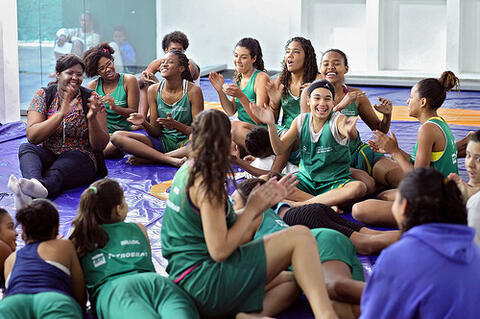
Coinciding with the beginning of the 2016 Summer Olympic Games in Rio de Janeiro, Brazil, UN Women, the International Olympic Committee (IOC), and Always/Whisper launched the One Win Leads to Another initiative, community-based programme to build the leadership skills and confidence of adolescent girls through sport. By 2017, One Win Leads to Another expects to reach 2,500 girls, aged 10-18 years, and 300 young out-of-school mothers in Rio de Janeiro, to later be replicated throughout Brazil and Latin America.
"The power of sport should never be underestimated. It can change lives, through increasing girls' and young women's beliefs in their own abilities, encouraging them to take initiative and aim high,” said UN Women Executive Director Phumzile Mlambo-Ngcuka. "A girl who has learnt her own strength and resilience on the games field is equipped to translate her skill into challenging the obstacles she faces outside the arena." One Win Leads to Another is build on the strategic use of sport to empower young women: in sport and for gender equality.
In 25 countries and with 217,000 girls and young women participating, the One Win Leads to Another curriculum, developed by UN Women's partner Women Win and adapted for the Olympic legacy programme in Brazil, is designed to improve girls' confidence and understanding of sexual health and rights, finances, and economic empowerment. Twice a week, One Win Leads to Another gives an opportunity to adolescent girls living in socially vulnerable contexts to go to one of the 16 participating Olympic Villas to practice sport and attend a gender workshop that uses sport as a tool to reduce gender inequalities and build and maintain confidence. Managed by the municipality of Rio de Janeiro, the Villas provide participants a safe space where they can gain economic and leadership skills, knowledge on their health and bodies, and awareness on violence prevention and available services. The skills training is designed to help them improve their ability to influence decisions that impact their lives at all levels. The company Always is supporting the training of trainers as multipliers of the programme in line with the brand's mission to stop the drop in confidence girls experience at puberty. The Always #LikeAGirl movement is an effort to change the meaning of "like a girl".
Adolescent Girls
"Upon entering adolescence, girls face new challenges, such as, less autonomy of their bodies, less encouragement and space to develop sport skills, more pressure to conform to traditions, and the almost exclusive responsibility to avoid early pregnancy, while their male counterparts enjoy new privileges reserved for men, including autonomy, mobility and power. At puberty, 49% of girls drop out of sports (6 times the dropout rate for boys), limiting the realisation of their full potential. This period of life is a critical time for interventions to reverse this cycle of inequality and generate long-term impact in the lives of adolescent girls and their communities."
Of the girls who took part in the 9-month curriculum in over 30 countries:
- 89% of girls say they are a leader, compared to 46% before One Win Leads to Another;
- 68% of participating girls have increased knowledge and understanding of gender-based violence, and 93% of them know where to report violence; and
- Nearly 80% of girls have an increased understanding of their sexual and reproductive health and rights and know how to prevent pregnancy and sexually transmitted infections (STIs).
As depicted in the video below, girls participating in One win Leads to Another were the IOC President's special guests at the Launch of Medals and Victory Ceremonies of the 2016 Olympic and Paralympic Games in Rio de Janeiro, Brazil. UN Women Executive Director Phumzile Mlambo-Ngcuka was invited to carry the Olympic Torch in Rio and nominated to be part of a jury to award a prize during the Opening Ceremony of the Olympic Games. Thaiza Vitória da Silva, 15, and Adrielle Alexandre, 12, participants of the One Win Leads to Another programme, also carried the Olympic Torch. With dreams of being a professional athlete or a rhythmic gymnastics teacher, Adrielle describes the sacrifices she had to make to keep practising sport yet also shares what she considers to be the best lesson of the programme. "I learned that being a winner is about making my dreams come true, helping others and helping change my community," said Adrielle. "When I carried the Olympic Torch, I was not only dreaming about becoming an Olympic rhythmic gymnast, but also about making my community a place free of violence," she added.
Teenagers such as Adrielle are part of the target generation for the Sustainable Development Goals (SDGs). The set of Goals adopted by all UN Member States to end poverty, protect the planet, and ensure prosperity for all by 2030, cannot be accomplished without achieving gender equality and women's empowerment. In this context, One Win Leads to Another seeks to contribute to generate agents of change to lead the realisation of this development agenda in their communities and in their societies.
UN Women, Women Win, IOC, Always
UN Women Press Release, August 6 2016; and United Nations Regional Information Centre for Western Europe (UNRIC) website, August 10 2016. Image credit: UN Women/Gustavo Stephan
- Log in to post comments