










































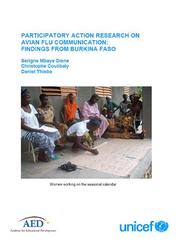
Participatory Action Research on Avian Influenza Communication: Findings from Burkina Faso
Academy for Educational Development (AED)
This 48-page paper, on participatory action research (PAR) conducted in two villages in Burkina Faso affected by avian flu in 2006, documents information on the existing social, cultural, and economic implications of bird flu in these villages with the following objectives:
- "Study community members’ understanding of the potential impact of avian flu on various aspects of their lives, through a process guided by the community using participatory research methods.
- Study the relations and connections between the social, cultural and economic factors of avian flu and its spread in the community putting the accent on opportunities or obstacles to the mobilisation of resources or the changing of practices to prevent or reduce the negative impacts of an occurrence.
- Study the existing communications resources which could be mobilised and feasible interventions which could be carried out with local resources to prevent avian flu, such as community actions to minimise the impacts of bird flu, and the most effective and credible sources of communication."
The conclusions of the research describe a lack of knowledge of modes and sources of avian flu infection and of the factors which can favour its spread. In contrast, there is a strong awareness and concern about the risk of transmission to both poultry and humans and about the economic consequences of losing poultry flocks. The communities are also concerned by the negative impact of avian flu on religious traditions involving chickens in certain ceremonies. The research found barriers to changes in behaviours, particularly, traditional poultry-raising practices. In addition, according to the research, the community has not taken action to try to mitigate the impact of disease because of expectations of outside interventions and resources.
The research suggests that: "Communications activities will be indispensable for causing people to change their behaviour and practices in order to combat avian flu. These actions must be carried out in close collaboration with customary authorities who enjoy a high degree of prestige in their communities and who have the trust of the people." It recommends:
- Activities to raise awareness and provide information, especially addressing the following risky behaviours: not separating poultry; transporting poultry; not washing oneself after contact with live poultry, poultry waste, or poultry meat; not reporting sick birds; and insufficient cooking of poultry.
- Communication that relies on two closely linked networks: the traditional communications network, in which the key actors are the head of the village, the chef de terre, the district heads, the delegate, the town crier, and the people; and the poultry-related communications network, in which the key players are the local government authorities (prefect and delegate), technical staff of the livestock service (veterinarian and village vaccinators), and poultry farmers.
- Messages tailored to communications channels: a chart in the document lists risky practices, focus groups for messages, channels of dissemination and appropriate messages. An example is: Insufficient cooking of raw meat for sacrifices requires the message of taking time to fully cook the meat, which can come from veterinary officers to the traditional healers and Chefe de terre.
- Communication methods include: person-to-person, including door-to-door vistations; video; theatre; and radio.
In the document's annex is an action plan. Communication-related solutions include: youth training centres; raising awareness of alternatives such as sheep, pig, and goat farming or henhouse construction (along with micro credit sources); obtaining and disseminating educational materials on avian flu; and organising and training a surveillance committee with bicycle transportation for their work.
- Log in to post comments