










































People's Video: Preserving Biocultural Diversity through Participatory Video
InsightShare
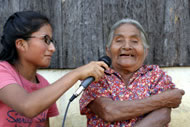
In this article, published in the magazine Resurgence, Nick Lunch, co-founder and co-director of the organisation InsightShare, explores the use of participatory video to enable indigenous peoples to share wisdom and to promote local solutions to preserve the world's biocultural diversity. Considering that, as Lunch notes, 80% of the planet's diversity is in indigenous areas - and yet the current global debate on protecting the planet's biodiversity is dominated by scientists, conservationists, and politicians - participatory video is described here as a tool to amplify the voices and perspectives of local people living in biodiversity hot spots, empowering them to share knowledge with the "outside" on their terms.
As Lunch claims, participatory video pilots launched by Insight in Mexico, Peru, Colombia, South Africa, Namibia, Uganda, Ghana, Sri Lanka, Nepal, Malaysian Borneo, and Indonesia "have resulted in startling video messages, filmed and authored entirely by indigenous communities and directly involving men, elders, youth and women." Insight has been developing toolkits to illustrate the practical steps required to successfully apply participatory video for specific outcomes (e.g., community conservation), as well as a handbook for setting up locally economically sustainable participatory video hubs, low-tech media centres run by and for the economically poor. Insight also offers "trainings for trainers" for indigenous facilitators so they can spread the strategy of participatory video as a tool for conservation - both throughout their communities and to donors, scientists, and policymakers.
He says that, as a process at the grassroots level, participatory video builds self-esteem, values local knowledge and skills, promotes communication, and it can act to bond disparate groups into a coherent and proactive force. At the level of policymaking, this tool "becomes a window to the world, a reality check, a system of ground-truthing." Lunch argues that the project, working at the grassroots level, not only challenges power inequality but also is empowering for government officials, United Nations (UN) officers, civil servants, donors, non-governmental organisations (NGOs), activists, and communities.
In conclusion, Lunch notes that: "Addressing the key threats to humanity and life as a whole demands a shift in consciousness away from Western-based lateral ways of thinking about human development as separate from those life systems that support us; towards a more holistic view that places humans as part of an interconnected web of life. Participatory Video is one way to give voice to that perspective."
Editor's note, July 19 2012: Since the publication of this article in Resurgence, InsightShare has worked with more indigenous communities across the world in Kenya, Panama, Peru, the Canadian Arctic, the Philippines, Cameroon, Samoa, Mexico, India, and Ethiopia as part of "Conversations with the Earth". This programme has helped create a network of autonomous "media hubs" - groups of local people trained in participatory video skills who organise community film projects and respresent their communities at international events and conferences. Their work enables indigenous people to share their experiences of climate change, campaign for action, and bring their concerns to international policymakers. For more information, click here.
Insight website and Resurgence website - both accessed on September 10 2010; and email from Marlene Bovenmars to The Communication Initiative on July 19 2012.

- Log in to post comments