










































Playback Theatre
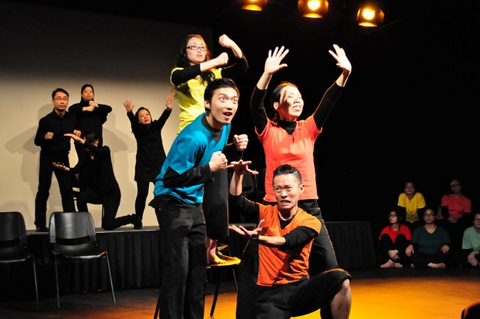
"We discover who we are by telling our stories."
Playback Theatre is an interactive form of improvisational theatre in which audience members tell stories from their lives and watch them enacted on the spot. Playback Theatre is used in a range of contexts including public performances, community arts, social dialogue, peace building, conflict resolution, education, change management, and celebrations. There are regular Playback training courses, gatherings, and festivals in different parts of the world. Playback Theatre, practiced in over 50 countries, promotes the right for any voice to be heard, brings group concerns to the surface, and stimulates a dialogue by making different perspectives visible.
Many communication professionals are familiar with Theatre for Development (TfD), where a group of actors and musicians set up, often unannounced, in public locations for short plays with educational messages. Often these include a question and answer (Q&A) session where actors respond in character to questions and comments from the audience, in the style that Brazilian artist-activist Augusto Boal calls Forum Theatre. But a different theatrical form called Playback Theatre is being used around the world to combine the power of personal story with community-building interaction. Playback Theatre is a modern recreation of an oral traditional ceremony. Such events can be, and still are in some places, entertaining for a village or clan community, but the purpose was always something larger - to heal sickness, solve social problems, or remind constituents of ancient wisdom.
Specifically, Playback Theatre is a participatory, highly collaborative experience in which a group of skilled actor/responders hear stories from the audience and perform the stories back on the spot, using dialogue, movement, and music. It is a very simple, yet powerful form that intends to bond attenders and performers in a short time. Interactive and spontaneous, playback theatre bases its material on the stories of the community. In theatres, workshops, and a wide range of educational and organisational settings, Playback Theatre draws people together and allows fresh perspectives. Performances are carried out by a team of actors, emcee (called the conductor), and musician. As the show begins, audience members respond to questions from the conductor, then watch as actors and musician create brief theatre pieces on the spot. Later, volunteers from the audience come to the stage to tell longer stories, choosing actors to play the main roles. The idea of this approach is to promote dialogue between different voices, since in the course of a Playback Theatre event many people have the opportunity to speak and see their stories embodied on the stage. Performing Playback Theatre, where the content is not known beforehand, and basic trust must be established before a teller is willing to come forward, requires a sophisticated understanding of group process.
Although performances often focus on a theme of interest or concern, the performers follow no narrative agenda, but bring their dramatic skills and their humanity to embodying on the stage the concerns and experiences of audience members. The method is extremely flexible, since there is no set play, and can adapt to the needs of many kinds of groups and organisations. Playback Theatre has been used in schools, colleges and universities, private sector organisations, nonprofit organisations, prisons, hospice centres, day treatment centres, as well as at conferences of all kinds. It works well for groups celebrating milestones, working through internal change issues and conflicts, community conflict resolution, and therapeutic interventions.
Troupes have focused on development issues such as transitional justice, human rights, refugees and immigrants, disaster recovery, and climate change. The flexibility of the Playback form permits a high degree of sensitivity to the needs of specific groups. Here are a few examples:
- Social change and action: A group in the Northern Territories of Australia performed to Aboriginal communities as part of a programme to enhance self-esteem and recovery from substance abuse. Playback has also been used in hearing from both sides on the Palestinian/Israeli issue. In Argentina, Playback helped reconstruct collective memory of their social/political history.
- In education: In Alaska, US, schoolchildren used Playback Theatre to deal with their grief over the death of a fellow student. Hong Kong teenagers perform playback as part of their community service programme.
- In therapy: Playback Theatre is used as an additional tool for psychotherapists in their group work. In Chicago, US, a group of schizophrenics who were outpatients at a psychiatric unit met regularly to do Playback Theatre for each other and tell stories of coping with everyday life.
- Corporate contexts: An audience of Swiss engineers and accountants shared stories through Playback Theatre about organisational re-structuring; an audience of Post Office workers in Washington, DC were facing redundancy and used Playback Theatre to deal with this.
- Public performances: Playback Theatre is performed to the general public at theatres and art centres all over the world. "It has been said that Playback is a theatre of neighbours. You may have come into the theatre as a stranger, but almost certainly by the end of the evening, you will feel a sense of aliveness and ease in talking to the people around you."
- Community events: In Sydney, Australia, Playback Theatre was part of a wedding celebration. In London, United Kingdom (UK), it was performed at a Remembrance Evening. In Japan, a Playback group performed for mentally handicapped people and their friends and family every month.
Founded in the United States (US) in 1975 by Jonathan Fox and Jo Salas, Playback Theatre has since spread around the globe; Playback companies now exist in over 50 countries on 6 continents. the International Playback Theatre Network (IPTN) links together these companies around the world, seeking to provide an "independent, inclusive global platform that strengthens Playback Theatre practice through connection and mutual influence." The IPTN has supported annual International Conferences since 1991 and published a bi-annual journal with experiences and tools from Playback Theatre practitioners in action globally. Launched in 2006, the Centre for Playback Theatre is an outgrowth of the School of Playback Theatre, which has been offering comprehensive training in Playback Theatre since 1993. Among other activities, the Centre for Playback Theatre offers training courses in Playback Theatre.
Examples of Playback performances in several languages are available by searching YouTube for "Playback Theatre". For example, one video is from a TEDx event featuring Greece's T!NG team, which was created in late October 2006 and since has organised international Playback team meetings in Russia, Italy, Germany, and Hungary. The meetings concluded with joint performances by the participating teams. It has also organised youth and adult educational seminars in cooperation with Vafopoulio Cultural Center. Moreover, T!NG team has been responsible for the training of another playback team, AquNa This. Finally, T!NG has performed multiple times in theatres and on unique occasions in Northern Greece.
Conflict, Rights, Environment
Emails from Joel Plotkin to The Communication Initiative on June 26 2014 and September 16 2014; and International Playback Theatre Network (IPTN) website and Centre for Playback Theatre website - both accessed on May 11 2016. Image credit: Centre for Playback Theatre
- Log in to post comments