










































Protecting Children on the Move in Asia through Information and Communication Technology (ICT) and Social Media
"In a region with more mobile phones than people,...digital growth in Southeast Asia presents opportunities for children on the move to make informed decisions prior to migration and could help to prevent children from moving alone or being separated from their families if that is not in their best interests."
This study from the Save the Children Asia Regional Office examines what level of access children who migrate in Asia have to information and communication technology (ICT) and social media platforms. It also looks at how these children are using communication devices and social media with the aim of utilising these findings to establish whether social media and technology can play a greater part in keeping children safe while on the move. Finally, it offers a number of recommendations for those implementing ICT interventions, stressing that they should be appropriate to the particular stage of the migrant's journey - before, during, or after - and to the particular context of children on the move in Asia.
Save the Children explains why children move and how they are particularly vulnerable while on the move; they are at risk of exploitation and abuse, of being trafficked or even of losing their lives. Focusing on children on the move in Bangladesh and Myanmar as source countries, as well as Malaysia and Thailand largely as destination countries, the study involved a total of 134 children through focus group discussions and surveys. In addition, 38 research participants from non-governmental organisations (NGOs), service providers, technology companies, and academics took part in the study.
The report provides an overview of the current situation regarding information provision to migrating children, and considers the key challenges and opportunities currently presented in this area. Among children who participated in the study, about 1 in 2 have access to mobile phones, and 1 in 3 use computers with internet access to communicate. In terms of ownership, about 2 in 3 children own a basic mobile phone or a smartphone, and fewer than 1 in 20 children actually own a computer or tablet. When asked about the nature of their usage of devices, children shared that their main use was for making phone calls; 82% of them keep in touch with their family members in this way. However, children are not frequently using these devices to find information relating to safe migration. No children involved in this study are using the applications (apps) designed for use by migrants, nor are these being employed by migrants elsewhere, because these apps are not sufficiently targeted or are not well publicised.
Children favour apps that allow voice or video transmission rather than text, placing a great emphasis on both LINE and Viber. They also make use of emoticons and "stickers", which depict messages without the need for words and can be used over Wi-Fi, without the need for a mobile phone connection. Twitter has very low usage among children, as it requires the use of writing, which deters those who are illiterate. Social media does not play a major role in the migration of children in this study, although they are used to communicate with others who have already travelled.
Access and usage differs before, during, and after their migration - and interventions should be tailored accordingly.
- Before migration and in the source country, access to technology is limited. Children in the study stated that accessing information is commonly done through landline phone, by asking family members, watching television, and listening to the radio. From children's perspective, family members were identified as the most useful source of information when planning their migration journey. The study did find that, although the children who participated in this study do not currently look for information about safe migration using ICT, they do use YouTube and watch video on mobile phones. Video is a good medium for promoting migration messages. Recommendations: Low-tech solutions for awareness-raising in areas of origin should be maintained, shared, and promoted among service providers across the region. In order to be fully prepared before migration, children need to be made aware of risks, know where they can find support and care along the way and whom to trust, and understand the reality of migration and the legal and social systems they will find in transit and at their destination. Evidence from stakeholders indicates that low-tech interventions such as games, street theatre, drama, folk art, and cartoons, are well received by communities. Children and their families can be assisted in simple planning of how to prepare, and what to do during their journey and after they arrive at their destination. There should also be a plan for if things go wrong, which can be accomplished through a simple verbal discussion with family or friends. In communities where more advanced technology exists, apps such as Microsoft's Helpbridge should be used or developed in order to define a plan and set up automatic alerts for what to do in case of an emergency. Existing information centres should be harnessed to connect the source to the destination.
- During their migration, children typically have with them a simple mobile phone rather than a smartphone. This is in contrast to other situations such as Syrians crossing into Europe, where migrants are likely to have better access to smartphones, be more digitally literate, and be financially better off. Only 59% of the children in the study felt that access to ICT and social media could keep them safe. Recommendations: Children on the move should be assisted to utilise the aforementioned information centres along their route to communicate their progress. Such centres should be identified by a logo known to children and should allow children on the move to provide an update on their movement, as agreed in their initial plan with relatives or friends. This could be by simple email. For those who have access to smartphones, apps such as Kricket and Northern Light track the migrant's movements. These apps also provide real-time information to migrants about services as well as risks and dangers on their route. Another solution is the harnessing or development of technology used by the app Companion, which tracks a user's movements and shares them with their chosen companion, who can monitor and ensure that their friend reaches the selected destination. In addition, technology should be further explored that works with simple mobile phones. The Green SIM is able to transform a simple mobile phone into a migrant-specific handset, and also provides a facility for a helpline. Free access sites such as Internet.org should also be better publicised and utilised by those providing information to migrant children. For those who have been trafficked or exploited along the route, a simple alert or hotline system should be developed to report the incident. This is available in apps such as Companion but is also available in far more simple devices designed for tracking children.
- Upon arrival at their destination, children very soon acquire access to a smartphone, using their first available funds to invest in one. Children highlighted that the smartphone is an extremely important asset for them and their family. Recommendations: Existing apps should be supported, focused, and strengthened, and solutions should be designed to link destination information applications to the source. It is important to ensure that service providers are not obliged to report irregular immigrants, families, and children. If children and their families are fearful of being reported, they will not access critical information about available services. Looking to the future, a comprehensive migration solution should be developed that links not only the source and destination but also the migrant as they travel along their route. Further work should be explored with the developers of destination information apps such as Save the Children's Kolorob, to develop its reach to those who remain in the source country. This kind of system is exemplified by the forthcoming Tripadvisor-style app being developed by The Issara Foundation, which allows migrant workers in Thailand to feedback about working conditions to those back home in Myanmar considering the same journey. The mapping exercise conducted for this study (see Annex) shows that there are currently many solutions that are overlapping, as well as many that are underused. In that light, and due to an expressed need and desire among stakeholders to collaborate more, coming together and utilising collaborative structures such as Liberty Asia's Freedom Collaboration for NGOs, Techfugees for the technology community, the Refugee Futures Initiative (a science-driven initiative), or Nethope (a cross-sectoral solution) are recommended for future programming in this area.
"Bringing the best practice together, using some of the existing platforms identified by this study, and collaborating on keeping children safe, will yield more effective and more sustainable solutions for children on the move in Asia."
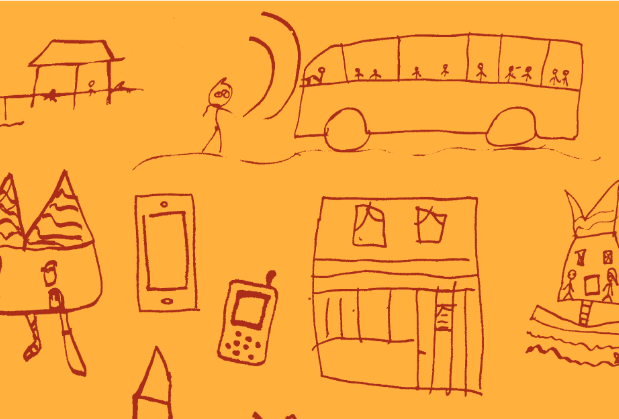
Save the Children's Resource Centre, September 18 2017. Image caption/credit: A child’s drawing describing his migration experience. Save the Children
- Log in to post comments