










































Seeing is Believing

At the core of this project is a documentary film called "Seeing is Believing: Handicams, Human Rights and the News", which was produced by Katerina Cizek and Peter Wintonick of Necessary Illusions in association with CBC-Newsworld/SRC/RDI. The one-hour film is premised on the notion that an important step towards understanding and curing the world's ills is "bearing witness"; even amateur videographers with access to handicams can record events around the world. Since the Rodney King beating was captured in this way in the United States in 1991, the use of digital technologies to document human rights abuses, prevent violence, and make those who commit crimes face justice has "skyrocketed". The film raises questions about this communication trend such as: Does the presence of a video camera help save lives or, rather, increase the danger to those being threatened? What will be the impact of this proliferation of personal video cameras? How will it affect privacy?
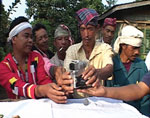
In the documentary, which was screened at various film festivals around the world, viewers follow independent human rights activist and investigative reporter Joey R.B. Lozano as he uses his personal video camera to assert indigenous land rights and to investigate corruption and environmental degradation in the Philippines. Joey delivers a new "Witness" camera to Nakamata, a coalition of 10 indigenous groups who have joined together to reclaim ancestral territory in Central Bukidnon. (Joey is a board member and partner of the New York (USA)-based human rights organisation Witness, which was founded in 1991 by musician Peter Gabriel and the Lawyer's Committee for Human Rights to put new technologies into the hands of local activists around the world). Together, Nakamata and Joey use technology as a tool to document a dangerous land claims struggle in this remote, economically poor place; "it doesn't take long for tragedy to unfold in front of the camera."
Visitors to the interactive Seeing is Believing website may learn exactly what happened in Nakamata, and participate in both discussion forums and advocacy activities to explore and address the rights-related issues raised in the film in greater depth. For instance, an Act Now! page enables people to demand justice for the murder cases featured in the film by writing letters of concern/protest; names and contact details for various Filipino authorities are provided here. In addition, several learning opportunities are offered. For instance, the technology section includes two collections of stories exploring the synergy of technology and culture, one of which features an interactive map designed to enable exploration of "how cell phones are changing the world everywhere". Furthermore, a Teacher's E-Zine to the Digital Revolution offers an approach to human rights education and media literacy that uses contemporary and historical case studies to help educators and students explore the use of rapidly evolving communications technologies in human rights work in Canada and around the world. The E-Zine contains explanations of key terms and concepts, discussion questions, activities, and resources, all organised thematically in four units.
Human Rights, Technology, Media Literacy Education.
Since 1986, over 40 Filipino journalists have been murdered in the line of duty, according the Committee to Protect Journalists.
Joey continues to work with the Nakamata as they embark on preparing documentation for their Ancestral Domain Claims. His blog details this process.
Click here for details about how to purchase the film.
Financial support provided by the Government of Canada through the Human Rights Program, a programme of the Department of Canadian Heritage.
Seeing is Believing website; and email from Peter Wintonick to The Communication Initiative on March 10 2009.
- Log in to post comments