










































Selected Routine Immunisation (RI) Peer-Reviewed Articles
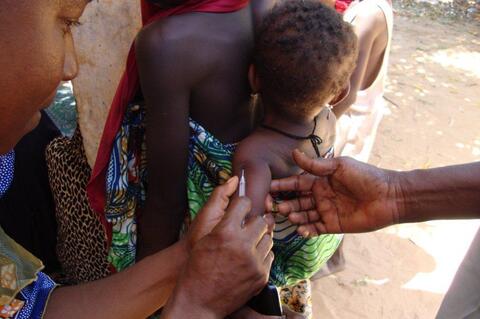
The following peer-reviewed journal articles focus on the use of communication to address routine immunisation (RI) issues around the world. Michael Favin of the Manoff Group alerted The Communication Initiative (The CI) to these publications on February 23 2015. The image is courtesy of Marit van Strien of the United States Agency for International Development (USAID) Nigeria.
Articles summarised on (and available for free access download from) The CI site:
- Click here to read a summary of "Vaccination Hesitancy: An Overview" on The CI website.
- Click here to read a summary of "Urban Settings Do Not Ensure Access to Services: Findings from the Immunisation Programme in Kampala Uganda" on The CI website.
- Click here to read a summary of "Improving the Monitoring of Immunization Services in Kyrgyzstan" on The CI website.
- Click here to read a summary of "Drivers of Routine Immunization Coverage Improvement in Africa: Findings from District-Level Case Studies" on The CI website.
- Click here to read a summary of "Home-Based Child Vaccination Records - A Reflection on Form" on The CI website.
- Click here to read a summary of "Attitudes to Vaccination: A Critical Review" on The CI website.
Articles which are either copyrighted or only available for purchase:
- "Story and Science: How Providers and Parents Can Utilize Storytelling to Combat Anti-Vaccine Misinformation" [PDF], by Ashley Shelby and Karen Ernst. Human Vaccines & Immunotherapeutics, Volume 9, Issue 8, August 2013, Pages 1795-1801. © 2013 Landes Bioscience
Abstract: "With little or no evidence-based information to back up claims of vaccine danger, anti-vaccine activists have relied on the power of storytelling...Utilizing some of the storytelling strategies used by the anti-vaccine movement, in addition to evidence-based vaccine information, could potentially offer providers, public health officials, and pro-vaccine parents an opportunity to mount a much stronger defense against anti-vaccine messaging." - "Recommendations Regarding Interventions Improve Vaccination Coverage in Children, Adolescents and Adults" [PDF], American Journal of Preventive Medicine, Volume 18, Number 1S. © 2000 American Journal of Preventive Medicine
Abstract: "This report makes recommendations on the use of interventions to increase vaccine coverage levels....Choosing strategies that work in general and that are well matched to local needs and capabilities, and then effectively implementing those interventions, is vital to improving vaccination coverage at the local level." - "A Systematic Literature Review of Missed Opportunities for Immunization in Low and Middle Income Countries", by Shruti Sridhar, Nadira Maleq, Elise Guillermet, Anais Colombini, and Bradford D. Gessner. Vaccine, Volume 32, Issue 51, December 5 2014, Pages 6870-6879
Abstract: "Missed opportunities for immunization (MOIs) may contribute to low coverage in diverse settings, including developing countries....We conducted a systematic literature review on MOIs among children and women of childbearing age from 1991 to the present in low- and middle-income countries.....We found 61 data points from 45 studies involving 41,310 participants....Among 352 identified reasons for MOIs, the most common categories were health care practices, false contraindications, logistic issues related to vaccines, and organizational limitations....MOI prevalence was high in low- and middle-income settings but the large number of identified reasons precludes standardized solutions." Click here in order to purchase this article. - "The Need for a Multi-Disciplinary Perspective on Vaccine Hesitancy", by Caroline M. Poland and Emily K. Brunson. Vaccine, Volume 33, Issue 2, January 3 2015, Pages 277-279
Abstract: "The authors of this article were invited members of a workgroup sponsored by the American Academy of Arts and Sciences in the fall of 2013. They came away convinced that a more holistic perspective of childhood vaccination is necessary in order to understand and ultimately address the complex, multi-faceted issues surrounding vaccine hesitancy and vaccine acceptance in the United States. The authors suggest that such a holistic view can only be obtained by carefully considering the findings and perspectives of research from a variety of disciplines, including, but not limited to, public health." Click here in order to purchase this article. - "A Qualitative Study on Knowledge, Perceptions, and Attitudes of Mothers and Health Care Providers toward Pneumococcal Conjugate Vaccine in Bandung, West Java, Indonesia and Acceptance", by Agnes Tri Harjaningrum, Cissy Kartasasmita, Joanna Orne-Gliemann, Marthe-Aline Jutand, Nicolas Goujon, and Jean-Louis Koeck, Vaccine, Volume 31, Issue 11, March 1 2013, Pages 1516-1522
Abstract: "Due to the high burden of pneumonia in Indonesia, the inclusion of pneumococcal conjugate vaccine (PCV) into Indonesia's National Immunization Program (NIP) is recommended by World Health Organization. Prior to the introduction of new vaccines, it is imperative to assess the perceptions of the public and medical community about the disease and the vaccine. The purpose of this qualitative study was to explore the knowledge, perceptions, and attitudes of mothers and health care providers (HCPs) toward PCV in Bandung, West Java, Indonesia....Fifty-five respondents (26 mothers and 29 HCPs) were interviewed at public and private health care facilities in Bandung using semi-structured interviews in May-June 2011....Although most mothers had low knowledge about PCV, did not perceive themselves as susceptible to the disease, perceived that cost was the main barrier to PCV access, and obtained little information on PCV, they considered pneumonia as a severe disease and a priority health problem, perceived benefits of the vaccine, and were likely to adopt it. Similarly, knowledge about PCV among most HCPs was limited. Despite perceiving cost as the main barrier, most HCPs perceived benefits of the vaccine, susceptibility and severity of the disease, regarded pneumonia as a priority health problem, and were likely to suggest the new vaccination." Click here in order to purchase this article. - "Understanding Vaccine Hesitancy around Vaccines and Vaccination from a Global Perspective: A Systematic Review of Published Literature, 2007-2012" by Heidi J. Larson, Caitlin Jarrett, Elisabeth Eckersberger, David M.D. Smith, and Pauline Paterson. Vaccine, Volume 32, Issue 19, April 17 2014, Pages 2150-2159
Abstract: "...The primary aims of this systematic review are to: 1) identify research on vaccine hesitancy; 2) identify determinants of vaccine hesitancy in different settings including its context-specific causes, its expression and its impact; and 3) inform the development of a model for assessing determinants of vaccine hesitancy in different settings as proposed by the Strategic Advisory Group of Experts Working Group (SAGE WG)....A broad search strategy, built to capture multiple dimensions of public trust, confidence and hesitancy around vaccines, was applied across multiple databases. Peer-reviewed studies were selected for inclusion if they focused on childhood vaccines [=7 years of age], used multivariate analyses, and were published between January 2007 and November 2012...[R]esults show...[that] determinants of vaccine hesitancy are complex and context-specific - varying across time, place and vaccines." Click here in order to purchase this article. - "The Feasibility of Using Mobile-Phone Based SMS Reminders and Conditional Cash Transfers to Improve Timely Immunization in Rural Kenya", by Hotenzia Wakadha, Subhash Chandir, Elijah Victor Were, Alan Rubin, David Obor, Orin S. Levine, Dustin G. Gibson, Frank Odhiambo, Kayla F. Laserson, and Daniel R. Feikin, Vaccine, Volume 31, Issue 6, January 30 2013, Pages 987-993
Abstract: "Demand-side strategies could contribute to achieving high and timely vaccine coverage in rural Africa, but require platforms to deliver either messages or conditional cash transfers (CCTs). We studied the feasibility of using short message services (SMS) reminders and mobile phone-based conditional cash transfers (CCTs) to reach parents in rural Western Kenya....We approached 77 mothers; 72 were enrolled into the study (26% owned a phone and 74% used someone else's). Of the 63 children with known vaccination status at 14 weeks of age, 57 (90%) received pentavalent1 and 54 (86%) received pentavalent2 within 4 weeks of their scheduled date. Of the 61 mothers with follow-up surveys administered at 14 weeks of age, 55 (90%) reported having received SMS reminders. Of the 54 women who reported having received SMS reminders and answered the CCT questions on the survey, 45 (83%) reported receiving their CCT. Most (89%) of mothers in the mPESA group obtained their cash within 3 days of being sent their credit via mobile phone. All mothers stated they preferred CCTs as cash via mobile phone rather than airtime. Of the 9 participants who did not vaccinate their children at the designated clinic 2(22%) cited refusals by husbands to participate in the study....The data show that in rural Western Kenya mobile phone-based strategies are a potentially useful platform to deliver reminders and cash transfers. Follow-up studies are needed that provide evidence for the effectiveness of these strategies in improving vaccine coverage and timeliness....More extensive engagement of husbands in the community is important." Click here in order to purchase this article. - "The Vaccination Confidence Scale: A Brief Measure of Parents' Vaccination Beliefs", by Melissa B. Gilkey, Brooke E. Magnus, Paul L. Reiter, Annie-Laurie McRee, Amanda F. Dempsey, Noel T. Brewer, Vaccine, Volume 32, Issue 47, October 29 2014, Pages 6259-6265
Abstract: "...We sought to develop a scale for measuring confidence about adolescent vaccination in diverse populations of parents [in the United States]....Data came from 9623 parents who completed the 2010 National Immunization Survey-Teen, an annual, population-based telephone survey. Parents reported on a 13- to 17-year-old child in their households. We used exploratory and confirmatory factor analysis to identify latent constructs underlying parents' responses to 8 vaccination belief survey items...using the Health Belief Model. We assessed the scale's psychometric properties overall and across demographic subgroups....Parents' confidence about adolescent vaccination was generally high. Analyses provided support for three factors assessing benefits of vaccination (mean = 8.5), harms of vaccination (mean = 3.3), and trust in healthcare providers (mean = 9.0). The model showed good fit both overall (comparative fit index = 0.97) and across demographic subgroups, although internal consistency was variable for the three factors. We found lower confidence among several potentially vulnerable subpopulations, including mothers with lower levels of education and parents whose children were of Hispanic ethnicity (both p < 0.05).....Our brief, three-factor scale offers an efficient way to measure confidence in adolescent vaccination across demographic subgroups. Given evidence of lower confidence by educational attainment and race/ethnicity, program planners should consider factors such as health literacy and cultural competence when designing interventions to promote adolescent vaccination to ensure these programs are fully accessible." Click here in order to purchase this article.