










































Shifting the Demand for Vaccines: A Review of Strategies
University of Southern California (Sood, Joshi); Stanford University (Nasserie, Bendavid)
"Why don't people vaccinate, and what can be done to increase vaccination rates besides providing free and easy access to vaccines?"
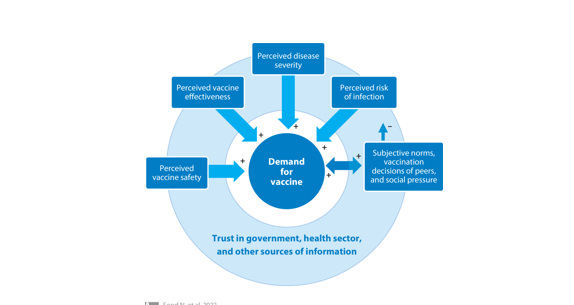
This review presents a conceptual framework, motivated by economic theory, of factors that shift the demand for vaccines. In standard economic theories, shifting of the demand curve happens whenever the good becomes more desirable at any cost, which can happen through multiple channels. The demand curve for vaccines can shift if the vaccine is perceived as more beneficial (e.g., if one's social contacts get vaccinated, which increases the social benefits of vaccination) or, alternatively, if the costs of not being vaccinated increase (e.g., if variants spread and cause more severe disease).
First, the article presents a conceptual framework (see image above) of the decision to vaccinate against an infectious disease. One consideration for an individual deciding whether to vaccinate includes how their lives would change as a result of vaccination. The perceived benefit of vaccination is an increasing function of perceived effectiveness of the vaccine, disease risk, and disease severity - subtracting all relevant costs, including considerations such as perceived side effects. This perceived net benefit of vaccination varies across individuals because they may have different sources of information. Individuals who trust or believe they have reliable information on vaccine effectiveness, vaccine safety, disease risk, and severity may be more likely to act on the information. An individual's decision to get vaccinated may also depend on the decisions made by others in the community and peer group to get vaccinated (social norms).
This conceptual framework has the following implications for public policy related to vaccines and for predicting disease dynamics:
- The relationship between disease risk and vaccinations is bidirectional and cyclical. An increase in disease risk will spur greater demand for vaccines. The greater demand for vaccines in turn will reduce future disease prevalence, which in turn would reduce the demand for vaccines.
- With conforming and nonconforming peer effects, the demand for vaccines may be unstable. For example, if initial conditions favour vaccination, then a certain fraction of the population will get vaccinated; conforming peer effects would encourage others to copy their behaviour, resulting in a high vaccination equilibrium. The reverse scenario is also possible, resulting in a low vaccination equilibrium.
- If society is in a high vaccination equilibrium, vaccine subsidies or public intervention to increase vaccination may not be required; if society is in a low vaccination equilibrium, then even small subsidies or modest public efforts to increase vaccination rates might be successful in moving vaccinations above herd immunity, as long as conforming peer effects are strong and dominate the incentives to "free ride" (benefit from others' vaccination without getting the vaccine oneself).
Next, the article offers a review of the empirical literature on key factors that shift the demand for vaccines. A major limitation of these studies is that they do not establish a causal relationship between the demand shifter and vaccine uptake. To truly measure the causal effect of a demand shifter on vaccine uptake, experimental or quasi-experimental variation is needed in the demand shifter. One of the approaches that have been used to estimate causal effects of demand shifters is pragmatic experiments, which focus on interventions that may shift the demand curve for vaccines by influencing these key factors:
- Interventions that provide information on vaccine safety, vaccine efficacy, disease risk, and disease severity - Although several educational interventions have succeeded, others have failed despite changing beliefs about the benefits of vaccination. Some studies suggest that providing detailed information on vaccine safety can reduce rather than increase vaccination rates.
- Interventions that intend to increase vaccine uptake by improving trust - In a systematic review on measuring trust, Larson et al. note that there is a paucity of interventions that examine changes in trust and how interventions that target trust affect vaccine uptake or changes in beliefs. Some studies show that, similar to the literature on educational interventions, providing detailed information on vaccine safety and risks can erode rather improve trust.
- Interventions related to norms, the decisions of peers, and social effects - As with intervention studies on trust, evidence about interventions on social norms is scant.
This review of the evidence supporting the role that different drivers play in shifting the demand for vaccinations leads to broad conclusions including:
- The literature on demand shifters uniformly supports an important role for perceived vaccine effectiveness and safety, trust in providers and the formal healthcare system, and social norms. At first glance, perceived vaccine safety and effectiveness appear to be the most important demand shifters, with the largest odds ratios and consistent associations across multiple populations (multiple countries, multiple age groups, rural and urban settings). However, the studies on the role of these demand shifters were heterogeneous, largely observational, and of varying quality.
- Studies of interventions are nuanced and identify occasionally unexpected direction of effects. Some studies that measure the targeted demand shifter find that the intervention changes the demand shifter without changing vaccine uptake or acceptance. Also, some interventions that included information about vaccine safety or tried to debunk myths about harm from vaccines seemed to lead to greater hesitancy among some groups, potentially a result of increasing the salience of vaccine risks.
The article concludes by providing directions for future research and lessons for policymakers and public health professionals:
- More interventional or quasi-experimental studies that estimate the causal effects of demand shifters on vaccine uptake would be beneficial for public health practice. Much of the existing literature identifies associations, and studies of interventions with a causal design cast some doubt on what we can learn from the associational literature.
- The areas that seem most ripe for research are interventions that harness peer effects and improve trust. There are strong theoretical groundings and studies suggesting that those effects could be influential, but there is so far little strong evidence to support those notions.
- Interventions need to be tailored to the individual or to a particular local population, as a one-size-fits-all approach may not work or may backfire.
The researchers conclude: "At a time when vaccine uptake is a central aspect of public health policy, we hope that this review provides a landscape for what is known and for highlighting which areas are important for further investigation to improve the demand for vaccination."
Annual Review of Public Health 2022. 43:541–57. https://doi.org/10.1146/annurev-publhealth-052620-093049.
- Log in to post comments