










































Sisimpur
Sismpur uses an entertaining yet educational television programme to encourage children to learn a range of cognitive, social and emotional skills related to literacy, numeracy, health, diversity, family and community, and Bangladeshi culture. Humour, music, fantasy, and daily life situations are integrated into the series. Organisers claim that content of Sisimpur was carefully researched and designed by local educators and child development experts to reach preschool children with age-appropriate content to address both academic and social issues most relevant to Bangladeshi children. In addition, the series works to develop local capacity in early childhood education, research, content development, production, and educational outreach.
Sisimpur features four Muppets specially developed for Bangladesh. The characters include: Halum, a tiger who enjoys playing and laughing, even when things go wrong; Shiku, a curious jackal who comes from a long line of clever family members, but is actually very naïve; Tuktuki, an extroverted 5-year-old girl who enjoys being helpful but is usually doing ten things at once; and Ikri Mikri, an affectionate 3-year-old who tries to do things by herself but doesn't always succeed. The Sisimpur characters are actively engaged in the learning process as they are introduced to letters, words and numbers. They also learn about the differences and similarities in various cultures.
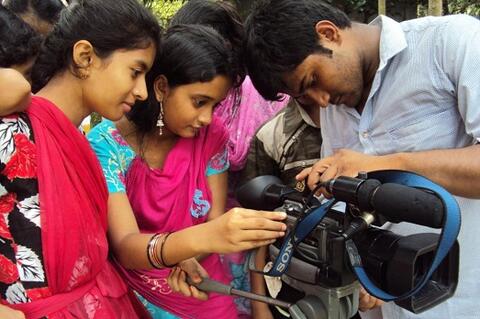
As part of a 7-month Rural Live Action Film Program, at least one episode of the series featured a film created by a young person; over 160 films were produced by students selected from regions all over the country. They began by learning how to pitch a story and moved on to studying camera angles and shot composition. When the day came to get out on location, each student called the shots as the director and camera operator for his or her film. The rest of the students worked as a team and assumed on-set responsibilities such as lighting, sound, and props manager. With the help of Sisimpur editors, the students rounded out the course by learning post-production techniques during a visit to the city of Dhaka. Some young filmmakers brought the process full circle by returning to help train the next season of students.
June 2015 update: The Sisimpur Enhancing Essential Life Skills (EELS) project (2013-2016) focuses on reading, democracy and governance, global health, climate change and earthquake preparedness, and cross-cutting themes of girls' education and gender equity. It involves 60 TV episodes and 6 TV public service announcements (PSAs). EELS also includes a classroom programme in 52 schools (grades pre-primary, 1, 2) in the geographic area of Raipura:
- Print materials: big books, charts, activity book, flash cards, story pond, posters, teacher guides, etc. designed to support teaching and learning in Bangla subject classes and "life skills" classes;
- Teacher and para-teachers trainings in reading instruction, using Sisimpur materials and activities with the government curriculum;
- Ongoing support to para-teachers and teachers through regular meetings and refresher training;
- Support and monitoring for teachers through an Interactive Voice Response (IVR) system (on mobile phones).
Click here to access the Sisimpur Wiki.
Click here to access the Sisimpur Facebook page.
Early Childhood Development, Education.
Studies suggest that Bangladeshi children who tune in to the Sisimpur TV programme are faster to pick up academic skills such as literacy and math. For instance, a 2008 Associates for Community and Population Research (ACPR) found that an overall literacy score of 4-yr.-olds with high exposure to the show was 54.8 vs. 32.9 for those with no exposure. Literacy scores of 4-year-olds who watch are reportedly 67% higher than those who don't.
Sesame Workshop and Nayantara Communications, with funding provided by the United States Agency for International Development (USAID).
Emails from June Lee to The Communication Initiative on March 14 2006 and June 29 2015; "Bangladeshi Filmmaking Program Teaches Kids to Teach us", by Kara Koch, May 31 2013; and Sesame Workshop website, accessed June 17 2015.
- Log in to post comments