











































Sixteen Days of Activism against Gender Violence

The dates that organisers chose for the campaign are meant to indicate a symbolic link between VAW and violation of human rights: November 25 marks the International Day Against Violence Against Women and December 10 is International Human Rights Day. The 16-day period also highlights other significant dates including December 1 (World AIDS Day) and December 6 (the anniversary of the Montreal Massacre, 1989, in which 14 women students at the École Polytechnique were systematically killed).
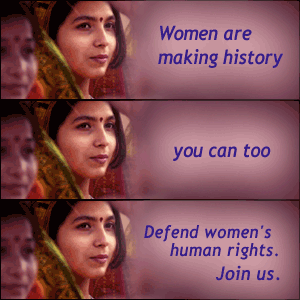
In coordinating the campaign, CWGL helps individuals and organisations plan activities that focus on developing and calling for the implementation of local, national, and global policies aimed at eliminating VAW. Resources available for campaigners include:
- an International Calendar of Campaign Activities - developed annually to highlight organising efforts as part of a broader movement for women's human rights; to provide others with examples of activities and strategies used during the Campaign; and to give activists an opportunity to join and support plans already in existence.
- an interactive website that includes resources and opportunities for global campaign organising and collaboration.
With these tools in hand, activists have engaged in the following approaches as part of campaign work:
- raising awareness about gender-based violence as a human rights issue at the local, national, regional, and international levels;
- strengthening local work around VAW;
- establishing a link between local and international work to end VAW;
- providing a forum in which organisers can develop and share new and effective strategies;
- demonstrating the solidarity of women around the world organising against VAW; and
- creating tools to pressure governments to implement promises made to eliminate VAW.
Each year, a particular theme is chosen; materials (e.g., the "take action kit") and activities are shaped around the theme. (To read about past campaign themes, please visit the 16 Days website). To cite one example, the 2009 theme is "Commit • Act • Demand: We CAN End Violence Against Women!"
Women, Rights, Health, Gender-based Violence.
In June 1993, representatives of nations and non-governmental organisations (NGOs) gathered in Vienna, Austria, for the United Nations [UN] World Conference on Human Rights. Women's human rights advocates had worked to ensure that women's rights were recognised as human rights there and that VAW was part of the discussion. The Vienna Declaration and Platform of Action, which was signed by 171 countries, was the result.
Organisers say that, while much work remains to be done, significant gains have been made since 1993 on the international level for the movement to end VAW. In that context, the 2003 campaign focused on how both the human rights framework and various international initiatives have affected the work being done to end VAW at the grassroots level. The 2004 and 2005 campaigns focused on women's health; the 2006 theme centred on 16 years of celebrating the 16 Days camapaign; in 2007, the theme was "Demanding Implementation, Challenging Obstacles: End Violence Against Women!", and the 2008 theme was"Human Rights for Women - - Human Rights for All: UDHR60 (the 60th Anniversary of the Universal Declaration of Human Rights)".
As of 2010, more than 3,400 organisations in over 164 countries have participated in the 16 Days Campaign since 1991.
The Association for Women's Rights in Development (AWID) Resource Net "Announcements" 174, August 13 2003; letter from the Center for Women's Global Leadership to The Communication Initiative on June 18 2004; posting to the AF-AIDS list server on November 8 2004; and 16 Days website on October 23 2009 and November 24 2010.
Comments

It is an excellent work on behalf of world peace and children. Given the fact my won family has been directly affected by child soldierin in Uganda, I can only agree with the producer-Andrew that no child should be employed as soldiers any where for any reason.
My own cousine sister was abducted by rebels in Uganda. I have lost other young close relatives to what we cancall child soldiering in Uganda.
Keep uo the work.
CRY Uganda,an NGO based in Uganda works with vulnerable youth/chldren which includes children who have either been rescued or escaped from rebel captivity.
Can we as CRY Uganda have a copy of the documentary?
Agula Joseph Ogoror
Programme Officer, Conflcit Resolution by Youth (CRY) Uganda.
Tel:+25677584000
POBox 11612 Kampala Uganda.
- Log in to post comments