










































Systematically Developing a Web-Based Tailored Intervention Promoting HPV-Vaccination Acceptability Among Mothers of Invited Girls Using Intervention Mapping
Netherlands Organization for Applied Scientific Research, or TNO (Pot, Paulussen, Heuvelink, van Keulen); Maastricht University (Pot, Ruiter); National Institute for Public Health and the Environment (de Melker, van Vliet)
"Too often design rationales of behavioral intervention programs are poorly described, leading to so-called 'black box' evaluations..."
This paper describes the design rationale behind an interactive Web-based tailored intervention promoting human papillomavirus (HPV) vaccination acceptability in the Netherlands. The paper encompasses all decisions that were made during the process of intervention development by using the Intervention Mapping (IM) protocol, which provides a highly structured approach in describing an intervention programme and its development.
IM is a systematic process for developing theory- and evidence-based health promotion interventions. The IM protocol describes the pathways from problem identification to solution and includes 6 steps, applied to the HPV vaccination intervention as follows:
- Needs assessment (IM Step 1): In 2008, the Dutch government decided to include the HPV vaccination of 12-year-old girls in the National Immunization Program (NIP). The existing education about HPV vaccination consists of an introduction folder and a link to a website providing generic information, which all girls are given at the age of 12. However, HPV vaccine uptake remains lower (53%) than expected (70%), indicating that education needs to be improved. A Dutch study showed that mothers play the most important role in girls' immunisation decision. Therefore, mothers were selected as the intended group for the educational intervention. In order to gain insight into determinants of mothers' HPV vaccination acceptability, the researchers conducted a longitudinal study. The results showed that intention was the main and stable predictor of HPV vaccination uptake. Intention, in turn, was best explained by attitude, behavioural beliefs, subjective norms, habit, and perceptions about the relative effectiveness of the vaccine. Furthermore, research showed that a substantial proportion of the mothers had not actively processed information about HPV vaccination (50%) and still felt ambivalent after they made their decision (25%). Hence, the secondary goal of the intervention is to improve informed decision-making, reduce decisional conflict, and positively influence determinants of HPV vaccination uptake.
- Formulation of intervention objectives (IM Step 2): The performance objectives (POs) are: (i) the mother makes a (informed) decision to have her daughter vaccinated against HPV; (ii) the mother discusses her decision with her daughter and partner; (iii) the mother guides her daughter toward receiving the first HPV injection; (iv) the mother guides her daughter toward receiving the second HPV injection. Change objectives (COs) outline the specifics of behavioural determinants to be targeted and are formed by crossing the POs with the determinants (see Table 1 in the paper for examples). This results in a matrix that can be seen as the core of the design rationale.
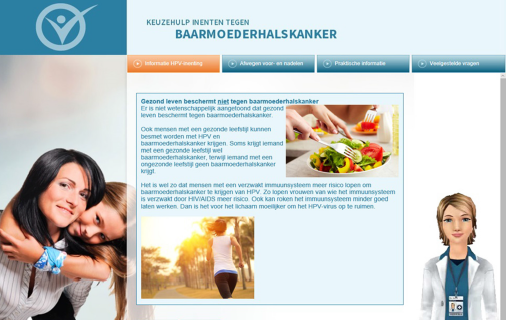
- Translation of theoretical methods into practical applications (IM Step 3): Because mothers indicated a preference for internet as the delivery mode of the information, a Web-based intervention was developed with 4 menu options: (i) 2-sided information about HPV vaccination, (ii) a decisional balance, (iii) practical information, and (iv) frequently asked questions (FAQs). Mothers could choose themselves which component in which menu they wanted to visit (i.e., freedom of choice design). However, once they entered a component, they were guided through it in "tunnel fashion". Computer tailoring was selected as the main theoretical framework for development. Tailoring is a health communication strategy by which messages are individualised to personal preferences and needs. The researchers selected virtual assistants for delivering tailored feedback. The mother-like assistant was used to guide mothers throughout the website and helped weigh their personal values in the decisional balance. As part of the effort to reduce decisional conflict through decisional balance, the mother-like assistant presented mothers with a list of pros and cons of HPV vaccination. Based on pros and cons mothers marked as most salient, a decisional balance (top right of the screen) revealed their current position on a scale ranging between not wanting (left side) and wanting (right side) to get their daughter vaccinated. The doctor-like assistant was used to deliver feedback about HPV vaccination.
- Integration into a coherent intervention (IM Step 4): This step involves detailing the experimental pre-testing (e.g., through focus groups) and pilot testing of prototypes. In order to anticipate an intervention that meets the requirements and preferences of the intended group, the researchers followed user-centred design procedures. These procedures are described in depth in the article.
- Anticipation of future implementation and adoption (IM Step 5): The researchers formed an advisory board of representatives of important linking agents (e.g., Public Health Services) and professionals involved in delivering the HPV vaccine. They organised 2 advisory board meetings.
- Generation of an evaluation plan (IM Step 6): Efficacy, effectiveness, and acceptability of the intervention were tested in a randomised controlled trial (RCT). Results from the RCT are described in detail elsewhere (see Related Summaries, below, for access to the paper), but the main finding was that the intervention showed a significant positive effect on informed decision-making, decisional conflict, and nearly all determinants of HPV vaccination uptake (P < 0.001). The main finding from the process evaluation was that mothers evaluated the intervention as highly positive.
In short, the intervention appeared effective in promoting HPV vaccination acceptability and informed decision-making, and it appeared to have potential for broad-scale dissemination and implementation. Reflecting on the process and results, the researchers explain that, not only did they tailor the content of the intervention to the mothers' personal interest, but they also used tailoring to guide the mothers' personal pathway through the intervention. The latter, they surmise, is likely to have improved the usability of the intervention. Furthermore, the intervention accounted for tailoring on a variety of determinants. For example, not only did they tailor on perceived barriers (e.g., beliefs about adverse effects) but also on other beliefs (e.g., beliefs about the daughters' sexual behaviour and age in relation to the need for the HPV vaccine), attitude, subjective norms, habit, relative effectiveness, anticipated regret, risk perception, self-efficacy, and knowledge. The use of virtual assistants in interventions promoting HPV vaccination acceptance seems promising, since results from the focus groups (IM Step 4) and the programme evaluation showed that mothers appreciated them.
The researchers believe that using IM greatly contributed to the intervention being effective. For example, according to IM, it is imperative that members of the intended group are involved in the development of the intervention. However, they indicate, currently, in many eHealth interventions, the design of the intervention is based on assumptions that are not validated with input from end-users. The present process, on the other hand, involved a user-centred design by extensively involving mothers in the intervention development from the beginning to the end. Not only did the researchers fine-tune the content of the intervention to the mothers' preferences, but the design of the website was chosen by the mothers.
According to the researchers, this paper adds to the call for systematic and detailed descriptions of design rationales in the eHealth field. Systematic descriptions may improve the quality of future systematic reviews that assess the link between design features and outcomes of an intervention. These reviews, in turn, can be used as a guide for eHealth researchers in designing future interventions with improved efficacy, reach, and user acceptability.
Frontiers in Public Health 6:226. doi: 10.3389/fpubh.2018.00226.
- Log in to post comments