










































Turkmenistan Child-Friendly School Initiative: Evaluation Report
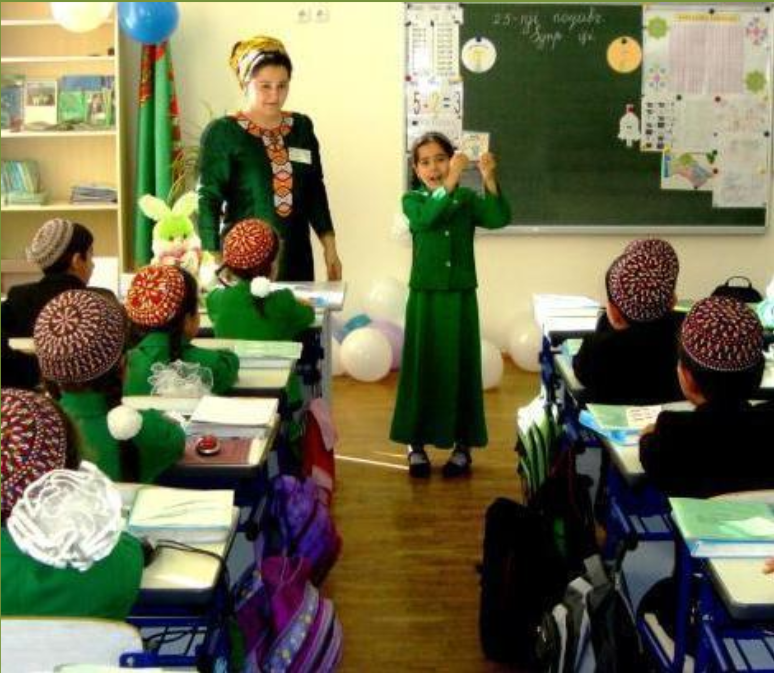
"The CFS concept is founded on the notion of 'inclusion' - and this means inclusion of every single child, no matter what their background or circumstance, in quality learning activities."
Prepared based on data collected during a field visit conducted from November to December 2013, this report evaluates a partnership between the United Nations Children's Fund (UNICEF) and the Turkmenistan Ministry of Education. The focus of this partnership since 2006 has been the introduction of the child-friendly school (CFS) concept to Turkmenistan, being a global initiative but adaptable to any context, strategically focused on the realisation of every child's right to quality education. A CFS has the following qualities: proactively inclusive and child-centred; academically effective for every child; gender-sensitive; healthy, safe, and protective; grounded in close partnership with parents and the community; and supported by strong leadership and management practices.
The report describes the collaborative process. A CFS National Working Group (NWG) was established in 2012 to take the lead role in the development of the CFS Certification Package. (Other key stakeholders included administration, teachers, students and their parents/guardians in the 26 model schools, and representatives of a wide range of public organisations and other government departments.) The revision of the Education Law in 2013 (including provisions for the extension of secondary schooling to a 12-year programme, the inclusion of children with disabilities in mainstream schools, and the establishment of public education standards to inform the education quality improvement process) presented an opportunity to take the CFS concept to the next step - hence, this evaluation of the CFS Initiative.
As detailed in the report, during Phase I (2006-2010), the CFS Initiative focused on the introduction of the CFS concept and strengthening the capacity of pilot school teachers, school heads, administrators, parents, and local communities to implement the CFS concept at the school and classroom level. Particular attention was directed to the application of child-centred teaching: learning methodologies emphasising active learner participation and respect for individual and gender differences. Specific activities included: development of CFS manual; conduct of CFS orientation courses for school administrators, teachers, school inspectors; and parents; in-service training of 800+ teachers in new teaching methods; training of CFS coordinators in 26 pilot schools; establishment of CFS Information Resources Centres; support for establishment of youth clubs and other extracurricular cultural activities; revision of Healthy Life Skills syllabus grades 1-10, with resources developed for grades 1-4; and development of CFS advocacy/awareness materials. From 2006 until the present time, development of the CFS concept has concentrated on 26 Model schools: 5 in each of 5 velayats (provinces) and 1 in Ashgabat city.
Conducted by a UNICEF-contracted consultant in partnership with the Ministry of Education, and, more specifically, the CFS National Working Group, the study involved data collection in all 5 velayats, including consultations with a wide range of stakeholders and visits to 10 schools - 2 in each velayat (one being a CFS Model School and the other a so-called "CFS Applicant"). A range of data collection strategies were used in relation to various sources - including teachers, students, parents, school administrators, and representatives of public organisations. These were complemented by school and classroom observation, including demonstrations of interactive teaching methods and presentations made by students.
An excerpt from the report follows:
"This study found the CFS Concept to be highly relevant to Turkmenistan - in terms of synchronicity with national education objectives, and in terms of meeting the needs of stakeholders. The CCFS concept is equally relevant to international human rights conventions....The CFS concept has been translated into practice, not only in the Model schools, but also in other schools who proactively took it upon themselves to become child-friendly....Of particular note are the efforts made by teachers, supported by school administration, in implementing child-centred active teaching and learning practices. Students, teachers and parents all conveyed great pride in their schools. Ultimately, the effectiveness of the CFS Initiative evidenced by the expressed readiness of the Ministry of Education to mainstream the CFS concept - together with widespread stakeholder awareness of, and commitment to, the CFS concept.
...The schools visited were seen to be successfully implementing a wide range of inclusive practices. However, this is the area where there continues to be a critical gap - and that relates to the inclusion of children with disabilities, who remain outside mainstream education. The address of this issue requires prioritization. With regard to gender, on the whole, schools appeared to have close to parity in terms of male and female enrolments, and boys and girls appear to have equal access to the range of school curricular and extra-curricular activities. Particular care is required to ensure curriculum and textbook content, and attitudes of parents and teachers, do not continue to pigeon-hole girls in traditional domestic roles.
While the CFS concept has focused on 26 schools to date, the intention was to extent the concept to every school in the country, so every child in Turkmenistan has the same access to quality education. With reports of widespread disparity in the distribution of education resources, it will be important to ensure even the most remote school receives the same range of quality education inputs as a school in the centre of Ashgabat.
The...UNICEF Turkmenistan education program would benefit from the development of a comprehensive result framework, articulating the range of actions required from the development of the standards to their realisation in schools. This analysis will enable the identification of any critical gaps...[such as]...school improvement planning, plan implementation, and the associated school-level capacity building required to achieve CFS standards...
[S]ustainability depends on local ownership of, valuing and eventually institutionalizing, the CFS concept. UNICEF processes have been effective in this regard. Stakeholders emphasized that the CFS initiative is not functioning as a separate project but is integrated within the routine operation of schools. The Ministry of Education has indicated that mainstreaming the CFS concept is now part of the national vision for developing education - 'by 2016, we want all schools to be child-friendly'.
...A multi-dimensional approach will be required. On the one hand there is need to address any institutional gaps (in terms of legislation, guidelines, resources, methodologies, other) that might constrain the realization of the CFS vision. On the other hand, there is need to a) develop a sound approach to rolling the CFS concept out to all schools and b) to build the capacity of local-level stakeholders to achieve the quality standards being established."
UNICEF Evaluation Database, accessed December 11 2014.
- Log in to post comments