










































Learning to Discern in the Era of Disinformation
Summary
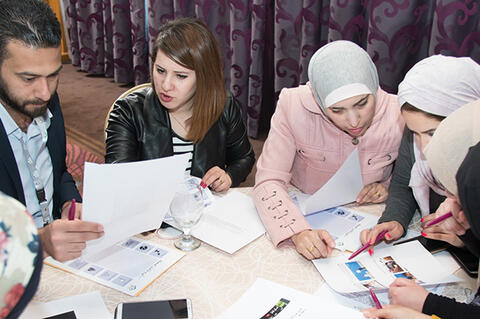
In 2015, I together with my team I designed and managed the innovative Learn to Discern project, a citizen media literacy initiative that reached over 15,000 Ukrainians, which has since been replicated in over dozen countries. IREXs Learn to Discern approach helps people of all ages develop healthy habits for engaging with information, online and offline. Unlike traditional media literacy approaches, Learn to Discern responds to the current needs of media consumers. It was designed for a polarized, hyperconnected, and impatient world. Learn to Discern (L2D) has been used around the world in classrooms, libraries, community centers, fellowship programs, peer-to-peer networks, and other contexts. Impact studies have shown that the approach is effective with a diverse range of participantsfrom adult populations to kids in classrooms. L2D has been featured in the New York Times, Washington Post, Christian Science Monitor, CNN, Columbia Journalism Review, Journal of Media Literacy Education, NPR, Slate, and other media outlets. In this Comm Talk I would like to share the journey of developing Learn to Discern approach, its evolution since 2015 and what challenges lay ahead for media and information literacy efforts.
Background/Objectives
Since late 2013, a sharp increase in Kremlin disinformation and propaganda has threatened to upend democratic progress and political stability in Ukraine. The strategy of hybrid warfare deployed messaging across Ukraine to stir up fear, confusion, play on national identities, and patriotic feelings. Ukraine has also been at the forefront of finding effective and innovative solutions to the problem and the objective of the Comm Talk is to share one of these examples and lessons learned with the wider audience.
Description Of The Big Idea/experience/innovation And Its Importance To The SBCC Field:
In 2015-2016 IREX implemented Learn to Discern project in Ukraine. Through intense skill-building seminars, L2D reached more than 15,000 people of all ages and professional backgrounds. Remarkably, L2D also reached more than 90,000 people indirectly: direct participants shared what they learned with family, coworkers, and peers. In 2017, IREX evaluated the long-term impact of the L2D training by assessing news media literacy skills using a stratified random sample of L2D participants and comparing the results to a control group.The results of the impact evaluation showed that L2D participants had statistically significant higher levels of disinformation news analysis skills, greater knowledge of the news media environment, and a stronger sense of agency over the media sources they consume. They were also more likely to consult a wider range of news sources.These effects persisted even 1.5 years after participants completed the program. This demonstrates that L2D is an especially effective approach, as prior studies have shown the effects of other media literacy programs wane after one year. The findings of the L2D impact study make a unique contribution to the media and information literacy research literature.
Discussion/Implications For The Field
Today the amount of information we receive and channels through which we receive it alone requires us all to obtain new skills in order to make sense of it all. What makes this even more challenging is that some of this information is deliberately manipulated in order to stir up fear, amplify divisiveness and create confusion. Problem of dis - and mis-information and manipulation is a growing problem and with unethical usage of AI and deepfakes would become even more complex to detect while making it cheaper to produce. We need resilience and effective and efficient solutions.
Abstract submitted by:
Myahriban Druckman - IREX
Approved abstract for the postponed 2020 SBCC Summit in Marrakech, Morocco. Provided by the International Steering Committee for the Summit. Image credit: IREX website