










































Understanding Key Terms and Data Related to HIV: Handbook for Adolescents and Young Key Populations at Higher Risk of HIV Exposure in Asia and the Pacific
"There are a lot of data about HIV and AIDS. How much of it do you really understand? Have you ever read a document, watched a presentation or talked with your friends about HIV data and not understood the meaning of certain terms?"
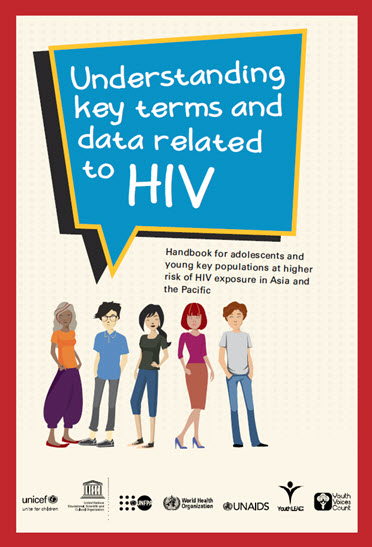
Designed as a comic book for young people between 15 and 24 years of age who are interested in HIV issues and have some basic math skills, this handbook aims to help simplify key questions about HIV terms, data, and statistics. Adolescent and young peer educators, young advocates, and young people involved in HIV programming for young people, including those from key populations at higher risk of HIV exposure, may find it a useful tool in their advocacy work with community and government leaders. "It can help you influence the decision-making process and programming for you and your peers. It can also help you to explain data to your peers so that they can be better advocates and leaders." The handbook was produced by the United Nations Children's Fund (UNICEF) East Asia and Pacific Regional Office (EAPRO) in partnership with the United Nations Educational, Scientific and Cultural Organization (UNESCO), the United Nations Population Fund (UNFPA), World Health Organization (WHO), the Joint United Nations Programme on HIV/AIDS (UNAIDS), Youth LEAD, and Youth Voices Count.
The comic book takes the reader through the experiences of Lucia (a 17-year-old who lives on the streets) and Aran (a 15-year-old who is a transgender person and lives with HIV), who have been chosen as youth representatives to speak at a community meeting about HIV. Both Lucia and Aran are excited to represent their peers but are uncomfortable, since they are unfamiliar with statistics and data. They have asked Tran, an 18-year-old outreach worker, to help them. Two other friends, Bindu (a 22-year-old who uses drugs) and John (a 19-year-old who works at the men who have sex with men (MSM) action centre), decide to join them as well.
There are 4 key sections: (i) defining and using key terms about data; (ii) reading tables and graphs; (iii) producing graphs for information sharing and advocacy; and (iv) questioning data. At the end of the handbook, readers will find quizzes to help test their learning, as well as definitions for terms used throughout the handbook.
Publishers indicate that the handbook can be translated and used widely in both Asia-Pacific and other regions.
Publishers
36
Asia Pacific Inter Agency Task Tram on Young Key Populations website, November 7 2016.
- Log in to post comments