










































Use of Rapid Diagnostic Tests to Improve Malaria Treatment in the Community in Uganda
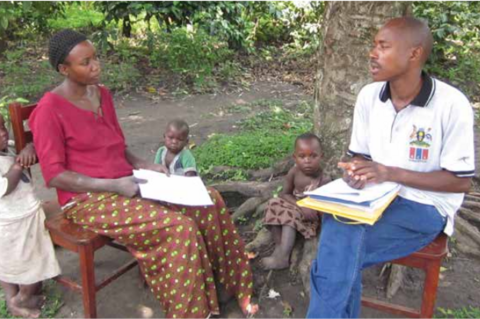
Based on the belief that community health workers can help patients in remote locations access prompt treatment for malaria, including artemisinin-based combination therapy (ACT), in this study in Uganda, community health workers (CHWs) - specifically, community medicine distributors (CMDs) - received training to use malaria rapid diagnostic tests (RDTs), how to prescribe ACTs to treat malaria, how to recognise signs of other infections in children, and when to refer patients. Offered by the ACT Consortium in partnership with the Ministry of Health, Uganda, as part of a research project, the training aimed to improve the clinical and diagnostic skills of CHWs, as well as communication with patients.
Two cluster-randomised trials were held in 2 contrasting areas of high and low malaria transmission in South West Uganda. In each trial, 96 CHWs received training to diagnose malaria using RDTs; they were compared them with 96 CHWs trained to diagnose malaria using signs and symptoms only. The approach was community-directed; village meetings were held to engage communities in selecting the CHWs to be trained, to help community members understand that many illnesses cause fever, and to provide information about RDTs.
The training was based on adult learning principles and used small group interactive processes, based around role play and the use of a series of materials available for download here to simulate communication with the patient/caregiver and reaching a treatment decision. The participatory training workshops (3-4 days) explored the rationale for the change to diagnostic testing for malaria, how to perform and interpret an RDT (a 1-day training based on a World Health Organization (WHO) manual (for CMDs in the RDT arm only), clinical management and referral guidelines, and communication skills to support the CMD to broker change with community/manage expectations. Trainees received a training certificate with a Ministry of Health logo, pictorial job aids for reference, supplies (e.g., bicycles), and close support supervision for the first 6 months after training. The community was involved in endorsement of CMD training; a training certificate was delivered during a graduation day held in the presence of local community leaders.
Malaria
According to the ACT Consortium, there is currently a significant over-use of antimalarial drugs. This happens because many cases of fever are immediately treated as malaria even without a blood test or laboratory confirmation. Since ACT drugs are generally more expensive than regular drugs, it is important that their use is restricted to people who are formally diagnosed with a blood test. This can be done by using RDTs, which don't require electricity or qualified health staff.
The study found that trained community health workers can use RDTs and comply with results, and that caretakers are willing for their child to be tested by CHWs before receiving treatment. The results showed:
- Over 85% of CHWs in both transmission sites complied with the results of the RDTs, reducing overprescription of ACTs.
- Fewer children treated by CHWs who used RDTs received an ACT compared to children treated by those using symptom-based diagnosis: 37% vs 99% in the high transmission area, reducing the number of ACTs used by over 60%. In the low transmission area, the number of ACTs used was reduced by 90%.
- ACTs were more accurately targeted where CHWs used RDTs, compared to where they made a diagnosis based on symptoms alone: 79% vs 31% of ACTs given were appropriate for patients' malaria infection status in the high transmission sites, and 90% vs 8% in the low transmission sites (both p<0.001).
- Treatments were missed in 11% of children seen by CHWs using RDTs in the high transmission area: They did not receive an ACT but microscopy showed that the children did have malaria. In the low transmission area, the rate of missed treatments was 4%. Many of these child had fewer than 200 parasites per microlitre of blood - the acknowledged limit of detection for most RDTs.
- CHWs using RDTs also referred more children to health facilities, but less than 15% of the children referred were actually taken to a health facility. "Factors which hinder parents from taking appropriate action when a child is referred to a health facility could be a challenge for the effective management of childhood illness, and warrant further study."
ACT Consortium and Ministry of Health, Uganda. The ACT Consortium is funded through a grant from the Bill & Melinda Gates Foundation to the London School of Hygiene & Tropical Medicine.
Email from Debora Miranda to The Communication Initiative on April 14 2016; and ACT Consortium website, April 15 2016. Image credit: ACT Consortium
- Log in to post comments