











































What makes for good gender- and intersectionality-responsive IEC materials?
Author: Ranjani K. Murthy, August 13 2024 - I was recently asked to review information, education, and communication (IEC) materials for marginalised people through a gender and intersectionality lens. I reviewed posters, videos, and audio materials. Through this process, several insights emerged on what makes gender- and intersectionality-transformative IEC, some of which are explored below.
The first insight is that the audio/video should be short, as marginalised women combine their care work and their productive work. In Bihar, India, a film that was telecast was one hour and 15 minutes in length. Though women were motivated enough to attend, half left in the middle, as they had other tasks to do.
Second, IEC material and how it should be used should be explained to the change agent using it, and it should be monitored. In one Indian state, it was noted that IEC material was hidden behind an office cupboard, while the image of a god was prominently displayed. Further, use of IEC materials may need to be monitored. It is useful if printed IEC materials are visual in countries with low literacy levels, with some simple sentences that can be read by neo-literates.
Ideally, the instructor/communicator would include a woman from a marginalised community, such as Indigenous women and Dalits, to communicate the message. The National Rural Health Mission in India included 3 jingles on a maternity benefit scheme. In one, a young child informs his or her mother; in the second, a postman informs a woman; and in the third, a woman and man discuss and communicate the scheme. The third perhaps is least patronising and could be used to reach men, too (IEC Materials: National Health Mission). It is important that local dialects are used too, as the same language may be spoken in different ways.
While some governments, like India's, have decriminalised same-sex relations and have enacted legislation to protect transgender persons, most messages see gender as binary. IEC through maternity vans address pregnancy of cis women; pregnancy of trans men or lesbians through assisted reproductive technology is not covered.
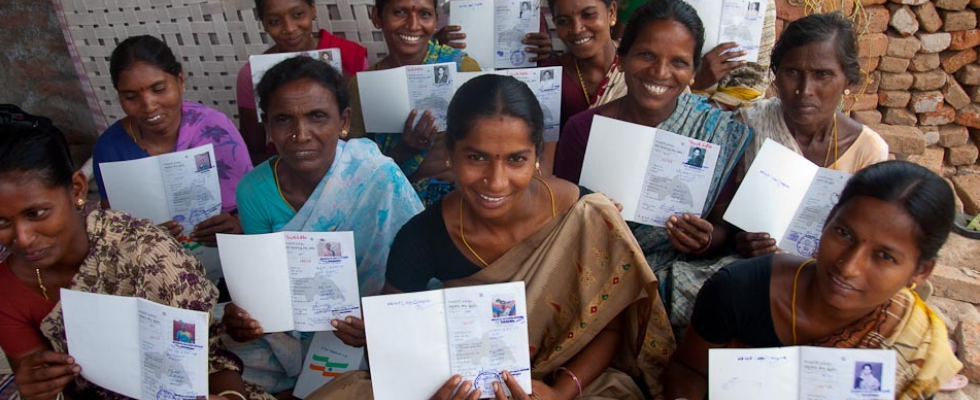
Another lesson is to communicate IEC messages "away from habitat spaces". Schemes of the government like Mahatam Gandhi National Rural Employment Guarantee scheme bring together 10-20 women at work sites. This setup offers a private space for communicating legislation and services on gender- based violence, gender equality and labour laws, non (intersectional) discrimination against Dalits and tribals, etc. In such settings, it important to promote content that is gender and socially transformative, like showing single women with joint/sole title deeds to land. In Orissa, 2,000 single women received land title deeds with their names from the government.
IEC should address both practical gender needs of women and usher in gender/socially transformative change!
Image credit: Deborah Espinosa, Property Landesa (CC BY-SA 3.0)
As with all the blogs posted on our website, the content above does not imply the endorsement of The CI or its Partners and is from the perspective of the writer alone. We do not check facts and strive to retain the writer's voice, as is detailed in our Editorial Policy.
- Log in to post comments