











































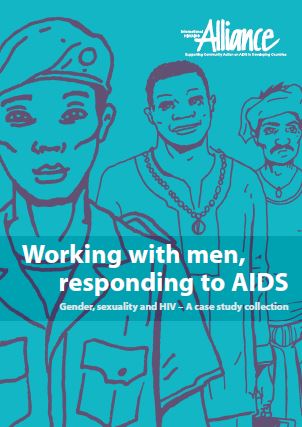
Working with Men, Responding to AIDS
Image
Subtitle
Gender, Sexuality and HIV - A Case Study Collection
SummaryText
The International HIV/AIDS Alliance has produced this collection of thirteen case studies in an effort to help education and prevention programmes conduct work with men on HIV/AIDS issues. It presents experiences and lessons from a range of different projects (some supported by the Alliance and some not) that are working with men. By showcasing experiences and lessons from the field in the form of case studies, this collection hopes to offer inspiration, ideas, and models for working with men in different cultural environments.
The case studies describe not only HIV/AIDS projects that are working with men, but also other kinds of projects that address other issues and problems relating to men (for example, gender identity, sexuality, violence). The aim of including this range of case studies is to show that:
According to the publication, in most cases, there were little or no evaluation data available on the projects. "This collection, therefore, does not attempt to define best practice in relation to the work of these projects. Instead, the emphasis is on drawing lessons from such work that will stimulate thinking on different ways of working with men."
The case studies come from projects located in Bangladesh, Belarus, Botswana, Bulgaria, India, Mongolia, Morocco, Pakistan, South Africa, and Zambia.
The case studies describe not only HIV/AIDS projects that are working with men, but also other kinds of projects that address other issues and problems relating to men (for example, gender identity, sexuality, violence). The aim of including this range of case studies is to show that:
- HIV/AIDS is connected to many other issues in the lives of men, and it is possible to have an impact on the epidemic by working with men on these related issues.
- Different kinds of men face many different needs and problems - "in order to do effective HIV/AIDS work with such men, it will often be necessary to work on these needs and problems as well".
- HIV/AIDS projects that are currently working with men, or interested in working with men, can learn from the experiences of projects that have successfully worked with men on other issues and problems.
According to the publication, in most cases, there were little or no evaluation data available on the projects. "This collection, therefore, does not attempt to define best practice in relation to the work of these projects. Instead, the emphasis is on drawing lessons from such work that will stimulate thinking on different ways of working with men."
The case studies come from projects located in Bangladesh, Belarus, Botswana, Bulgaria, India, Mongolia, Morocco, Pakistan, South Africa, and Zambia.
Publishers
Publication Date
Number of Pages
68
Source
Posting to the Gender-AIDS listserv, November 17 2003, and AIDSPortal website, April 29 2010, and email from Kate Gerrard to The Communication Initiative on May 4 2010.
- Log in to post comments