










































World's Largest Lesson
"If every school in the world teaches children about these goals, we will help them become the generation that changed the world."
Through its various entertaining yet educational resources and activities, this collaborative education project is designed to support the September 25 2015 announcement of the United Nations (UN)'s Global Goals for Sustainable Development. The 2030 Agenda for Sustainable Development includes a set of 17 Sustainable Development Goals (SDGs) to end poverty, fight inequality and injustice, and tackle climate change by 2030. Though the idea of the World's Largest Lesson is that schools around the world would teach a lesson about the Goals during the week commencing September 27 2015 using the resources available on the World's Largest Lesson website, educators are encouraged to teach a lesson about the SDGs whenever possible.
The project resources, which can be amended to suit any teaching/learning style and school setting, have been produced for children aged 8-14 years but can be developed to suit any age group. Available in 10 languages, they include:
- A 6-minute film (see below or click here to access the sign language version) that uses animation to establish a context for the Goals, explain the role of the UN, and ask children to think about how they can help contribute to the success of the Goals. Developed through a collaboration between animators Aardman and creative educator Ken Robinson, "[i]t suggests that as human beings we all the most creative creatures that live on the earth and that we all have the power to make change." This film could be used as part of an assembly, class, or lesson in conjunct with the introductory lesson plans (see below). As of October 2015, it had been used in 160 countries.
- A 6-page comic book, "Heroes for Change", which introduces the Goals and invites children to become superheroes themselves by taking action to end poverty, inequality, and climate change. "Comics are effective teaching tools because they require readers to not only passively receive information, but also interact with the text and images to construct meaning, and that is the key to the magic. Words and pictures work together!" One idea for teachers: "You can use the comic as the lesson itself, by printing and sharing it or displaying it at the front of the class, and reading through it together. You can stop to check for understanding, ask questions or start a discussion about the images and text that you think are most relevant to the children you are teaching."
- A searchable page of information and teaching resources for each of the Goals. "Here you will find a wealth of background information on all of the Global Goals, together with teaching tips, classroom activity ideas and links to lesson plans, film clips and teaching packs."
- Lesson plans and downloadable materials for teachers.
- An 8-page teacher's guide that explains how to use the various World's Largest Lesson resources in the classroom and provides suggestions to offer to students about how to take action and engage in advocacy around the Goals, such as by joining existing youth organisations and networks working to hold governments to account.
- The World We Want! A Guide to the Global Goals for Children and Young People, a 32-page guide designed to help children explore the goals in more detail. Written by and for children and young people across the world, it features clear descriptions of each Goal, accompanied by stories, comics, games like crossword puzzles, and questions for students to inspire them to take action.
- A campaign toolkit, which includes all that is needed to participate in the World's Largest Lesson, taking place the week of September 27 2015 but relevant at any time. Offered here are brand logos, a communication toolkit (includes e-marketing and social media materials), educator tools wuch as posters and templates), and an image library.
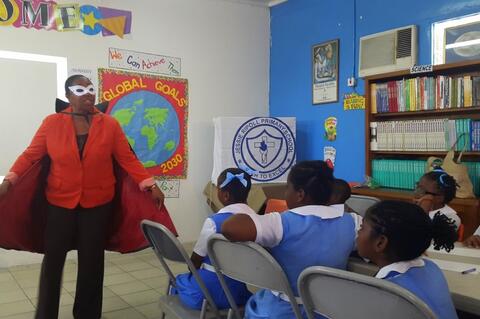
- Activities in schools around the world as illustrated via photos, videos, and descriptions on the World's Largest Lesson Facebook page. For example, the Jamaican Ministry of Education developed an advert to create awareness about the project across the country. It places the Goals in the context of Jamaica's most pressing problems, all set to a superhero-worthy soundtrack, and was broadcast on local television. The winner of the project's lesson-plan competition, a teacher in New Zealand created a video featuring shots of drawings and debates swinging across the screen with her student protagonists declaring: "We will lead the World to make a difference. The future is now. Dear World, we are ready." As can be seen on the Facebook page, individual students, classes, and whole schools wrote heartwarming and humorous songs about the Goals. For instance, in a School Hall in Brunei, the lesson took place to the tune of Michael Jackson's "Heal the World", and in the pews of St. Stithian's school chapel in South Africa, as a choir of students sang their original composition on the Goals. Community action is also part of the lesson: In Buenos Aires, Escuela Técnica 12 took a tour of their neighbourhood, collecting rubbish with which they then constructed life-size Global Goals superheroes.
Poverty, Rights, Environment, Children, Youth
One of the project partners, Project Everyone, states that 500 million children have been reached with the World's Largest Lesson thanks to commitments from Ministries of Education in 103 countries.
In this video from the Ecuadorian ministry of education, students are asked what they took away from the World's Largest Lesson. The answer: "Sí, yo puedo ser parte de la solución" - the conviction that "I can be part of the solution".
According to organisers, World's Largest Lesson is living proof of the importance of Global Goal 17 "Partnerships for the Goals" and would not have been possible without the collaboration the United Nations Children's Fund (UNICEF), Project Everyone, TES Global Education International (EI), and all of the partners, which are listed here.
World's Largest Lesson website, January 5 2016; and Bringing the World's Largest Lesson to Life in Film!", by Eloïse Haylor, October 15 2015.
- Log in to post comments