










































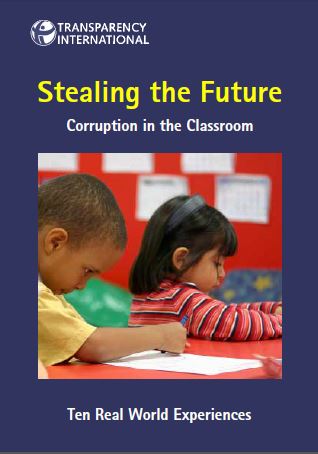
Stealing the Future: Corruption in the Classroom
Image
SummaryText
This booklet by Transparency International (TI) addresses corruption in the education sector. It cites the need for instruments to curb corrupt practices to ensure that funds allocated are contributing to achieving goals in the current context of decentralisation, privatisation, globalisation, and diversification of educational services.
The organisation's approach to analysing situations and instruments for achieving transparency is the presentation of 10 studies carried out by TI Chapters in 2004 and 2005 in Argentina, Bosnia and Herzegovina, Brazil, Georgia, Mexico, Nepal, Nicaragua, Niger, Sierra Leone, and Zambia. The studies assess the forms and extent of corruption at schools, in universities, and in education administration, providing examples of how civil society can help curb corrupt practices in education.
The studies cover university-level corruption, such as: nepotism and bribery, irregularities in final examinations, and corruption in gaining access to scholarships, transfers, study abroad opportunities, exam success, and professional positions and promotions. In the private sector, the booklet discusses textbook procurement and monitoring of construction contracts and maintenance procurement. On the topic of funds, it covers misuse of federal funding at the municipal level and misuse of donor-generated funding by non-governmental organisations working on child labour issues.
For each issue of corruption, the booklet describes how TI Chapters in each location worked to develop instruments to respond. These include: agreements, stakeholder monitoring organisations, monitored certifications of suppliers, parent/community involvement, internal audits, laboratory testing, standardised selection criteria, increased supervision, awareness raising, and exam monitoring, among others.
The following are some conclusions from the case studies:
The organisation's approach to analysing situations and instruments for achieving transparency is the presentation of 10 studies carried out by TI Chapters in 2004 and 2005 in Argentina, Bosnia and Herzegovina, Brazil, Georgia, Mexico, Nepal, Nicaragua, Niger, Sierra Leone, and Zambia. The studies assess the forms and extent of corruption at schools, in universities, and in education administration, providing examples of how civil society can help curb corrupt practices in education.
The studies cover university-level corruption, such as: nepotism and bribery, irregularities in final examinations, and corruption in gaining access to scholarships, transfers, study abroad opportunities, exam success, and professional positions and promotions. In the private sector, the booklet discusses textbook procurement and monitoring of construction contracts and maintenance procurement. On the topic of funds, it covers misuse of federal funding at the municipal level and misuse of donor-generated funding by non-governmental organisations working on child labour issues.
For each issue of corruption, the booklet describes how TI Chapters in each location worked to develop instruments to respond. These include: agreements, stakeholder monitoring organisations, monitored certifications of suppliers, parent/community involvement, internal audits, laboratory testing, standardised selection criteria, increased supervision, awareness raising, and exam monitoring, among others.
The following are some conclusions from the case studies:
- Teachers play a crucial role, which is negatively affected by salary problems.
- Community participation increases ownership and adds valuable stakeholder management.
- Awareness of existing legislation and enforcement of visible sanctions can be effective.
- Impartial monitoring can benefit students, professors, administrators, contractors, and civil society as a whole with the concept of a level playing field.
Publishers
Publication Date
Number of Pages
88
Source
Email to The Communication Initiative from Bettina Meier on January 16 2007 and the Transparency International website, accessed on January 16 2007 and October 23 2008.
- Log in to post comments