










































Our Valuable Voices: Community Digital Storytelling for Good Programming and Policy Engagement
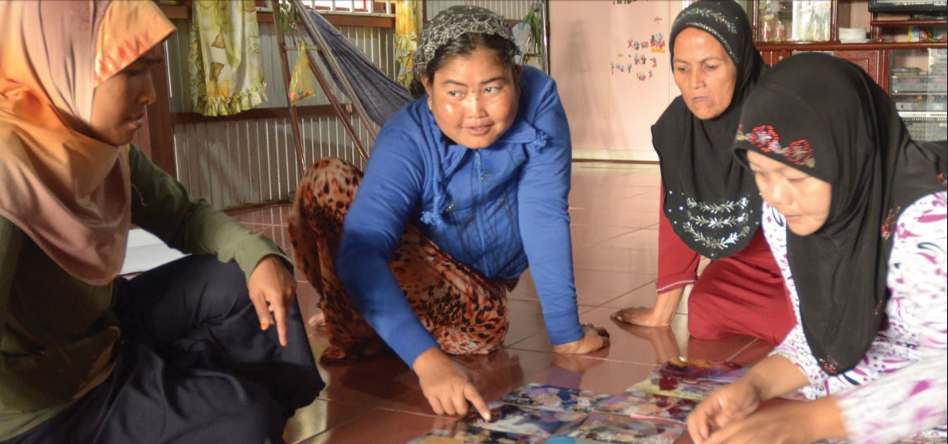
"CARE believes that a vibrant, diverse society becomes stronger when everyone can equally contribute their voice to decisions that impact them."
This document describes a participatory development approach CARE is using - Community Digital Storytelling (CDST) - in an effort to enable people (especially those living in poverty) to gain knowledge, build their confidence, and share their concerns with others who can address them. Through CDST, community members collectively create and share stories in their own language using audio, photos, and music. The resulting photo-videos are often 3-5 minutes long and in the local language. CARE has used CDST in Vietnam, Kenya, Mozambique, Ghana, and Niger - primarily with communities affected by disasters and a changing climate. This has included fisherwomen and men living in the Mekong Delta, rural farming communities in West Africa and pastoralists in East Africa. This particular report focuses on how CARE in Vietnam integrated CDST into the Integrated Community-based Adaptation in the Mekong (ICAM) project funded by the Australian Department of Foreign Affairs and Trade. "People living in poverty or vulnerable situations struggle to have their voices heard. These people may not speak the official language. They may be restricted by gender, social or cultural norms, or affected by stigma. They may have restricted access to local, regional or international policymaking spaces. They may lack the confidence to raise their voice with more influential people in society. Or they may be so busy making a living that they cannot attend community discussions." The idea is that the storytelling process makes it possible to show how climate change impacts people's daily lives and what they already do to deal with these changes. Hopefully, in this way the stories can add to a wider conversation about how development programming and government policies can more effectively help different vulnerable groups adapt to a changing climate.
According to CARE in Vietnam, these stories are driven by the community members themselves, who develop the content and decide what photos best represent the narratives they want to tell. In many cases, local participants take their own photos for their stories. Several case studies are included in the report to illustrate the process. For example, in An Giang province, Vietnam, CARE in Vietnam worked with landless and land-poor fisherwomen and fishermen in sex-separated groups to tell their stories about how they are affected by climate change. To develop their stories, participants first took photos of who they are as fisherwomen and men and how they are adapting to climate change. With the CDST facilitators, they then sorted through printed photos to build a visual timeline of their story. Next, they took more photos illustrating the impacts of flooding and their hopes and visions for addressing those impacts. After further discussions, they took any final photos that they thought were missing. They then wrote a script and narrated it in their own language. "While the stories addressed similar issues, they reflected the different experiences and perspectives of women and men. For example, the women's photo-video focused more on children's education and health and the men's photo-video focused more on livelihoods and infrastructure. Such knowledge from two different perspectives helps CARE in Vietnam, its government partners and community members develop more inclusive climate change adaptation strategies. Separating women and men specifically brought out issues valuable for not only CARE in Vietnam staff, but also the fisherwomen and men themselves. For example, when watching the women's photo-video, the men said they more fully realised how much support their wives provide on a daily basis and in times of disaster. Such recognition can strengthen family relationships, increase women's status in their families and build confidence for the women to speak more freely in community meetings about their concerns....When watching their final stories, the Cham [descendants of refugees from the ancient kingdom of Champa] fisherwomen and men expressed how proud they were in being able to express and share their culture, religion, climate change adaptation solutions and needs. They were especially happy to have photo-videos in their own language that show the reality of how they live."
The report explains the benefits and process of CDST in detail. For instance, it describes the importance of being aware of how local power dynamics affect who participates ("...it is important to be mindful that some people might be obvious experts on a subject, but others might have valuable knowledge that is not recognised.") Three stages of CDST are outlined, including:
- Preparing the story - this involves: (i) facilitation training and (ii) activity introduction, which uses "mind mapping", a participatory technique that starts by a person drawing a circle in the middle with the overall topic. Participants unpack the elements of this topic by adding more circles in different sizes and shapes. People can also use letters, symbols, pictures, arrows, etc. to show the linkage or relationship between different issues.
- Developing the story - this involves:
- Story Visualisation: Community members take photos of their lives to visually explain the story they want to tell. The CDST facilitation team prints the photos. The community group reflects on and discusses their photos to develop their story. This is done through multiple sessions so that people have time to personally and collectively reflect on the topic, take additional photos, and determine what images best represent their story publicly. Throughout this stage, discussions occur about whom the photo-video is designed to reach and what the purpose is of making it.
- Story Creation: Community members build a storyboard using the final photos and then collectively develop a script to determine what will be said when the photos are edited into the photo-video. They decide who will work with the facilitation team to record the narration and then do so in their local language. The community members perform their own music or work with the facilitators to find locally appropriate music and obtain copyright permission for its use.
- Story Production: Guided by the community photo-based storyboard and narration, the CDST facilitators and/or local community members edit the photos, narration, and music into a final photo-video and add subtitles as needed.
- Sharing the story: After community members review the produced video and any needed changes are made for another round of reviews, a strategy is finalised for screening the photo-videos as appropriate for the context and in line with community agreements (from local to national to international screenings). Next, the photo-videos are used to create discussion spaces for policy engagement between community members and those who can best respond to concerns raised in the stories. This might include one-on-one meetings or larger photo-video screenings and dialogue sessions with: the local community; media; local or national organisations and policymakers; and/or other key decision-makers at national, regional, and global levels. "Community members should be involved in determining who will see the photo-videos and be part of the resulting discussions where possible as this can deepen their confidence and capacity for engaging with and influencing decisions that affect them."
Several suggestions and lessons learned when using CDST are included. For example, CARE stresses that it is important to understand and mitigate risk in varying social and political contexts. "Photography can further marginalise people if the photos or final photo-videos are used against them later as evidence, such as in cases of gender-based violence or human rights abuses. Thus, organisations need to assess risks through discussions with participants and community leaders to ensure people are aware of and willing to participate....In some situations, it may be especially risky to discuss and publicise sensitive issues with vulnerable groups, such as children or sex workers."
In the case of the ICAM project, described above, CARE in Vietnam found that, because collaborative storytelling and filmmaking is a relatively new approach in Vietnam, the potential and value of the CDST process was not always easy for government partners to fully comprehend. So, while CARE in Vietnam says that the storytelling process did generate dialogue with decision-makers on the issues raised, the final Cham fisherwomen and fishermen CDST photo-videos were not approved by the government for public screenings. "This highlights the importance in ensuring that all government partners are fully aware and supportive of the storytelling activity before it begins. Doing so assures that the government partners internalise all CDST values, see the potential benefits of hearing the stories, and increases the likelihood that the concerns of some of the most vulnerable populations in Vietnam have a stronger chance of being listened to for better programming and policy."
The report concludes with a synopsis of these learnings in the form of six questions that practitioners can ask when implementing CDST to ensure the activity is consistent with their organisation's values. Following each question are insights into good practice and recommendations for the future. For example: "Are we ensuring INFORMED CONSENT and copyright permissions? GOOD PRACTICE: Participants in the Mekong Delta activity made sure that people photographed understood how the photos were being used and provided informed consent. Consent forms were verbally translated in the local language, which were read to participants who could not read. Children's parents were asked as well for their permission."
Emails from Tamara Plush to The Communication Initiative on July 1 2015, July 18 2015, July 26 2015, and August 9 2015; and "Vietnam: Breaking down language and cultural barriers", by Camilla Krabbe Sørensen, June 2 2015, Southern Voices on Climate Change website, accessed July 24 2015. Image caption/credit: "Ay Sah, Cha Wa Ri Giah, Mây Sâm and Sa Mi Roh decide which photos they want to use in telling their story about climate change impacts in their community in An Giang province in the Mekong Delta." CARE in Vietnam
- Log in to post comments