










































Nepal Terrace Farmers and Sustainable Agriculture Kits (SAKs)
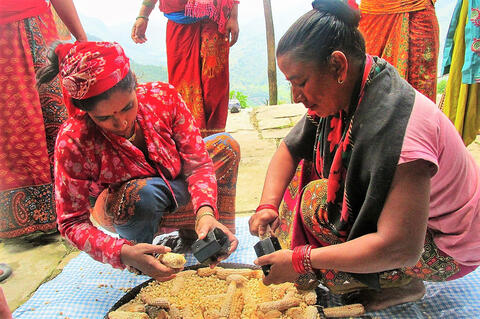
This research-based initiative aims to improve the livelihoods of farmers working on the hillsides and terraced plots of land in central Nepal. Its focus is on improving agronomic practices and outcomes with simple, low-cost tools and affordable seeds. The project emerges from a private-public partnership model for sustainable development, led by Local Initiatives for Biodiversity, Research and Development (LI-BIRD) in Nepal and the University of Guelph in Canada.
Although enough knowledge exists on how to improve productivity at the farm level with seeds, inexpensive tools from the private sector, and indigenous practices, these innovations are not being fully taken advantage of or shared with the farmers who need them most. What is lacking is a means to package, deliver, and share these technologies to farmers who earn only US$1-US$2 per day.
The research partners are finding that the sustainable agriculture kits (SAKs) they have pioneered can improve agricultural productivity, reduce farmer drudgery, and contribute to environmental sustainability - all while reducing institutional reliance and empowering more subsistence farmers and rural entrepreneurs, especially illiterate women. As the project enters its final stages, the emphasis is on proving that the concept can scale up (as of August 2017, it was being used in nine districts in central Nepal), be successfully handed off to LI-BIRD's private-sector seed subsidiary Anamolbiu (which means "precious seed" in Nepalese), and be self-sustaining. It is estimated that by the time the project ends in January 2018, it will have reached approximately 200,000 people in 40,000 households.
The SAK concept is based on examining history. For example, agriculture became successful in the United States in the early to mid-1900s because of a combination of public and private initiatives. This involved publicly-funded agricultural extension services for farmers that promoted sound agronomic practices coupled with improved seeds and technologies from the private sector. SAK seeds and tools are an attempt to make technologies available to economically poor people at the correct economy of scale, along with private-sector know-how and innovation. The SAK Picture Books are an attempt to complement the function of extension officers in reaching farmers in the most isolated places.
Like a restaurant menu, SAKs are intended to be regional menus of private sector technologies and agro-ecological practices that are locally relevant (there is no universal SAK because there is no universal agricultural system, cultural preference, soil type, or climate). Individual farmers can purchase one or more items at a cost of US$1 (ideally) to assemble a SAK that is appropriate for his/her own needs. (See the video, below.) These items are sold at stalls in villages, using Anamolbiu as a vehicle along with distribution through existing agricultural vendors. Each SAK consists of:
- SAK Seeds: Non-genetically modified organisms. Locally approved seeds for food and micronutrient fortification, companion crops that reduce the need for expensive chemical inputs while raising yields and improving the soil (e.g., legumes and cover crops), and seeds for cash income generation from Anamolbiu.
- SAK Tools: Low-cost tools such as corn shellers and garden gloves that reduce female drudgery and/or improve profits (e.g., grain storage bags), along with more expensive Community SAK machinery (e.g., grain thresher).
- SAK Picture Book: Knowledge-extension books that explain how to use the above technologies, and to communicate practices (indigenous and scientific) to illiterate farmers to empower and encourage them to experiment (e.g., to breed their own hybrid seeds and graft high-value trees).
- The free-of-charge SAK Written Manual, consisting of ~120 chapters that explain ~120 low-cost technologies and practices.
In addition to economic development and female empowerment, the SAKs are intended to promote climate change resiliency (e.g., biodiversity seed kits, drought tolerant crops, drip irrigation, dry season weeds as animal forages); reduce post-harvest waste (e.g., grain storage bags, fruit ripening bags); improve protein and micronutrient nutrition, especially for women and children (e.g., seed kits of legumes, leafy greens, fruits, vegetables); and promote water and soil sustainability (e.g., farmyard manure improvement, conservation farming, legumes, and cover crops).
Inherent in the selection of SAK tools and practices is that each technology should not only be inexpensive to purchase or rent ("Community SAK" machinery) but should be based on farmer-defined needs. To that end, the SAK philosophy is to build kits from the bottom-up using participatory approaches that start with months of intensive surveying (for example, the ~30 page SAK Survey), employing local agronomists and local marketing and distribution experts. Each step of the SAK chain is intended to be profit and job-oriented in order to be economically sustainable. Women in particular are involved in each step of the design and implementation process; for instance, Li-Bird is using participatory approaches to determine if SAK interventions would be adopted or should be modified, focusing on women farmers.
Local entrepreneurs worldwide are encouraged to start their own SAK projects making use of the above concepts and free resources that are available on the SAK Nepal website and SAK Global website. To secure long-term prosperity and financial sustainability, the project team plans to test the effectiveness of procuring products from Canadian ag-companies and linking them to Anamolbiu, combined with organising bilateral trade workshops, newsletters, and a website.
Agriculture, Livelihoods, Environment, Nutrition, Women
The world has approximately 500 million subsistence farms that involve the work of about 2 billion adults and children. Millions of Nepalese make their living as farmers on tiny, multi-tiered plots on the incredibly steep hillside terrace farms of central Nepal, beneath Himalayan peaks, where they struggle against food insecurity, environmental calamity, and physical distress. The latter is especially true for girls and women, who carry out most of the labour and suffer disproportionately from injury, drudgery, and a lack of other opportunities.
The team acknowledges that SAKs cannot take the place of a good public extension system, expert breeders, and access to synthetic fertilisers. However, they consider the SAK approach to be appropriate for the 30-40 nations that rank lowest in the United Nations Development Programme (UNDP) Human Development Index. These nations do not have an effective extension system, sufficient breeders, or access to fertilisers, and they suffer from an under-developed private sector due to a history of colonialism, war, corruption, disaster, and/or geographic remoteness.
The University of Guelph, Local Initiatives for Biodiversity, Research, and Development (LI-BIRD), Anamolbiu, and Canadian Mennonite University. Jointly funded by Global Affairs Canada and the International Development Research Centre (IDRC) via the Canadian International Food Security Research Fund.
Emails from Liane Cerminara to The Communication Initiative on October 4 2017 and December 7 2017; and "The simple agricultural kit improving life for Nepal's terrace", by Brian Banks on August 16 2017, and SAK Nepal - both accessed on October 5 2017. Image caption/credit: Nepalese women use a handheld sheller, one of the simple, low-cost tools included in the SAKs, to remove kernels from corn cobs. Photo: Dr. Tejendra Chapagain, University of Guelph
- Log in to post comments