










































A Community Guide to Environmental Health
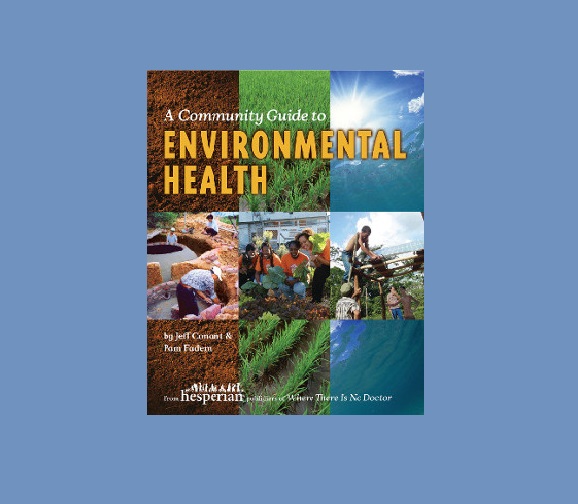
Developed in collaboration with communities from around the world, this resource provides practical and comprehensive strategies for grassroots groups that are organising to create better health and environmental conditions in their communities. The illustrated training and reference guide includes immediate preventive and first aid measures, as well as longer-term strategies for understanding and addressing the root causes of environmental health problems. It is designed to help health promoters, development workers, educators, activists, and community leaders take charge of their communities' environmental health.
A Community Guide to Environmental Health features activities to stimulate critical thinking and discussion, inspirational stories, and instructions for simple health technologies such as water purification methods, safe toilets, and non-toxic cleaning products. 23 chapters cover topics including:
- preventing and reducing harm from toxic pollution
- forestry, restoring land, and planting trees
- protecting community water and watersheds
- food security and sustainable farming
- environmental health at home
- environmental rights and justice
- solid waste and health care waste
- how to reduce harm from mining, oil, and energy production
The book is available for free download here. It may also be purchased in book form for US$28, as a CD for US$18, or as a book/CD combination for US$36 plus shipping. To order online, click here, email bookorders@hesperian.org or call 1-510-845-4507 or toll-free 1-888-729-1796 (within the USA).
In response to requests by partner organisations in Spanish-speaking countries, Hesperian is working to produce the Spanish edition of the book, Una guía comunitaria para la salud ambiental. Click here to download some of the chapters in Spanish.
Publishers
English, Spanish (translation in process as of December 2008)
600
Email from Hesperian Books to The Communication Initiative on July 3 2008.
Comments

Merging the Ministries of Health and Environment: a necessity
The increasing cross-sector exchange of experience and expertise, combined with a global interest in improving and strengthening capacity building in terms of policy- and decision-making, is creating new opportunities to prepare health professionals with a broader outlook and better prepared to address complex challenges of the future. In practical terms, the health services, together with the environment sector, have a huge potential to secure the health of individuals and communities. Unfortunately, this potential, mainly due to a lack of coordination and/or collaboration, is largely untapped in most societies. For instance, looking ahead at the diverse range of challenges and changes emerging from the growing importance of urbanization and globalization, there are, without question, opportunities to build upon this potential.
ALTERNATIVE POLICY OPTIONS ON ENVIRONMENTAL HEALTH
Lifting obstacles to merging the ministries of health and environment (1) is the dificulty of coordinating operations across connecting institutions and converging sectors. Many countries, whether they be rich or poor, have limited institutional capacity to do so and, very often, do not have enough capable professionals to cope with the work involved. Short-term planning horizons, lack of understandable evidence, unclear intersectoral collaboration and, above all, vested interests reinforce the need for comprehensive policy reforms focused on better governance and further leadership.
ADVOCACY FOR A NETWORK OF EXPERTISE AND EXPERIENCE
Increasingly, responsibility for health is being delegated to local level. Clearly, health outcomes have to be obtained locally, while at the same time the most powerful health determinants predominantly operate at global and international levels. In response to this paradoxical situation, we have no alternative but to align our health policies and strategies with the realities and specificities of a globalized world.
The context in which the above-mentioned mutations are unfolding require to merge the ministries of health and environment. Only such an innovative approach or process can play a catalyzing role in assembling a critical mass of diversified and specialized expertise and experience.
IN SUMMARY
Health and environment appear indissolubly bound together. Otherwise said, the interests of both areas of expertise are closely intertwined. Now more than ever, merging the ministries of health and environment is, in the final analysis, justified on the grounds of greater efficiency, effectiveness and equity. A high-profile example of this crucial necessity is the response to malaria in many, if not most, sub-Saharan African countries (2,3,4).
Doctor Michel ODIKA
1. Michel ODIKA, Pourquoi fusionner les ministères de la santé et de l'environnement? (http://connect.docuter.com/documents/19640191124ac33e0c9d5871254309388…)
2. Michel ODIKA, Malaria Observatories: Opportunity for Africa (http://www.slideboom.com/presentations/183735/Malaria-Observatories%3A-…)
3. Michel ODIKA, Advocacy for a Malaria Observatory (http://www.booksie.com/health_and_fitness/article/michel_odika/advocacy…)
4. Michel ODIKA, Malaria Observatory - Human Development Project (http://www.comminit.com/en/node/289841/307)
- Log in to post comments