










































Mapping How Information about Childhood Vaccination Is Communicated in Two Regions of Cameroon: What Is Done and Where Are the Gaps?
Norwegian Knowledge Centre for the Health Services (Ames, Glenton, Fretheim, Lewin); University of Yaoundé (Njang); University of Oslo (Fretheim); La Trobe University ( Kaufman, Hill); University of Calabar (Oku, Oyo-Ita); Universidade Eduardo Mondlane (Cliff); International Union for Health Promotion and Education (Cartier); Swiss Tropical and Public Health Institute (Bosch-Capblanch); University of Basel (Bosch-Capblanch); Pontificia Universidad Católica de Chile (Rada); Departamento de Saúde (Muloliwa); South African Medical Research Council (Lewin)
"By identifying the interventions used in Cameroon and developing an intervention map, we allowed stakeholders to see where they were concentrating their communication efforts and where gaps exist, allowing them to reflect on whether changes are needed to the communication strategies they are using."
In response to the lack of a comprehensive approach to identifying and organising the broad range of communication interventions used to improve childhood vaccination uptake globally (especially in low- and middle-income countries), the COMMVAC project has developed a classification system, or taxonomy, as part of its effort to build research evidence for addressing vaccine hesitancy and the non-vaccination of children. (To learn about this project, see the Related Summaries section, below.) The researchers describe the research conducted in Cameroon between January and May 2014 to map the childhood vaccination communication interventions being used in the North West and Central Regions of the country, applying the COMMVAC taxonomy to help classify these interventions and identify gaps, including with regard to their purposes and intended audiences. They also sought to assess the COMMVAC taxonomy as a research tool for data collection and analysis.
Based on the 2011 demographic health survey, 53% of Cameroonian children are fully vaccinated, with a range of 31-83% across the 10 regions; 5% of children receive no vaccinations at all. In its 2011-2015 multi-year plan, the Cameroonian vaccination programme identified a lack of focus on routine vaccination communication due to factors such as insufficient implementation of communication interventions; low levels of "passion" of health district supervisors for communication activities; low levels of financing; insufficient involvement of stakeholders such as opinion leaders, traditional leaders, and religious authorities; a lack of training of focal communication persons; and a polio epidemic which diverted attention away from the routine vaccination programme towards running a series of national immunisation days against polio in 2014-15.
Developed through a process of literature review and consultation with expert groups, the COMMVAC taxonomy includes interventions that influence interactions between health care providers and consumers as well as interventions that involve communication with, and participation of, parents, informal caregivers and community members. The taxonomy organises communication interventions into 7 categories based on their intended purpose for 3 intended groups: parents, communities, and health care providers. The categories are, in brief: inform or educate; remind or recall; teach skills; provide support; facilitate decision making; enable communication; and enhance community ownership. (See Figure 1 on page 4 for definitions and examples.)
Data collection methods, detailed in Figure 2 on page 6, included semi-structured interviews, participant observation and informal conversations, document and media analysis, and a survey of parents and caregivers. As part of an ongoing, iterative process, the researchers used the COMMVAC taxonomy of vaccination communication strategies to organise the collected data into a descriptive map showing which strategies were being delivered to whom, how, and for what purpose. (See Figure 3 on page 7 for an overview of the Cameroonian map. A document describing in detail all of the individual interventions identified is available from the authors on request.) "We found that the COMMVAC taxonomy allowed us to create a detailed and structured overview of the strategies that we identified in the data. When presenting the taxonomy framework and Cameroonian map to study participants, their feedback was that these were easy to understand and gave them a simple visual overview of how communication strategies were being used in their setting. However, the majority of participants who were asked about the map did not distinguish between interventions designed to inform or educate and interventions designed to remind or recall because the vast majority of messages about vaccination in Cameroon end with a reminder to attend your next vaccination appointment or to join in the next campaign....Another challenge of the mapping process was how to classify communication strategies that addressed multiple purposes and multiple target groups."
An excerpt from the paper follows:
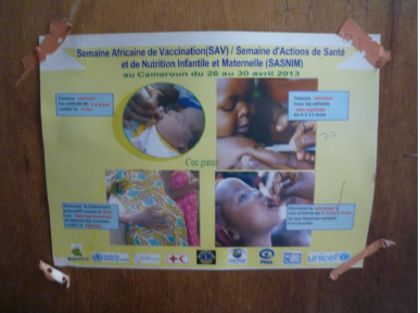
"Our study shows that the focus in Cameroon at the time of fieldwork was on communicating about vaccination campaigns....This focus on campaigns, as opposed to routine immunization, is related to the international polio eradication initiative and the polio outbreak in 2013-14....This focus also seems to have led to a shift from communicating directly with parents to targeting a broader audience: the community. The frequent use of mass media (for example radio, TV, newspapers, SMS [text messaging] etc) as a communication channel can also be seen as a consequence of the focus on campaigns and on the community. Interventions targeting parents, on the other hand, were mostly delivered at health centres. Very few interventions focused on health workers; when they were targeted, it was during training days for campaigns or for the introduction of a new vaccine.
The top - down structure of the extended program of immunization may have limited the extent to which communication materials could be adapted to local settings....[T]o develop more local communication materials and strategies the capacity of health workers and district EPI [Expanded Program on Immunization] programs would need to be strengthened and this would require considerable resources.
We categorised many of the interventions we found as belonging to the inform or educate category of the taxonomy. However, the aim of this information appeared primarily to be to get parents to bring their children for vaccination and to complete the vaccination calendar on time as opposed to giving parents and community members an understanding of what each vaccination was for and why people should be bringing their children to vaccination clinics....When provided with vaccination information in health facilities, many mothers did not actively engage vaccinators even when asked if they had questions....This lack of information and or shared decision-making could possibly lead to decreased trust in the vaccination program if a vaccination rumour were to appear...
This study suggests that the COMMVAC taxonomy has a range of applications within childhood vaccination programmes at national and sub-national levels. Firstly, it can assist programme managers in mapping the range of communication strategies they are using in a way that identifies the key purposes of each strategy (for example, to enhance community ownership of childhood vaccination programmes)....Secondly, it can help programme managers and researchers standardise the description of strategies within and across countries, making it easier to compare the approaches used in different settings. Finally, the taxonomy can help programme managers to identify key types of communication strategies (e.g. teaching skills, providing support) that they are not using widely and that might be useful if scaled up."
BMC Public Health. 2015; 15: 1264 - from Europe PMC, January 21 2016.
- Log in to post comments