











































Maternal and Child Survival Program Polio Communication Program Summary [Expert Technical Advice]
The Communication Initiative
Expert Technical Advice
Technical Advisory Groups

Since 2014, MCSP provided technical communication expertise on the Afghanistan and Pakistan TAGs. During this time, there were 11 TAGs, which looked at the overall polio programs in each country and made recommendations toward strengthening all aspects of polio work. Each TAG produces a report, all of which are summarized on the polio website as soon as they are made public by the World Health Organization (WHO) Eastern Mediterranean Regional Office. See, for example, Report on the Meeting of the Technical Advisory Group for the Eradication of Poliomyelitis in Afghanistan (November 2017) and Report on the Meeting of the Technical Advisory Group for the Eradication of Poliomyelitis in Pakistan (November–December 2017).
TAGs are an important part of the official global oversight structure for the Global Polio Eradication Initiative (GPEI), providing independent review and assessment of national polio programs and recommendations to guide program strategy. The communication technical expertise MCSP provided to both these TAGs had a direct impact on the evolution of communication strategies and activities during a time of significant expansion of the scope and size of communication and social mobilization activities in both countries. For instance, TAGs have made recommendations to:
- Improve the use of social data for planning communication activities at local levels, resulting in the development of new planning tools, such as challenge mapping in Pakistan and clustered missed children identification in Afghanistan.
- Develop and implement strategies for utilizing social media to respond to rumors, reduce the impact of false information and disseminate accurate immunization information, leading to the establishment of a social media cell in Pakistan and increased social media capacity in Afghanistan.
- Establish new communication approaches and materials for use in areas where security has compromised access, resulting in a range of new strategies and materials specifically designed for circumstances, such as those in which house-to-house campaigns are prohibited.
Communication Reviews

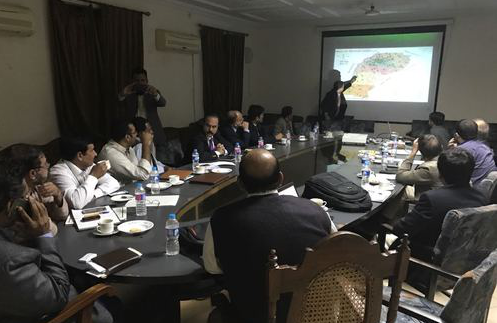
MCSP led or co-led polio communication reviews in Pakistan and Afghanistan. In Pakistan, this included (1) a special joint mission with the TAG chair, in which MCSP was asked to accompany the Mission to review the communication program in Punjab, Sindh, Baluchistan, and Khyber Pakhtunkhwa provinces in November 2016, and (2) two reviews organized with UNICEF Pakistan in May 2018 and April 2019 that focused on social mobilization, data use at local levels for planning, and improving communication interventions to reduce missed children. In Afghanistan, this included a special review in which MCSP was asked to identify gaps in district-level communication plans in east Afghanistan in December 2015 and a full review of polio communication strategies and activities in December 2018.
These reviews were part of program planning and evaluation processes, and the recommendations were incorporated into annual polio communication work plans for UNICEF and into national emergency action plans, which guide national program strategies and direction. As such, each review had a direct impact on polio communication priorities and activities providing critical insight and recommendations on problematic areas, such as the use of data for communication planning and strengthening community-level social mobilization.
Outbreak Response Assessments

MCSP provided expert communication advice to six outbreak response assessments (OBRAs). In June 2015, a communication expert joined the Horn of Africa OBRA to review Kenya’s cross-border response and help make recommendations on progress in Somalia. In October 2015, an expert consultant was identified and sent to join an assessment team to review and make recommendations related to social mobilization and communication in the outbreak response in Madagascar. In 2016, MCSP sent an expert consultant to focus on similar issues with the Lao PDR OBRA team for assessments in May 2016, August 2016, February 2017, and November 2017.
OBRA recommendations are used for two purposes. The first is to provide independent oversight and guidance to the country in developing and implementing its response to the outbreak. The second is to set milestones to be used to determine whether the response is adequate and provide periodic assessments as to whether the outbreak has stopped. Using the Lao PDR OBRA, as an example, MCSP's involvement focused on developing the communication and social mobilization elements of the response plan, with special reference to communication with a marginalized group, the Hmong, among whom the outbreak was centered. A summary of the plan can be found at this link.
Editor's note: Above is part of an end-of-project report on the Maternal and Child Survival Program (MCSP)'s work as part of a global 5-year cooperative agreement funded by the United States Agency for International Development (USAID) to support the global effort to eradicate poliomyelitis by providing expertise, research, and knowledge dissemination in communication. The full table of contents is here.
The next section in this paper is Research.
The previous section in this paper is Key Accomplishments in Brief.
Image credit: Chris Morry
- Log in to post comments