










































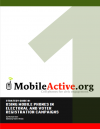
MobileActive Strategy Guide #1: Using Mobile Phones in Elections and Voter Registration Campaigns
Image
SummaryText
This series of Strategy Guides is designed to equip organisations around the world with the know-how to deploy effective mobile campaigns for a variety of types of activism and advocacy. Guide #1 covers the use of mobile phones in elections, both as voter registration and monitoring tools. They can also be used to educate citizens on candidates and their stances on issues and for fund raising in support of candidates. According to the guide, "with 3 billion phones in circulation around the world, in many countries mobile phones are the easiest and least expensive way to communicate and are far more pervasive than the Internet."
Mobile phones have been used for systematic election monitoring in Nigeria, Macedonia, Sierra Leone, and Kenya, among women voters in Saudi Arabia, and in popular uprisings in the Ukraine and South Korea. In the 2004 United States (US) election, almost 10,000 people started their voter registration process through a mobile campaign. Text messaging, particularly popular with young people, is a mobile phone capability that is used by 75% of phone owners in some countries, while it has 40% usage in the US due to the pay-per-use cost structure model.
The guide is both a how-to document and a case study resource. It explains how to choose what data to track, how to register voters, messaging options, such as Short Message Service (SMS) text messages, politically themed ring tones, six-digit "mobile short codes" for recruiting at concerts and events, fund raising by instant donation via mobile phone, and "forward-to-a-friend" function.
The document includes the following sections: Mobile Phones in Elections and Voter Registration Campaigns; Electoral Monitoring and Participation; Mobile Phones in Election Monitoring; Voter Registration; Candidate and Political Party Support; and Lessons Learned.
The guide's host website, MobileActive, is a global community of strategists, activists, and technicians who are using mobile phones in their social change work. This site includes blogs as conversation from the "MobileActive" community of site users, data, including statistics on mobile usage, a directory of mobile technology projects and practitioners, and strategy resources to leverage mobile technology for campaigns.
Mobile phones have been used for systematic election monitoring in Nigeria, Macedonia, Sierra Leone, and Kenya, among women voters in Saudi Arabia, and in popular uprisings in the Ukraine and South Korea. In the 2004 United States (US) election, almost 10,000 people started their voter registration process through a mobile campaign. Text messaging, particularly popular with young people, is a mobile phone capability that is used by 75% of phone owners in some countries, while it has 40% usage in the US due to the pay-per-use cost structure model.
The guide is both a how-to document and a case study resource. It explains how to choose what data to track, how to register voters, messaging options, such as Short Message Service (SMS) text messages, politically themed ring tones, six-digit "mobile short codes" for recruiting at concerts and events, fund raising by instant donation via mobile phone, and "forward-to-a-friend" function.
The document includes the following sections: Mobile Phones in Elections and Voter Registration Campaigns; Electoral Monitoring and Participation; Mobile Phones in Election Monitoring; Voter Registration; Candidate and Political Party Support; and Lessons Learned.
The guide's host website, MobileActive, is a global community of strategists, activists, and technicians who are using mobile phones in their social change work. This site includes blogs as conversation from the "MobileActive" community of site users, data, including statistics on mobile usage, a directory of mobile technology projects and practitioners, and strategy resources to leverage mobile technology for campaigns.
Publication Date
Languages
English, Arabic
Number of Pages
13
Source
HUB website accessed on March 10 2008.
Comments

Hello.
I am freelance Afghan-American journalist. I find this method very useful for the upcoming elections in Afghanistan. Taking into account the insecurity and limited access to reach out to the majority of people in Afghanistan, and especially, because of the mass availability of cell phones, it will be a very effective method of election awareness and attracting people to participate/contribute and have their voice heard without the threats and biased influence of local leaders. I will bring some more attention to this issue.
thanks for the input.
Shakila Khalje
- Log in to post comments