

























Development action with informed and engaged societies

After nearly 28 years, The Communication Initiative (The CI) Global is entering a new chapter. 

Following a period of transition, the global website has been transferred to the University of the Witwatersrand (Wits) in South Africa, where it will be administered by the Social and Behaviour Change Communication Division. Wits' commitment to social change and justice makes it a trusted steward for The CI's legacy and future. 

On the transfer, co-founder Victoria Martin expressed her pleasure to see this work continue under Wits' leadership, knowing that co-founder Warren Feek (1953–2024) would have felt deep pride in The CI Global's Africa-led direction. 

As Wits, we honour the team and partners who sustained The CI for decades and look forward building from that strong base. This includes co-founders Warren Feek (1953-2024) and Victoria Martin as well as La Iniciativa de Comunicación (CILA), which continues independently at lainiciativadecomunicacion.com with links to The CI Global site. We are also eager to forge new partnerships and entertain new ideas as we consider how best to contribute to social and behaviour change in our rapidly evolving environment.

If you are joining the International Social and Behaviour Change Communication (SBCC) Summit in Panama, please join Wits and CILA on Monday, 22 June, to share your thoughts and suggestion for the relaunch of the Communication Initiative. We will be in Pacifica 5 from 12-1:25 for the Refuel, Reflect, and Renew Lunch Series: The Communication Initiative: celebrating a driving force for Communication for Social Change and the way forward. We will reflect on the legacy of Warren Feek and family in creating the Communication Initiative, consider the contributions of CI over the years and then turn our attention towards the future in this dynamic session. 

If you are unable to join us in Panama, we still want to hear from you. Please contribute your thoughts by following this link: https://redcap.link/CommunicationInitiative2026 or reaching out to ci_surveys@commint.com

You can also follow the QR Code:

 https://redcap.link/CommunicationInitiative2026

Time to read
2 minutes
Read so far

Solar Radios for Women in South Kivu
0 comments
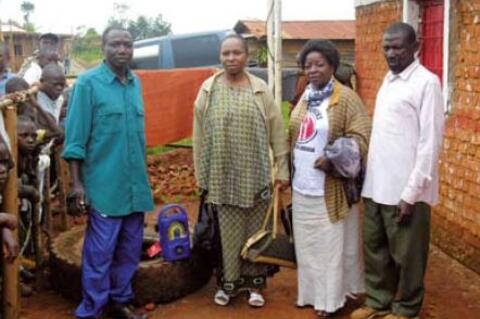
Initiated by Dimitra (a project of the Food and Agriculture Organization of the United Nations (FAO) working on gender, rural women, and development) and its local partner Sauti ya Mwanamke Kijijini (SAMWAKI), this initiative involves the distribution of solar radios to listeners' clubs and women's networks in eight rural districts within the province of South Kivu in the Democratic Republic of Congo. The aim of the project is to enable members of distant communities to share knowledge and experiences, in particular with respect to farming practices and HIV/AIDS. One key aspect of the project is that women are trained to use the solar radios and are put in charge of them. Under their supervision, the radios are then passed around from family to family, or listened to in a group situation.
Communication Strategies

The solar radio project involved training listener's clubs and women's groups on the technical aspects of using the solar radios – how to tune them, adjust the volume, and change the frequency, as well as how to charge them, either with solar power or with a mechanical crank.

Each of the groups rotates the radio amongst its members so that each member has the opportunity to use the radio and listen with their family, friends, and communities. According to the organisers, the availability of radios and the fact that women are in charge has made a significant difference in the lives of women and men in these communities. The reasons are as follows:

Gender balance - Previously in the area, men generally had control of the radios, and did not give women or young people access to them. With the solar radios given specifically to women and women's groups, the project intends to develop women's ownership of the radios, giving them the opportunity to decide what to listen to, when to listen, and with whom to listen.


Knowledge sharing - Having radios in the community gives individual women as well as listening groups access to existing radio programmes on agriculture and community development. According to the organisers, many of the groups and individuals have started up their own small-scale farming or micro-finance projects based on knowledge gained from radio programmes.


Breaking the silence around sensitive issues - According to the organisers, members have been able to use the radios to broach sensitive or difficult-to-talk-about topics such as HIV within their families. One member reported being able to bring the radio home and tune in to a programme on HIV. After listening to the programme, her family was able to discuss the issue more comfortably than if she had tried to bring up the subject on her own.

Development Issues

Gender, Agriculture, HIV/AIDS

Key Points

Launched in 2002, SAMWAKI is a women's organisation active in the rural areas of South Kivu. Its mission is to ensure that rural women are empowered through access to information, training, and communication. SAMWAKI is a founding member of the Network of Community Radios and Television of Congo and the Association of Community Radios of Congo.

Partners

SAMWAKI, Dimitra (FAO), King Baudouin Foundation.

Sources

Dimitra Newsletter [PDF], Issue 14, March 2008 (available in French (PDF) by clicking here); and email from Maartje Houbrechts to The Communication Initiative on September 8 2008.

Teaser Image
http://portal.unesco.org/ci/fr/files/22569/11531277043women_receiving_radio_Doug_Harris_165.jpg/women%2Breceiving%2Bradio%2BDoug%2BHarris_165.jpg